Recommended resources
The freely available resources this lesson will direct you to.
Hello! In the previous lesson, you checked whether a swatch changes size or transfers colour during care. You have also examined weight, hand, drape, opacity, and recovery. Now you can put those observations to work: what kinds of garments are common fabrics suited to, and why?
This lesson focuses on tops, trousers, salwar kameez, and sari blouses. The aim is to recognize likely uses—not to assume that every fabric sold under one name behaves identically. Allow about 40 minutes, including the short readings and videos.
Read the fabric name, then examine the fabric
A fabric name can tell you different things. Cotton and silk name fibres; twill names a weave; denim and georgette name recognizable fabric types. Consequently, “cotton” alone does not tell you whether a piece is light enough for a blouse or firm enough for trousers.
The pictured swatches make that distinction visible:
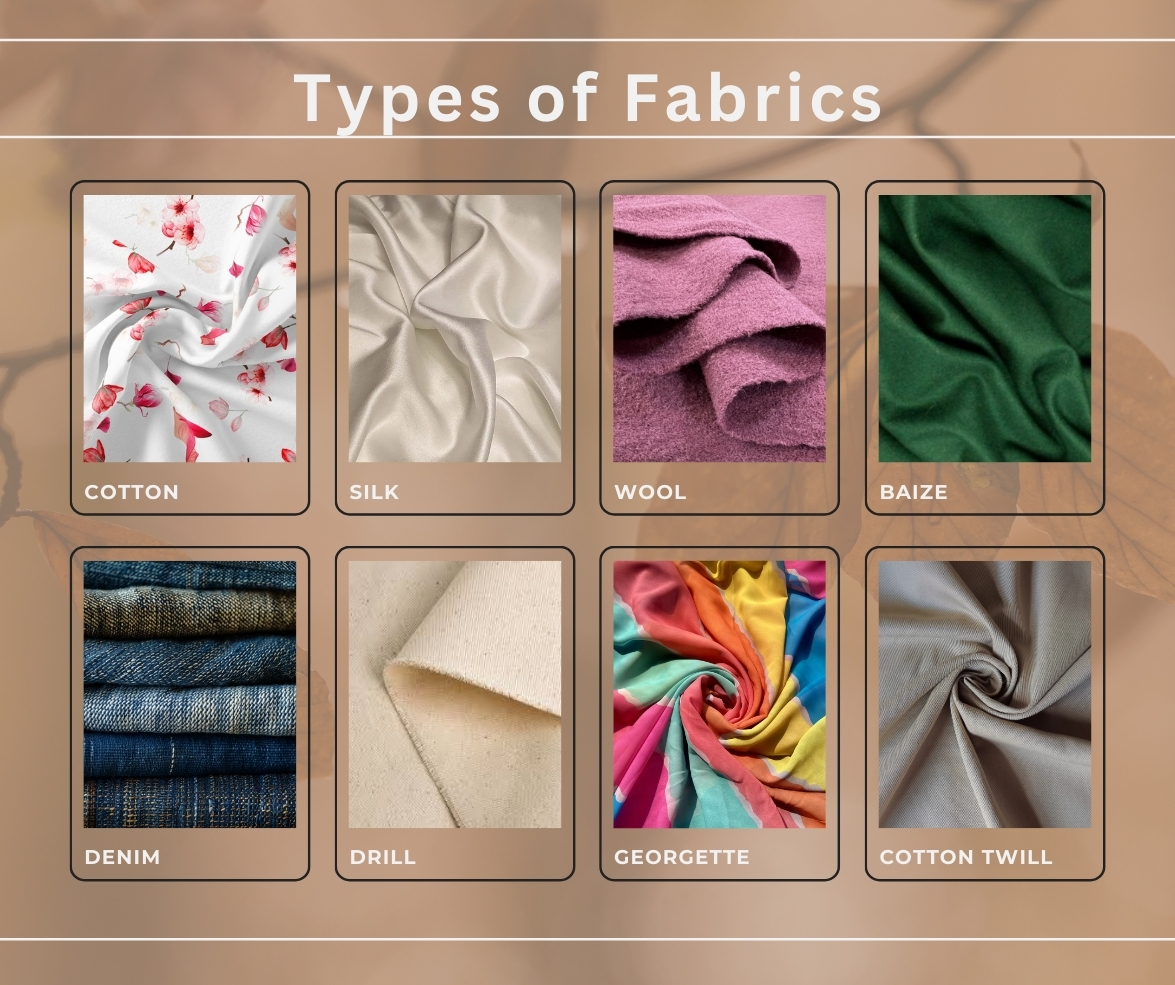
Notice especially the overlap between denim, drill, and cotton twill. All can have a diagonal twill structure; denim and drill are particular kinds of sturdy cloth, while “cotton twill” leaves a wider range of weights and finishes open. Georgette, by contrast, is typically lightweight, softly flowing, and somewhat sheer; it may be made from silk or manufactured fibres. A smooth, shiny photograph labelled “silk” does not mean every silk cloth is shiny or suitable for the same garment.
For a compact reference, read the fabric entries in the Fabric Study students’ handbook. Look for the connection each entry makes between construction, feel, and end use.
The students’ handbook gives brief descriptions of common apparel fabrics. Use it to build a working vocabulary rather than trying to memorise every entry.
In Unit 3, “Fabric Terminologies and End Uses,” read the entries on printed pp. 18–19. On p. 18, begin at “Cambric” and continue through “Georgette” in the first group; pay particular attention to cambric, crepe, denim, drill, and georgette. On p. 19, begin at “Organdy” and finish at “Voile” in the second group. Compare crisp fabrics with fluid ones, and note which descriptions flag sheerness or substantial strength.
Treat those end uses as starting points, not rules. A fabric type can come in several weights, and two cloths with the same fibre label may hang quite differently.
Tops: decide whether the silhouette should stand or flow
For a top with a defined collar, placket, or crisp outline, a light- to medium-weight cotton poplin is a familiar choice. Its relatively stable woven structure is helpful when you want clean edges. Fine cambric can suit a lighter, softer top. Linen can also give a top some body, although its tendency to crease will be part of the finished look.
If the design calls for softer folds, consider viscose (rayon) challis, a suitable lightweight crepe, or georgette. Their movement may be attractive for a gathered blouse, but the trade-off is less crisp definition at an edge. Lightweight voile, chiffon, and georgette can also be sheer: check a single layer against the light and over the intended undergarments before deciding whether a lining or another layer is needed.
Watch the fabric comparison in Digital Pattern Library’s How to Choose the Best Fabrics for Sewing: A Beginner’s Guide. The useful question is not simply “Is this cotton?” but “What shape does this particular cotton make?”
How to Choose the Best Fabrics for Sewing: A Beginner’s Guide
In “How to Choose the Best Fabrics for Sewing: A Beginner’s Guide,” Digital Pattern Library places fabrics on a dress form and connects their weight and drape to garment uses.
Watch the drape comparison between poplin and a much lighter, more transparent cloth. Then watch garment choices for blouses and trousers. Focus on how the desired silhouette changes the fabric requirement, even within one garment category.
A jersey knit is another common top fabric, particularly for a T-shirt. Unlike the stable wovens above, it generally stretches because of its looped construction. A top pattern intended for a woven poplin and one intended for a stretchy jersey are not automatically interchangeable; the required fit and construction differ. For now, recognize jersey as an option for knit-designed tops.
Trousers: balance durability with movement
Trousers face repeated bending, sitting, and abrasion. The cloth needs enough strength for the intended fit, but strength does not always mean stiffness. Think of two different outlines: a firm, sharply defined trouser leg and a soft, flowing wide leg.
Denim, drill, sturdy cotton twill, and canvas commonly serve structured or utility-style trousers. They can hold seams, pockets, and creases visibly, though a very firm version may make a wide leg look more architectural than fluid. A lighter cotton twill can offer a middle ground: some shape without the rigidity of heavy canvas. Wool suiting can provide a smoother, more fluid tailored trouser, depending on its weight and weave.
For loose, flowing trousers, a viscose challis or lighter viscose twill may work. Do not infer from its attractive drape that a thin version will suit a closely fitted trouser: the strain at the seat and seams is different. Fabric weight, garment looseness, and the support supplied by features such as a waistband all matter.
Closet Core Patterns demonstrates these differences with actual trouser fabrics in How to Choose Fabric for Trousers and Pants:
How to Choose Fabric for Trousers and Pants
Closet Core Patterns compares sturdy and fluid trouser fabrics on camera. Watch how the cloth holds its shape rather than relying only on its name.
Watch sturdy options for denim and canvas, noticing the pronounced shape of the canvas trouser example. Continue through lighter twills to see a balance of body and flexibility. Finish with fluid options, concentrating on why lighter viscose fabrics are discussed for roomier trousers rather than close-fitting ones.
The distinction to retain is structured trousers versus fluid trousers, not “heavy fabric versus light fabric” as an absolute rule. A fabric must also suit how closely the garment fits and how it will be worn.
Salwar kameez: consider the two garments separately
A salwar and a kameez are worn together, but they do not ask the cloth to do the same job. A straight, everyday kameez often suits breathable cotton, cotton poplin, or an appropriate linen. These fabrics can keep a fairly clear silhouette. A flowing kameez or Anarkali may benefit from viscose, crepe, or georgette, which fall in softer folds. Georgette and some other lightweight occasion fabrics may need lining where coverage is required.
For a salwar, ask how you want its fullness to fall around the legs and gather at the waist or ankle. A supple cotton or viscose can allow softer folds. A very stiff trouser-weight denim would hold that fullness away from the body and make gathered areas bulky. Conversely, a very delicate, sheer cloth may lack the coverage or durability wanted for everyday lower-body wear.
Read the comparison table in FAB VOGUE Studio’s Fabric for Salwar Kameez. It offers examples of fabrics for both everyday and festive looks; interpret them alongside the actual swatch’s opacity and drape.
Fabric for Salwar Kame – FAB VOGUE Studio
FAB VOGUE Studio’s table pairs fabric characteristics with typical salwar-kameez uses. Read it as a guide to possible effects, not a promise that every cloth with the same name will behave alike.
Under “Choosing Fabric for Salwar Kameez: Occasion and Style Guide,” find the table beginning with “Fabric Type” and ending just before “The Art of Drape and Comfort: Specific Fabric Deep Dive.” Read the comparison, focusing on cotton, georgette, silk crepe, and Chanderi. Note especially which options are described as sheer or fluid. A label such as “satin” describes a fabric surface or weave, not a guaranteed fibre content or opacity.
This is also where your earlier tests become useful. If a kameez has pale trim or lining, check a dark fabric’s colour transfer; if either garment will be washed, consider its measured shrinkage before cutting.
Sari blouses: coverage and support matter as much as appearance
A sari blouse often has a closer fit and more defined neckline and edges than a flowing top. That makes adequate coverage, stable seams, and support for the design especially important. A fine but sufficiently opaque cotton poplin or cambric can suit an everyday blouse. For an occasion blouse, an appropriately weighted silk or silk-blend woven, satin, or brocade may give a smoother or more embellished appearance. Check the actual cloth: fibre and fabric names alone do not establish how firm, slippery, or opaque it is.
Georgette and chiffon can create sheer sleeves or an outer layer, but a sheer, loosely supported single layer is not automatically a good foundation for a close-fitting blouse body. A lining or supporting underlayer may be needed for coverage and for the intended shape. Likewise, a stiff embellished fabric may look striking but feel bulky where a close-fitting blouse has multiple seams. Those are properties to notice now; you will address fit and construction in later modules.
Across all four garment groups, make one final distinction: “commonly used for” does not mean “suitable in every version.” A lightweight denim and a heavy denim, or a crisp cotton and a sheer cotton, can lead to very different results despite sharing part of their names.
Key takeaways
Recognize a fabric by connecting its weight, structure, drape, opacity, and strength to the garment’s intended shape and wear. Crisp poplin often suits a defined top; denim or sturdy twill can support structured trousers; supple fabrics can let salwar fullness and flowing kameez styles fall softly; and a close-fitting sari blouse needs appropriate coverage and support. Confirm these expectations with the actual swatch—and with care-test results—rather than the label or photograph alone.
Next, you will use these observations to choose a fabric for a specified design and justify your choice.