Recommended resources
The freely available resources this lesson will direct you to.
Introduction
In our last lesson, we explored Leonard Meyer's theory of musical expectation, which provided a powerful cognitive model for how music generates emotion through the interplay of anticipated and realized patterns. We saw that the brain isn't just a passive listener but an active prediction engine, and that the tension and release we feel are tied to the confirmation or violation of learned musical syntax.
This lesson takes the next logical step. Having established a general mechanism, we will now drill down into the specifics. Your learning outcome is to summarize the scientific research linking specific musical parameters—namely tempo, mode, and pitch—to universal emotional responses. We will investigate which acoustic ingredients in the "auditory cheesecake" tend to produce consistent emotional flavors across different people and even cultures. This inquiry moves us closer to your goal of understanding how music can be intentionally crafted to evoke particular states, such as bhakti bhav.
The Universal and the Cultural
A central question in the psychology of music is whether our emotional responses are innate and universal, or learned and culturally specific. Does a fast, high-pitched melody sound 'happy' to everyone on Earth, or only to those raised with Western musical conventions? The current scientific consensus suggests the answer is a fascinating mix of both.
The following comprehensive review article explores this topic in depth. It introduces the idea that while our responses to music are shaped by culture, they seem to draw upon universal, domain-general psychological mechanisms—systems that evolved for other purposes, like interpreting emotion in speech.
Universality, domain-specificity, and development of psychological ...
This article from Nature Reviews Psychology synthesizes a vast body of research on the psychology of music. It will provide the scientific framework for our entire lesson.
First, read the Abstract to get a high-level overview of the authors' conclusions. Next, read the section on emotional responses to understand the different models of emotion (basic vs. dimensional). Then, carefully read the subsections titled Cross-cultural similarities and Mechanisms for emotional recognition. Pay close attention to the evidence for both cultural differences (like the perception of major/minor modes) and universal similarities (like the interpretation of tempo and pitch).
As the article highlights, humans across cultures are surprisingly good at identifying the intended emotion or function of foreign music, even if they've never heard it before. This suggests that music leverages a shared code. Let's break down the key elements of that code.
1. Tempo and Rhythm: The Speed of Feeling
Perhaps the most intuitive link is between tempo (the speed of the music) and emotional arousal. Dr. Hauke Egermann explains this by linking musical characteristics to the sounds of human emotional expression.
Emotional responses to music | Hauke Egermann | TEDxGhent
In this segment from his TEDx talk "Emotional responses to music," Dr. Egermann explains how music can mimic the sonic qualities of emotional body language.
Please watch the section on expressive emotional movement. Notice how he explicitly connects loudness, speed (tempo), and pitch to the expressions of happiness and sadness.
The core finding, replicated across numerous studies, is straightforward:
- Fast Tempo: Associated with high-arousal emotions like happiness, excitement, anger, and tension.
- Slow Tempo: Associated with low-arousal emotions like sadness, calmness, and tenderness.
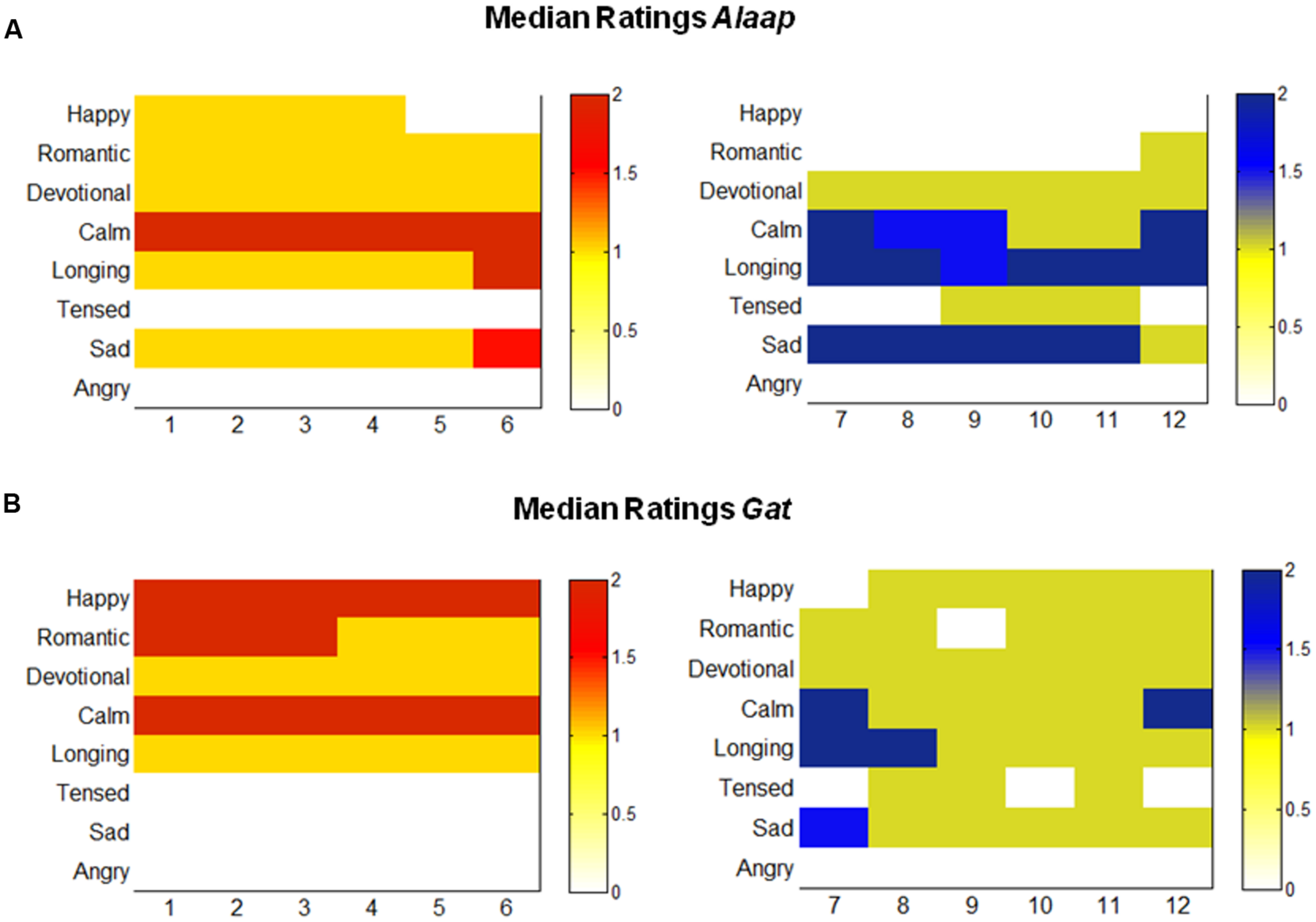
This principle holds true in the context of Indian Classical Music as well. A research study on emotional responses to Hindustani ragas directly investigated the role of tempo (measured as note density) and rhythmic regularity (pulse clarity).
Emotional responses to Hindustani raga music: the role of ...
This study provides a fantastic bridge from general psychoacoustic principles to the specific musical system you are interested in.
First, read the section that defines how the researchers measured tempo and rhythm: Raga composition and tempo. Next, read the section titled Effect of Rhythmic Regularity and Tempo, including Table 3. Focus on the conclusion that high-arousal emotions are linked to higher note density (faster tempo) and greater pulse clarity (clearer rhythm).
This study demonstrates how the transition within a raga performance from the slow, arrhythmic alaap to the faster, rhythmic gat fundamentally alters the music's arousal level, and thus its emotional impact. You can see this visually in the provided heatmaps, which show the median emotional ratings for Alaap and Gat sections.
2. Mode and Tonality: The Color of Harmony
In Western music, the distinction between major and minor modes is a primary tool for conveying emotion.
- Major Mode: Generally perceived as "happy," "bright," or "triumphant."
- Minor Mode: Generally perceived as "sad," "dark," or "serious."
This is rooted in the physics of sound and the concepts of consonance and dissonance. The following video provides a clear, simple explanation.
The Science Of Emotions In Music
This video, "The Science Of Emotions In Music," breaks down the acoustic and psychological basis for consonance, dissonance, and the major/minor distinction.
Watch from the introduction of consonance to understand the difference between notes that "gel" and notes that "clash." Pay close attention to the segment from where he connects these concepts to real-life emotions and introduces the major/minor distinction.
As the video explains, consonant intervals feel settled and resolved, while dissonant intervals create a sense of conflict and tension. This maps neatly onto our psychological experiences of positive and negative emotions.
However, as the review article from Nature pointed out, the major-happy/minor-sad association is one of the most culturally variable aspects of music perception. So, is there a more universal principle at play?
The same Hindustani raga study offers a compelling answer. Instead of major/minor modes, it analyzed the frequency of shuddh (natural/major) versus komal (flat/minor) intervals.
Emotional responses to Hindustani raga music: the role of ...
Let's return to the raga study to see how it addresses tonality and emotion, providing a parallel to the Western major/minor concept.
Read the section titled Effect of Tonality and look at Figure 4. The key finding is stated here: the link between interval type and emotion. Now, read the first paragraph of the Discussion section on tonality. It highlights the crucial role of the minor second (komal re) in conveying tension. Focus on the sentences describing how its presence or absence strongly predicts whether a raga is perceived as positive or negative.
This is a profound finding. While the specific scales are different, the underlying principle is similar: music that predominantly uses intervals considered more consonant and "major" within its system tends to evoke positive valence, while music emphasizing more dissonant, "minor" intervals evokes negative valence. The komal re (minor second), a highly dissonant interval, acts as a powerful signifier of tension and sadness in ragas.
3. Pitch: The Highness and Lowness of Emotion
The third key parameter is pitch—the perceived highness or lowness of a sound. The general associations are:
- High Pitch: Often associated with lightness, excitement, happiness, and at times, anxiety.
- Low Pitch: Often associated with seriousness, sadness, power, and threat.
These associations are likely rooted in the physics of our world and our bodies. Large, heavy, and often threatening things (e.g., thunder, large animals, dominant male voices) produce low-frequency sounds. Small, light, and less threatening things (e.g., birds, bells, infant vocalizations) produce high-frequency sounds.
The review article we read earlier confirms this, stating that "in both music and speech, variations in tempo, volume, and pitch often (although not always) communicate similar emotional states." A happy vocalization, like happy music, tends to be faster, louder, and higher in pitch.
This chart provides a helpful visual summary of how different elements of Indian Classical Music are understood to map onto the brain and our psychological functions.

Conclusion
Today, we have moved from the general theory of musical expectation to the concrete psychoacoustic evidence linking specific musical "parameters" to emotional responses. We've seen that while culture plays a significant role, there are strong universal tendencies that composers and performers have intuitively used for centuries.
Key Takeaways:
- Universal tendencies exist: Cross-cultural studies show that people can often recognize the basic emotional tone (e.g., happy, sad, angry) and behavioral function (e.g., lullaby, dance song) of music from unfamiliar cultures.
- Tempo dictates arousal: Fast tempos reliably increase arousal, corresponding to emotions like happiness or tension. Slow tempos decrease arousal, corresponding to calmness or sadness.
- Tonality colors valence: The use of consonant, "major" intervals is associated with positive emotions, while dissonant, "minor" intervals are associated with negative emotions. This principle appears in both Western music (major/minor modes) and Indian ragas (shuddh/komal swaras).
- Pitch adds another dimension: High pitches are often linked to lightness and excitement, while low pitches are linked to seriousness and weight.
- Music leverages general systems: These universal responses are likely not due to a "music-specific" part of the brain, but because music effectively mimics the acoustic cues of emotion that we use in speech and interpreting sounds in our environment.
In this lesson, we focused on how music makes us feel. In our next lesson, we will explore one of the most striking physical reactions to music: the experience of music-induced "chills." We will investigate the neurological basis of this phenomenon, discovering its direct connection to the brain's dopamine reward system and what it tells us about the profound pleasure we derive from sound.