Recommended resources
The freely available resources this lesson will direct you to.
- Emotional responses to music | Hauke Egermann | TEDxGhentwww.youtube.com
- From Perception to Pleasure: How Music Changes the Brain | Dr. Robert Zatorre | TEDxHECMontréalwww.youtube.com
- Music and Emotion - Notes on Leonard Meyer - Hugo Ribeirohugoribeiro.com.br
- Schema Theory and Aesthetic Categories in North Indian Classical Dhrupad | History of Music Theoryhistoryofmusictheory.wordpress.com

Introduction
In our last lesson, we journeyed into the brain to see where the magic of music happens, tracing the path of sound from the ear to the auditory cortex and into the deep emotional centers of the limbic system. We established that the brain is not a passive recipient of sound but an active participant, and that the interplay between its analytical and emotional networks is what gives music its power. This laid the anatomical groundwork for a deeper question: what is it about the structure of music itself that so powerfully engages these neural circuits?
This lesson delves into one of the most influential answers to that question, moving from the "where" of neuroscience to the "how" of cognitive psychology. We will explore Leonard Meyer's theory of musical expectation. Your learning outcome is to be able to describe this theory, which posits that emotion arises directly from the fulfillment or violation of the patterns our brains learn to anticipate. For someone with your background in software development and neurology, this concept of the brain as a prediction engine, running real-time analysis on an incoming data stream of sound, should be a particularly fascinating model.
The Brain as a Prediction Engine
At its heart, Meyer's theory is built on a simple psychological observation: we are constantly, and mostly unconsciously, predicting what will happen next. This is as true for music as it is for any other part of life. When you listen to a melody, your brain, drawing on a lifetime of listening experience, is already forming hypotheses about which note will follow.
The following short video provides a very accessible introduction to this idea.
Emotional responses to music | Hauke Egermann | TEDxGhent
In his TEDx talk "Emotional responses to music," Dr. Hauke Egermann offers several explanations for how music creates emotion. We'll focus on the one that directly introduces our topic.
Please watch the segment from the beginning of the explanation on musical expectations. Notice how he connects our "statistical knowledge" of musical styles to the creation of expectations and, subsequently, emotion.
As Dr. Egermann explains, your ability to hum along to a new but stylistically familiar song is evidence of this predictive process. Your brain has learned the "musical syntax" and is generating expectations. Meyer's groundbreaking contribution was to place this process at the very center of musical emotion.
The Inhibition Thesis: Meyer's Core Idea
Leonard Meyer's theory, first published in his 1956 book Emotion and Meaning in Music, begins not with music, but with a general theory of emotion. He argued that emotion is not a mysterious force, but a direct cognitive and physiological response that occurs when a goal-oriented action is blocked.
The following text summarizes the core of his argument.
Music and Emotion - Notes on Leonard Meyer - Hugo Ribeiro
This resource is a set of notes by music theorist David Huron on the first chapter of Meyer's seminal book. It provides a clear distillation of his complex arguments.
Start by reading the section titled Undifferentiated Emotion, which explains Meyer's view that emotional arousal is initially a general state, not a specific feeling. Then, focus on the crucial section, Meyer's Inhibition Thesis. Pay close attention to the central premise and the "Law of Affect," as this is the absolute foundation of the entire theory.
Meyer's "Inhibition Thesis" is the key: "Emotion or affect is aroused when a tendency to respond is arrested or inhibited."
How does this apply to music? In music, the "tendency to respond" is our expectation for the music to continue in a way that conforms to the style we have learned. When a composer writes a melody that goes exactly where we expect, the tendency is fulfilled smoothly. But when the composer introduces an unexpected chord, delays a resolution, or moves in a surprising melodic direction, our "tendency to respond"—our expectation—is temporarily arrested. In that moment of inhibition and uncertainty, Meyer argues, affect is generated.
This creates a fascinating dynamic:
- Fulfillment: Meeting an expectation can lead to feelings of satisfaction, comfort, and resolution.
- Violation/Delay: Deviating from or delaying an expectation creates tension, surprise, or suspense.
The emotional richness of music comes from the masterful interplay between these two states. A piece of music that is entirely predictable becomes boring. A piece that is entirely unpredictable is chaotic and meaningless. The art lies in the middle ground, where expectations are strategically built up, partially violated, and ultimately resolved.
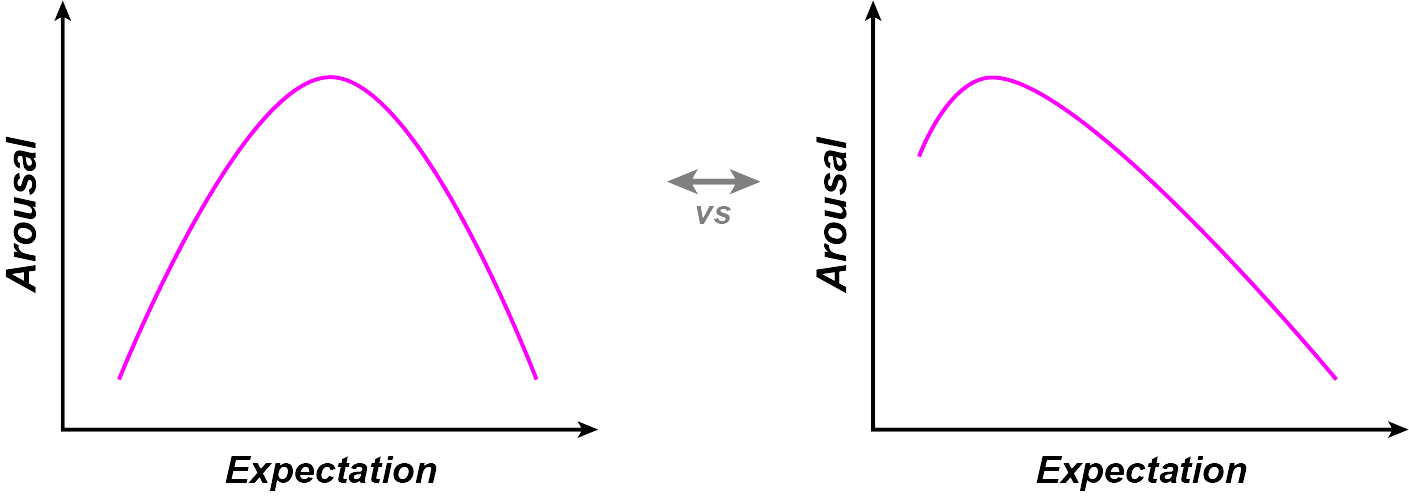
Embodied Meaning: How Music Points to Itself
If emotion arises from inhibiting expectations, what exactly are we expecting? Meyer distinguishes musical meaning from the meaning of language. A word like "tree" refers to an object in the external world. Meyer argued that the primary meaning in music is embodied meaning. One musical event has meaning because it points to, and makes us expect, another musical event.
This idea is explained further in the notes on his book.
Music and Emotion - Notes on Leonard Meyer - Hugo Ribeiro
Let's continue with the same resource to unpack this concept of musical meaning.
First, read the section Expectation, Suspense, and the Unexpected. Focus on how Meyer frames deviations from stylistic norms as the direct source of emotion. Then, move to the section on Meaning. Read the paragraph that defines embodied meaning. This is a critical concept. Finally, read the definitions for the three types of meaning Meyer proposes: hypothetical, evident, and determinate.
Let's use an analogy from your software development background to clarify these three types of meaning:
- Hypothetical Meaning: As you listen to a phrase of music, your brain generates multiple possibilities for what might come next, based on the learned style. This is like looking at a function call and predicting its possible return values based on its signature and context, before it has finished executing.
- Evident Meaning: When the next musical event actually occurs, you perceive the relationship between what you expected (hypothetical) and what happened (the reality). The meaning of the first event becomes "evident" in light of the second. This is like the function returning its actual value, allowing you to understand its specific output in that instance.
- Determinate Meaning: After the entire piece is over, you can reflect on the piece as a whole. You understand the role that earlier moment of surprise or resolution played in the grander structure of the entire composition. This is like analyzing the full codebase and understanding how that one function contributes to the architecture and overall behavior of the application.
For Meyer, the emotional journey of listening to music is this very process of forming hypothetical meanings, having them confirmed or denied to create evident meaning, and ultimately grasping the determinate meaning of the whole work.
From Theory to Raga: Expectation in Indian Classical Music
Meyer's theory, though developed with Western music in mind, provides a powerful lens for understanding the emotional depth of Indian Classical Music. The very structure of a raga is a system of expectations. The aaroh (ascent), avroh (descent), pakad (signature phrase), and the roles of the vadi and samvadi swaras all combine to create a highly specific set of melodic probabilities.
The following article applies these ideas directly to Dhrupad, one of the oldest forms of Hindustani music.
Schema Theory and Aesthetic Categories in North Indian Classical Dhrupad | History of Music Theory
This academic blog post connects Meyer's work to modern cognitive science through "schema theory" and applies it to Dhrupad performance. A "schema" is essentially the mental template or pattern your brain uses to generate expectations.
Please read the second paragraph of the article, which begins with "To understand the banis musically...". Pay close attention to how it explicitly references Leonard Meyer and his claims about how we abstract mental templates from repeated listening, which then "produce meaning and manipulate expectation."
This article makes the crucial link: a raga is a highly refined schema. When you listen to Raga Yaman many times, your brain isn't just memorizing tunes; it's abstracting a set of rules and probabilities. You learn to expect the prominence of Ga and Ni, the movement towards the upper Sa, and the characteristic phrase Ṇi-Re-Ga-Má-Pa. The profound feeling of peace (shanta rasa) associated with Yaman comes, in part, from the skillful fulfillment of these expectations.
Conversely, a raga like Malkauns, which omits Re and Pa entirely, creates a completely different set of expectations. The tension and release in a Malkauns performance arise from how the artist navigates the unique pathways of its pentatonic scale, playing with the expectations inherent to that specific schema. The deep, introspective mood is generated by the fulfillment and subtle violation of patterns within that constrained melodic world.
The Neurological Payoff
Finally, let's connect this cognitive theory back to the brain science from our last lesson. Why does the fulfillment or violation of an expectation feel so powerful? The answer lies in the brain's reward system.
Dr. Robert Zatorre, a leading neuroscientist in this field, provides the final piece of the puzzle.
From Perception to Pleasure: How Music Changes the Brain | Dr. Robert Zatorre | TEDxHECMontréal
In his TEDx talk "From Perception to Pleasure," Dr. Zatorre explains the neurological basis of musical pleasure, which directly involves the predictive process Meyer described.
Please watch the two short clips: First, from the discussion on planning, where he explains how the brain forms expectations and composers "play with" them. Then, watch the following segment from the "fusion" of systems, where he connects this advanced cognitive process to the brain's primitive reward systems.
As Dr. Zatorre explains, the beauty of music is that it fuses our most advanced cognitive functions (the auditory cortex predicting future events) with our most ancient and powerful emotional systems (the limbic system and its dopamine-based reward network). The "chills" you feel during a powerful musical moment are the physiological signature of the nucleus accumbens releasing dopamine, rewarding your brain for correctly predicting a complex pattern or for being successfully surprised and then shown the resolution. The tension from a delayed resolution in a raga is your brain in a state of heightened alert, waiting for the expected pattern to be completed. The pleasure of the final resolution is, quite literally, a neurochemical reward for solving the puzzle.
Conclusion
Today we have explored a foundational theory in the psychology of music. Leonard Meyer's work provides a compelling mechanism for how abstract sequences of sound are transformed into profound emotional experiences.
Key Takeaways:
- Emotion from Inhibition: Meyer's core thesis is that emotion is aroused when a tendency to respond (an expectation) is arrested, inhibited, or delayed.
- Expectation is Learned: Our musical expectations are not innate; they are learned through exposure to specific musical styles. A raga is a perfect example of a learned system of melodic probabilities.
- Embodied Meaning: Music's primary meaning is "embodied"—musical events have meaning because they make us expect other musical events.
- The Cognitive-Reward Loop: The process of forming, violating, and fulfilling musical expectations directly engages the brain's dopamine-driven reward system, linking high-level cognitive prediction with primal feelings of tension and pleasure.
In our previous lesson, we saw the "what" and "where" of music in the brain. Today, we've explored the "how." In our next lesson, we will get even more specific. We will look at scientific research that attempts to correlate specific musical parameters—like tempo, pitch, and mode (major/minor)—with universal emotional responses, and we will also examine the fascinating phenomenon of entrainment, where musical rhythms synchronize with our internal biological rhythms.