Recommended resources
The freely available resources this lesson will direct you to.
Hello Shiva,
In our previous lesson, we explored the Principle of Virtual Work, a powerful method for analyzing the equilibrium of ideal, frictionless systems. We now transition from that idealized world to more practical engineering scenarios by incorporating the effects of friction. This is a crucial topic, as friction is an omnipresent force in civil engineering structures and machinery.
This lesson is designed to equip you with the skills to solve advanced static friction problems, a frequent and high-yield topic in the UPSC exam. We will specifically focus on three common applications: wedges, ladders, and belt-pulley systems. By mastering these, you'll be well-prepared to tackle complex equilibrium problems where friction is the deciding factor.
1. The Foundation: Impending Motion and the Friction Angle
Before diving into specific applications, let's briefly consolidate the core principle of static friction. You'll recall that the static friction force adjusts to counteract any applied tangential force, up to a maximum value, . Motion is said to be impending when this limit is reached:
where is the coefficient of static friction and is the normal force.
A more elegant way to handle problems at impending motion is to use the friction angle, . This is the angle between the resultant reaction force (the vector sum of and ) and the normal force .
The resultant force R is the vector sum of the normal force N and the friction force F. At impending motion, the angle between R and N is the angle of static friction, \phi_s, where \tan(\phi_s) = \mu_s.
Using the friction angle allows you to combine two forces ( and ) into a single resultant force whose direction is known. This often simplifies a multi-force problem into a three-force equilibrium problem, which can be solved quickly using a force polygon or Lami's theorem.
These slides from IIT Guwahati provide a crisp summary of these fundamental concepts.
Focus on the slide titled "Mechanism of Dry Friction". Review the concepts of the maximum static-friction force and the subsequent slides explaining the friction angles and their relationship with the coefficient of friction. This will be the basis for the methods we discuss next.
2. Wedges: Mechanical Advantage in Action
Wedges are simple machines used to create large forces for lifting heavy objects or making fine adjustments to positions. Analyzing them is a direct application of static friction on multiple interacting bodies.
The strategy involves:
- Isolating each body (the wedge and the object it's moving) and drawing their Free Body Diagrams (FBDs).
- Crucially, determining the direction of impending motion for each contact surface. The friction force on each surface will oppose this motion.
- Applying the equations of equilibrium () to each body to solve for the unknowns.
A more efficient method is to use the friction angle concept. For each body, you will have three forces: the weight (or applied load), the reaction from the first surface, and the reaction from the second surface. With motion impending, these reaction forces will be inclined at their respective friction angles to the surface normals.
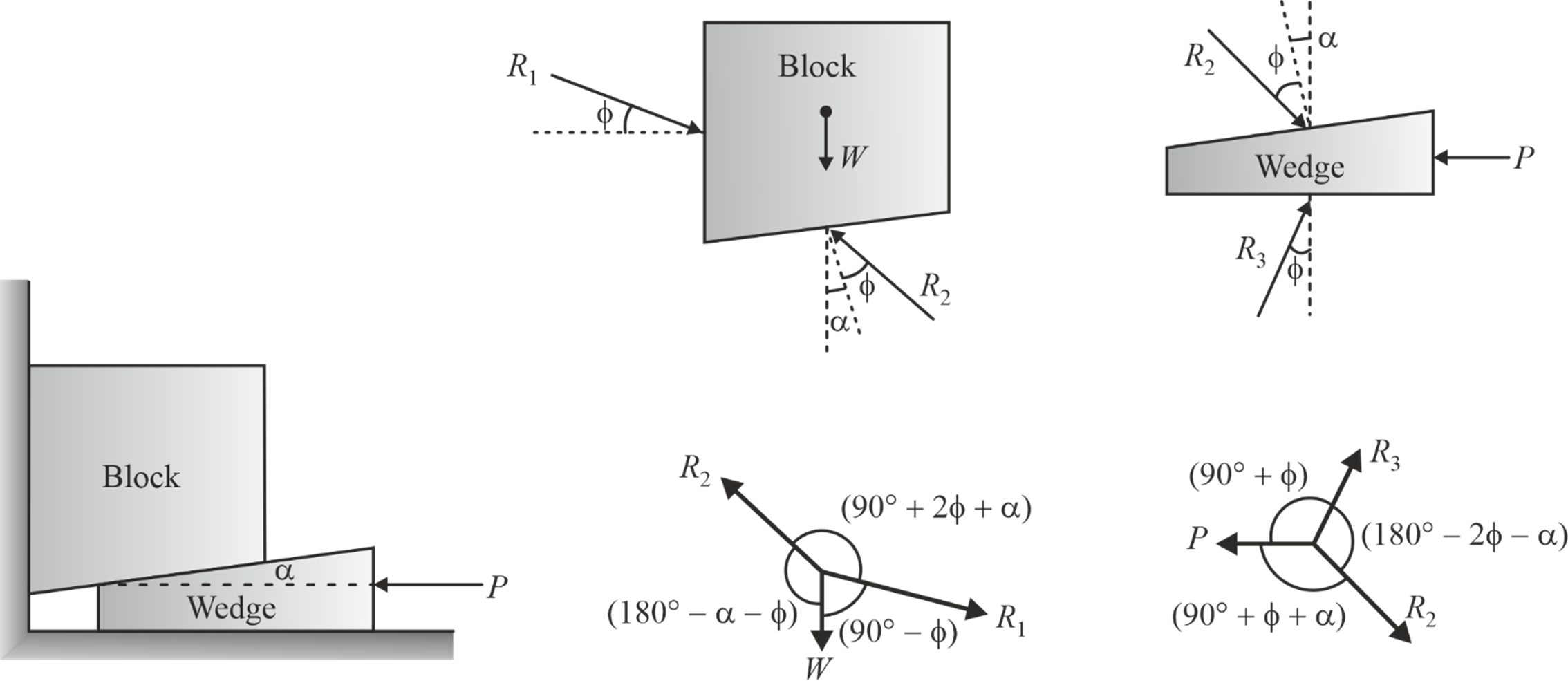
This section of the IIT Guwahati notes demonstrates the wedge analysis using both the component method and the force polygon method.
Read the section on Wedges. Pay close attention to how the FBDs are drawn for the "Forces to raise load" case, specifically the direction of the reaction forces inclined at the friction angle \phi. Then, study the solved example, observing how the solution is found using component equilibrium equations and how it could be solved graphically with force polygons. The problem on lifting a cylinder in the IIT Bombay notes ("Problem 2" in 0da7e) is another excellent example to review mentally.
3. Ladder Friction: A Classic Stability Problem
Ladder friction problems are a staple of mechanics and a common question type in competitive exams. They test your ability to apply all three equilibrium equations, especially the moment equation, in a practical context.
The typical questions involve finding:
- The minimum angle of inclination to prevent slipping.
- The maximum distance a person can climb before the ladder slips.
- The minimum coefficient of friction needed for stability.
- An external force required to prevent slipping.
The approach is systematic:
- Draw a complete FBD of the ladder, including its weight, any external loads (like a person), and the reactions at the contact points.
- Determine the direction of impending motion. The base of the ladder will tend to slide away from the wall, and the top will slide down the wall. The friction forces must oppose these tendencies.
- Carefully apply the three equilibrium equations: , , and . Choosing the moment center
Ostrategically (e.g., at a point with the most unknown forces) can significantly simplify the algebra.
The following video provides a comprehensive masterclass on solving various types of ladder friction problems.
Ladder Friction L - 12 | Engineering Mechanics | GATE 2022 | K2K Batch
This lecture by Unacademy GATE systematically breaks down different ladder friction scenarios, demonstrating the application of equilibrium principles for each case. It's an excellent resource for building problem-solving fluency.
I recommend watching the solutions to these specific problems to cover the full range of question types: Finding the Angle of Inclination: Watch the first problem where the goal is to find the angle \theta at which a uniform ladder begins to slip. This is a fundamental case. Finding the Coefficient of Friction: Next, observe the solution for a problem where a man is standing on the ladder and you need to calculate the required CoF, \mu. Finding an Applied Force: This problem involves an external horizontal force P applied to prevent slipping. Watch the setup and solution here: calculating P. Finding Maximum Distance: Finally, see how to determine the maximum distance x a man can climb before the ladder becomes unstable. This is a very common and important problem variant.
4. Belt Friction: Tension and Torque
Belt friction is critical in power transmission systems (belt drives), braking systems (band brakes), and scenarios involving ropes or cables wrapped around fixed objects. The analysis is governed by a single, powerful relationship.
When a flexible belt or rope is wrapped around a surface, friction allows the tension to change along the length of contact. For a flat belt at the point of impending slippage, the tension on the tight side () and the slack side () are related by:
Where:
- is the larger tension, acting in the direction of impending motion.
- is the smaller tension.
- is the coefficient of static friction.
- is the total angle of wrap, which must be in radians.
Friction.pdf - Engineering Mechanics
These notes from IIT Bombay provide a clear derivation of the belt friction formula and several worked examples that demonstrate its application in various contexts.
Start by reviewing the section Belt Friction. Understand the FBD of the belt element that leads to the derivation. The final equation is the key takeaway. Then, work through the solved problems to see this equation in action: Problem 46: A pulley problem where you find the force needed to generate a specific torque. Problem 47: A classic two-pulley system where you find the largest possible torque before slipping. Problem 48: A rope over two pipes, showing how to handle different angles and surfaces. Extra Problem: Calculating the required number of wraps to restrain a motor boat. This is a great practical application.
Conclusion
In this lesson, we have moved beyond ideal systems to analyze equilibrium problems where friction plays a determining role. You have learned the standard procedures and more efficient techniques for solving problems involving wedges, ladders, and belt friction.
Key Takeaways:
- Friction Angle (): Using the resultant force inclined at to the normal can simplify FBDs and lead to quicker solutions, especially for wedge problems.
- Systematic FBDs: For all friction problems, the most critical step is drawing an accurate FBD with friction forces correctly oriented opposite to the direction of impending motion.
- Wedges: Solved by analyzing the equilibrium of each component body, either with force components or force polygons.
- Ladders: Solved by applying the three equations of equilibrium () to the ladder as a whole.
- Belt Friction: Governed by the exponential relationship , where the angle of wrap must be in radians.
Our next lesson will shift from statics to dynamics as we begin to explore the rotation of rigid bodies. We will analyze concepts like angular momentum and rotational kinetic energy, which are essential for understanding the motion of components like flywheels and compound pulleys.