Recommended resources
The freely available resources this lesson will direct you to.
- What is Affiliate Marketing and How Does it Work? (Affiliate Marketing Explained for Beginners 2023)www.youtube.com
- What are Cookies, First click and last Click Attribution in Affiliate marketingwww.youtube.com
- Affiliate Marketing: What It Is and How It Works (2026) - Shopifywww.shopify.com
- The Complete Guide to Affiliate Networkstipalti.com

Hello! Last time, you followed a customer from a recommendation to a possible purchase and saw why a click is not the same as a commission. This lesson looks behind that journey. You’ll separate who sells the product, who sets the referral terms, and what records and credits the sale. Those distinctions will help you understand what an affiliate link can—and cannot—do when you eventually promote offers to audiences in different countries.
The merchant, the program, and the network
Keep the headphones example from the previous lesson. You publish a useful review, a viewer clicks your link, and the viewer considers buying. The merchant is the business selling the headphones. It controls the product, price, checkout, and order fulfillment; you provide the recommendation, not the checkout.
The merchant’s affiliate program is the arrangement under which referrals can earn commission. Its terms answer questions such as: Which actions qualify? Which products are eligible? How long can a referral remain eligible? When will a sale be approved and paid? The program is not another party buying or selling the headphones—it is the set of terms and processes governing the partnership.
A merchant can run its program directly, using its own systems or affiliate software. Alternatively, its program may be available through an affiliate network. A network helps affiliates and merchants find each other and commonly supplies tools for joining programs, creating links, tracking activity, reporting results, and managing payments. Joining a network does not mean that every merchant on it has identical rules: each program still needs to be understood on its own terms.
Read Tipalti’s The Complete Guide to Affiliate Networks for its distinction between a program and a network. Focus on the relationship, rather than its suggestions about which programs to join; suitability depends on the current program terms and your intended audience.
The Complete Guide to Affiliate Networks
Tipalti distinguishes an individual affiliate program from the network that can host many programs. Read this to put a clear boundary between the merchant's offer and the intermediary's services.
In "Affiliate Networks vs. Affiliate Programs," begin with the paragraph explaining that networks help publishers find programs. Read the comparison through the paragraph about marketplace programs. Notice the general distinction—a program concerns a merchant's affiliate arrangement, while a network can bring together many arrangements—and the marketplace exception that makes a name alone an unreliable guide.
You may hear affiliate platform, tracking software, and network used near each other. They overlap, but they are not perfect synonyms. Tracking software supplies technical tools; a network also serves as a place where multiple merchants and affiliates can connect. A direct merchant program can use tracking software without belonging to a broad network.
Seeing those roles in an actual arrangement
This image shows one network-based arrangement. Here, Webgains is the intermediary between an advertiser (the merchant) and a publisher (the affiliate). Read the picture as an example of one setup, not a rule that every program uses Webgains, sets a browser cookie, or pays through a network.
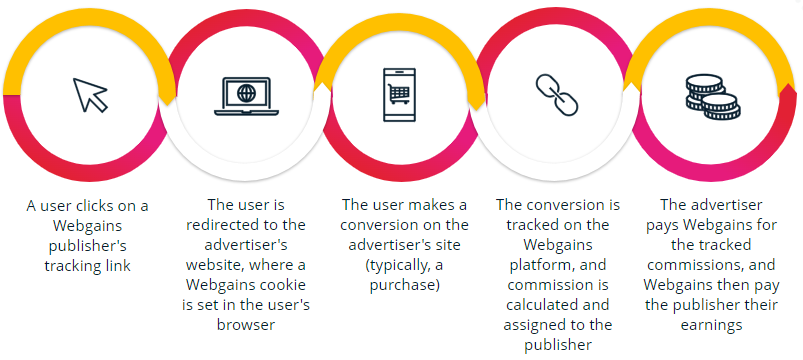
Notice where the customer buys: on the advertiser’s site, not from the publisher or the network. Also notice that tracking and payment are separate. The network may record a conversion and calculate a proposed commission, but the transaction must still satisfy the program’s terms before payment is due.
For your purposes, the useful question is not simply “Which network should I join?” It is “Which merchant’s program am I promoting, what does it count as a valid referral, and which system will show me the result?” This matters for a global audience: someone abroad may be able to click your link even if the merchant cannot sell to them or that purchase is not eligible under the program. We’ll investigate country and program eligibility in a later module.
A link identifies a referral; a cookie can help recognize a return visit
An affiliate tracking link is a URL issued for your referral activity. It contains, or redirects through a system that records, an identifier associated with you. When someone clicks it, the tracking system can record that referral and send the visitor to the merchant. An ordinary product link might reach the same page without recording your referral.
That initial click is only one piece of evidence. Suppose the customer leaves the headphones page, then returns tomorrow without clicking your link again. Some systems use a cookie—a small piece of browser-stored data—to help recognize that the visit was referred earlier. Other permitted tracking methods may also be used. A cookie does not make a purchase happen, and its presence alone does not entitle you to a commission.
Watch Harsh Agrawal’s What are Cookies, First click and last Click Attribution in Affiliate marketing for a short explanation of the browser cookie and the question that arises when a shopper clicks more than one affiliate’s link. Treat the specific cookie-duration example as an illustration, not as a promise about any current program.
What are Cookies, First click and last Click Attribution in Affiliate marketing
Harsh Agrawal explains how a browser cookie can preserve referral information and introduces two ways of deciding which affiliate receives credit. Watch to distinguish the stored tracking data from the rule applied to it.
Start with cookies and duration, beginning where he defines a cookie as browser-stored data. Then watch competing referrals, beginning with his question about a customer clicking another publisher's link. Focus on how the same sequence of clicks can produce different results under different attribution rules.
A practical limitation is that browser data may not be available when the customer returns—for example, if the cookie has expired or been cleared, the visit is in a different browser, or privacy settings restrict tracking. Neither a recorded click nor a stated cookie duration guarantees that a later order will be credited. The program also has to recognize a qualifying action and apply its rules.
Attribution rules decide who gets credit
Attribution means assigning credit for a qualifying purchase or other action to a referral. An attribution window is the period after a referral during which an action may still be eligible for credit. People sometimes use “cookie duration” and “attribution window” interchangeably, but it helps to keep the ideas separate: a cookie is one way to retain tracking information; the window is a program rule about eligibility.
Shopify’s Affiliate Marketing: What It Is and How It Works describes both the infrastructure and this distinction. You saw its overall customer journey in the previous lesson; read only these focused passages now.
Affiliate Marketing: What It Is and How It Works (2026) - Shopify
Shopify separates what a tracking platform does from the program rule that determines how long a referral remains eligible. Use these passages to refine the cookie explanation in the video.
In "Affiliate platforms and tracking tools," read the platform description, ending after the paragraph about dashboard metrics. Then, after the note about Shopify Collabs, begin at "While affiliate tracking tools make attribution possible" and read the window explanation through the sentence distinguishing an identifier from the eligibility rule. Focus on which functions belong to the platform and which decision belongs to the program.
A window does not settle every question. Imagine a program with a seven-day window. On Monday, a shopper clicks your headphones link. On Tuesday, the shopper clicks another affiliate’s link to the same merchant. On Wednesday, the shopper buys, and both referrals have been successfully recorded and remain eligible.
Under a first-click rule, your Monday referral would receive credit. Under a last-click rule, the other affiliate’s Tuesday referral would receive credit. Neither rule changes what the customer paid or where they checked out; it changes which referral the program rewards. Programs can have additional conditions, so the example illustrates the distinction rather than predicting every real sale.
Now change one fact: the shopper buys only after your seven-day window has passed, with no later eligible referral from you. Your earlier click alone would not normally qualify. This is why two questions must be asked separately: Is a referral still eligible? and if several referrals are eligible, which one gets credit?
The merchant’s program specifies those rules; the tracking system applies them using the information it has. If you promote through a network, the network may display the click and sale records, but it cannot turn an ineligible purchase into a commission merely because your link was clicked.
Reading a program without confusing the parts
When you encounter an affiliate offer, you can identify its moving parts in this order:
- Merchant: Who actually sells and fulfills the product?
- Program: What action earns commission, and what conditions apply?
- Network or platform: Where do you obtain links and see tracked results? Is it a multi-merchant network or the merchant’s direct system?
- Tracking link: How is a visitor’s click associated with your referral?
- Cookie or other identifier: What may help recognize the visitor if they return?
- Attribution rules: How long can the referral qualify, and how is credit decided if there are multiple referrals?
These are questions to investigate, not assumptions to make from a program’s promotional page. In particular, a long window is not a guarantee of credit, and access to a network is not proof that every offer there is suitable for every country. Later, when you compare real programs, you’ll examine their current terms alongside product fit and customer access.
Key takeaways
The merchant sells the product. Its affiliate program defines what earns a commission. A network, when one is involved, connects parties and provides operational tools; a direct program can work without one. Your tracking link identifies a referral, a cookie or other identifier may help recognize a returning visitor, and attribution rules determine whether—and to whom—a qualifying result is credited.
Next, you’ll use this understanding to estimate earnings from audience reach, clicks, purchases, commissions, and refunds. That calculation will make clear why neither a large audience nor a high click count automatically produces income.