Recommended resources
The freely available resources this lesson will direct you to.
- What is Affiliate Marketing and How Does it Work? (Affiliate Marketing Explained for Beginners 2023)www.youtube.com
- Affiliate Marketing for Beginners: Complete A-Z Tutorialwww.youtube.com
- Affiliate Marketing Crash Course: How Affiliate Tracking Worksblog.rakutenadvertising.com
- Affiliate Marketing: What It Is and How It Works (2026) - Shopifywww.shopify.com

Hello! This course begins with the mechanics of affiliate marketing, then moves toward choosing products, creating useful content, reaching audiences in different countries, and improving what works. Before thinking about where to post a link, it helps to understand what must happen after someone sees it.
In this lesson, you’ll follow one customer from a recommendation to a purchase and see why a commission may—or may not—result. The central idea is simple: content can introduce a product, but a commission depends on a qualifying action that the affiliate program can credit to your referral.
A recommendation starts the journey
Suppose you publish a short, faceless video called “What to check before buying headphones for work calls.” It explains microphone quality, comfort, and device compatibility, then points viewers to a pair that meets the needs you described. If you have joined that seller’s affiliate program, you can use a unique affiliate link rather than an ordinary product link.
The arrangement involves three people or parties:
- You, the affiliate, create the recommendation and provide the link.
- The merchant sells the headphones and handles the product page, checkout, and order.
- The customer decides whether the product is right for them and whether to buy it.
You are not selling the headphones yourself. You are helping a potential customer make a decision and, if they choose to visit the merchant, sending a referral the program can recognize. Unlike a sponsored post that may pay for publishing content, a typical sales-based affiliate arrangement pays when the specified result occurs.
What is Affiliate Marketing and How Does it Work? (Affiliate Marketing Explained for Beginners 2023)
Watch “What is Affiliate Marketing and How Does it Work?” from Funnel for a concrete example of a recommendation connected to a unique link.
Watch the definition for the basic payment arrangement. Then watch the review example: notice the difference between featuring a product in content and using a link that identifies the referring affiliate.
A viewer might appreciate your video and never click. Another might click but decide the headphones are unsuitable. Both can be useful interactions from the customer’s point of view, but neither is automatically a commissionable sale. That distinction matters when you later decide what content to make: attracting attention is only the beginning of the journey.
Follow the customer from content to purchase
Shopify’s explanation lays out the whole process, including two steps that happen largely out of the customer’s sight: the merchant sets the program’s rules before you promote anything, and the program checks a resulting order before crediting commission.
Affiliate Marketing: What It Is and How It Works (2026) - Shopify
Read Shopify’s explanation to connect the customer’s visible journey with the program’s tracking and approval process.
Under “What is affiliate marketing?”, read the opening definition. Then, under “How affiliate marketing works,” read the six numbered steps, from the sentence introducing the list through step 6. Pay particular attention to what the link identifies, what the customer must do, and why approval appears at the end.
The diagram below shows a similar journey from the customer’s click through payout. Read it as a map, not a promise that every click reaches the final stage.
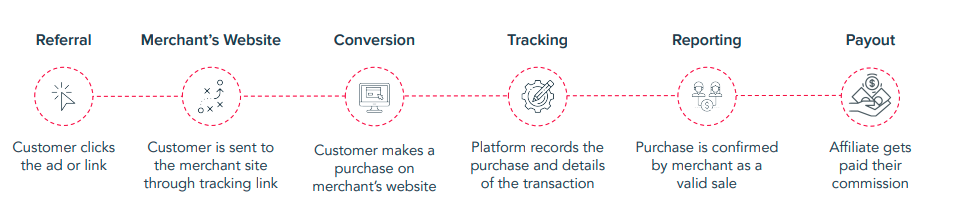
Let’s place your hypothetical headphones video on that map.
First, someone encounters your content. Perhaps they searched for help with unclear audio on work calls. Your explanation helps them identify what to look for. The content gives the recommendation context; without it, a bare link offers little reason to trust or even open it.
Next, they click your affiliate link. The link carries an identifier associated with your referral. The tracking system records the click and sends the customer to the merchant’s site. The identifier is why an affiliate link matters: an ordinary product URL might take the customer to the same page without telling the program that you referred them.
Then the customer decides whether to purchase. They can read specifications, compare alternatives, check the price, and leave if the product does not suit them. If they buy, they complete checkout with the merchant, not with you. Your content may have helped them arrive informed, but you do not control the merchant’s stock, checkout experience, or the customer’s final choice.
Finally, the program checks the referral and order. Its system connects the qualifying purchase to recorded referral information and applies the program’s rules. A recorded sale may initially appear as pending while the merchant confirms that it is valid. Once approved, a commission can be credited to your account; payout may happen later according to the program’s schedule. That is why the diagram separates tracking, reporting, and payout rather than treating a click as instant income.
The customer does not need to understand these backstage steps to shop. You do need to understand them to interpret your results. If a post gets many views but few clicks, the problem is different from a post that gets clicks but no qualifying purchases.
Why a click is not a guarantee
A purchase does not always happen immediately. Someone may open your link, think about the headphones overnight, and return to the merchant later. Many programs use a browser cookie or another tracking identifier to help recognize a returning visitor. A program also sets a period during which a referral can remain eligible for credit, often called an attribution window.
Return to the video for an example of a delayed purchase:
What is Affiliate Marketing and How Does it Work? (Affiliate Marketing Explained for Beginners 2023)
Continue Funnel’s video to see why a customer might return later rather than buy during the first visit.
Watch the delayed purchase. Focus on the role of the saved referral information and its limited lifespan. Treat the example as a possible outcome, not a guarantee that every later purchase will be credited.
Tracking has limits. A referral might no longer be eligible when the customer returns; the relevant browser data might not be available; or the program’s rules might credit a different referral. An order might also fail to qualify or later be refunded. You do not need to master those rules today—the next lesson will separate tracking links, cookies, and attribution in more detail. For now, remember the practical principle: a valid click makes credit possible; it does not promise credit.
This also changes how to think about reaching people globally. A viewer in another country can find your content and click your link, but that alone does not mean the merchant sells to them or that your affiliate program covers their purchase. When you eventually choose offers for different audiences, product availability and program eligibility will matter as much as the size of your audience.
What your content can contribute
Your strongest influence is before the customer reaches checkout. You can choose a real buyer question, explain the criteria that matter, show where a product fits, and be clear about where it does not. In the headphones example, “this pair is suitable if you need a wired connection; check your device’s port first” is more useful than “buy these now.” It helps the right customer move toward a decision and helps the wrong customer avoid a poor purchase.
A natural invitation at the end might be: “If a wired pair fits your setup, you can check the current specifications and price at the product link.” The customer can then verify the details on the merchant’s site. Make your affiliate relationship clear wherever you promote the link; later lessons will cover disclosure and platform rules in depth.
This approach works whether your content is a video, article, pin, or helpful post in a community that permits relevant links. The format changes, but the underlying journey does not: a person finds useful content, considers a relevant recommendation, visits the merchant through a trackable referral, and may complete an eligible purchase. More link placements cannot substitute for a product that fits the customer’s needs.
Key takeaways
An affiliate commission comes from a qualifying, credited result, not simply from publishing content, gaining views, or collecting clicks. Your unique link lets a program identify your referral; the customer chooses whether to buy from the merchant; and the program checks the purchase before commission is approved and eventually paid. Delays, tracking limits, program rules, and refunds can affect the outcome.
Next, you’ll look more closely at the roles of merchants, programs, networks, links, cookies, and attribution rules—the machinery behind the journey you have just followed.