Recommended resources
The freely available resources this lesson will direct you to.
Hello! In the previous lesson, you compared physical products, digital products, software, and services as affiliate offers. You also saw why a high commission does not necessarily mean high earnings: people still have to find your content, click, buy, and keep the purchase.
That uncertainty is precisely what some online pitches hide. This lesson will help you recognize three related risks: unrealistic promises made to aspiring affiliates, deceptive tactics used to persuade buyers, and scams disguised as affiliate opportunities. The goal is not to distrust every program. It is to know what evidence to ask for before you spend money, share a link, or put your audience’s trust behind an offer.
When an income claim skips the difficult parts
An affiliate link is a way to attribute eligible customer actions to you; it is not a source of customers by itself. Someone promising that you can “post links and earn guaranteed passive income” has skipped the work of reaching people with a relevant need and helping them decide whether an offer fits.
Watch these two short portions of Santrel Media’s Affiliate Marketing Tutorial For Beginners 2026. The creator’s experience is useful as a counterpoint to instant-income claims, not as a prediction of what you will earn.
Affiliate Marketing Tutorial For Beginners 2026 (Step by Step)
Santrel Media discusses slow early progress and later warns that shortcuts can put an affiliate account and audience trust at risk.
Watch earnings expectations for the contrast between one creator’s results and guaranteed outcomes. The suggested monthly-income milestone near the end is a goal someone might choose, not a typical result or a promise. Then watch program rules for why apparently effective promotional tactics can still be prohibited by a merchant.
Notice the distinction between possible, plausible, and guaranteed. It is possible to earn substantial affiliate income. That does not establish that a new account, a particular product, or 30 minutes of daily work will produce it on a fixed schedule. Nor does a screenshot of sales tell you the creator’s costs, refunds, previous audience, or years of work.
Your earlier earnings model gives you a way to question a claim. If a pitch says “earn from day one with no audience,” ask where the relevant viewers and clicks come from. If it shows a large commission total, ask how many eligible purchases produced it and whether the figure is before refunds or expenses. You do not need the promoter’s private records to recognize that a result without its conditions is not a forecast.
The US Federal Trade Commission (FTC) describes how fraudulent business offers and coaching programs use guaranteed earnings, impressive success stories, and pressure to buy. Its examples are about business opportunities broadly, but the warning signs apply to pitches aimed at new affiliate marketers.
When a Business Offer or Coaching Program Is a Scam | Consumer Advice
Read this FTC consumer guide to understand how an appealing online-income pitch can become an expensive obligation.
Under “Examples of Business Offer Scams and Coaching Scams,” begin with guaranteed-income claims, then read the “Online business coaching” examples. Continue to “Pyramid schemes,” from recruitment pitches. Under “How to Avoid Business Offers and Coaching Scams,” read the precautions. Finally, under “What To Do Before You Join a Coaching Program or Buy a Business Opportunity,” read the questions about the work, customers, income, and expenses. Focus on what the seller must explain—not just how confident the seller sounds.
A course or paid tool is not automatically a scam, and a genuine success story is not automatically false. The warning appears when a seller treats exceptional results as ordinary, will not explain how customers are reached, or says you must pay immediately to access a “proven system.” A low initial price may also be followed by expensive coaching or software presented as necessary for success.
Deception can happen on either side of the link
You may encounter misleading claims as the prospective affiliate: “Buy this training and you will earn a fixed amount every month.” You can also encounter them as a publisher choosing what to say to customers: “Tell viewers this product works for everyone.” Both matter. A dubious program can cost you money; a misleading recommendation can cost buyers money and damage your credibility.
Consider a faceless video recommending an online design course. These versions of the message create different problems:
- “I used this course and it doubled my income.” That is deceptive if you did not use it or cannot support the income claim.
- “Students routinely double their income.” A few impressive testimonials cannot establish what students generally achieve.
- “Only three places left today.” That is misleading if places are not genuinely limited.
- “Here is my unbiased review.” That becomes misleading if you conceal that purchases through your link pay you a commission.
- “This course teaches layout skills, includes a sample lesson, and may not suit complete beginners. I may earn a commission if you buy through my link.” This gives a buyer more useful information without promising a result.
The FTC’s endorsement guidance explains why honest recommendations and visible financial connections matter. It also cautions against using exceptional outcomes to imply that everyone can expect them.
FTC's Endorsement Guides: What People Are Asking
Read the FTC’s explanation of honest endorsements and its answers to questions specifically about affiliate links.
In the opening explanation, read the core principles before the question-and-answer sections. Under “WHAT ABOUT AFFILIATE OR NETWORK MARKETING?”, find the question beginning “I’m an affiliate marketer with links to an online retailer on my website” and read the disclosure answer. Continue to the question “Is ‘affiliate link’ by itself an adequate disclosure?” and read the wording advice. Under “USING ENDORSEMENTS THAT DON’T REFLECT THE TYPICAL CONSUMER EXPERIENCE,” read the typical-results warning. Focus on what a viewer would understand from the whole message, not just whether each individual sentence could be defended.
The FTC guidance concerns US advertising; other countries and platforms may have their own requirements. If you want to reach buyers globally, a sound starting practice is to make commission relationships understandable wherever you publish and avoid claims you cannot verify. A later lesson will work through disclosure placement in detail. For now, remember the principle: a buyer should know about your incentive before relying on your recommendation.
Not every promotional technique is deceptive. An honest comparison, a genuine limited-time price, or a clearly labeled affiliate link can help someone decide. The difference is whether you give people accurate information—or manufacture urgency, hide your incentive, impersonate a customer, or promise an outcome you cannot substantiate. A shortened link is not inherently deceptive either; concealing where it leads or using it to misrepresent an offer is the problem. Program and platform rules may also restrict particular link or advertising methods.
Recognize the opportunity being sold to you
Affiliate marketing normally concerns recommending a merchant’s product or service to potential customers under a program’s rules. Be cautious when an “affiliate opportunity” makes the main purchase your own entry into a money-making system.
The FTC’s Spot an income scam infographic collects several phrases you might see around business offers. They are signals to investigate, not proof that every offer using one of those words is fraudulent.
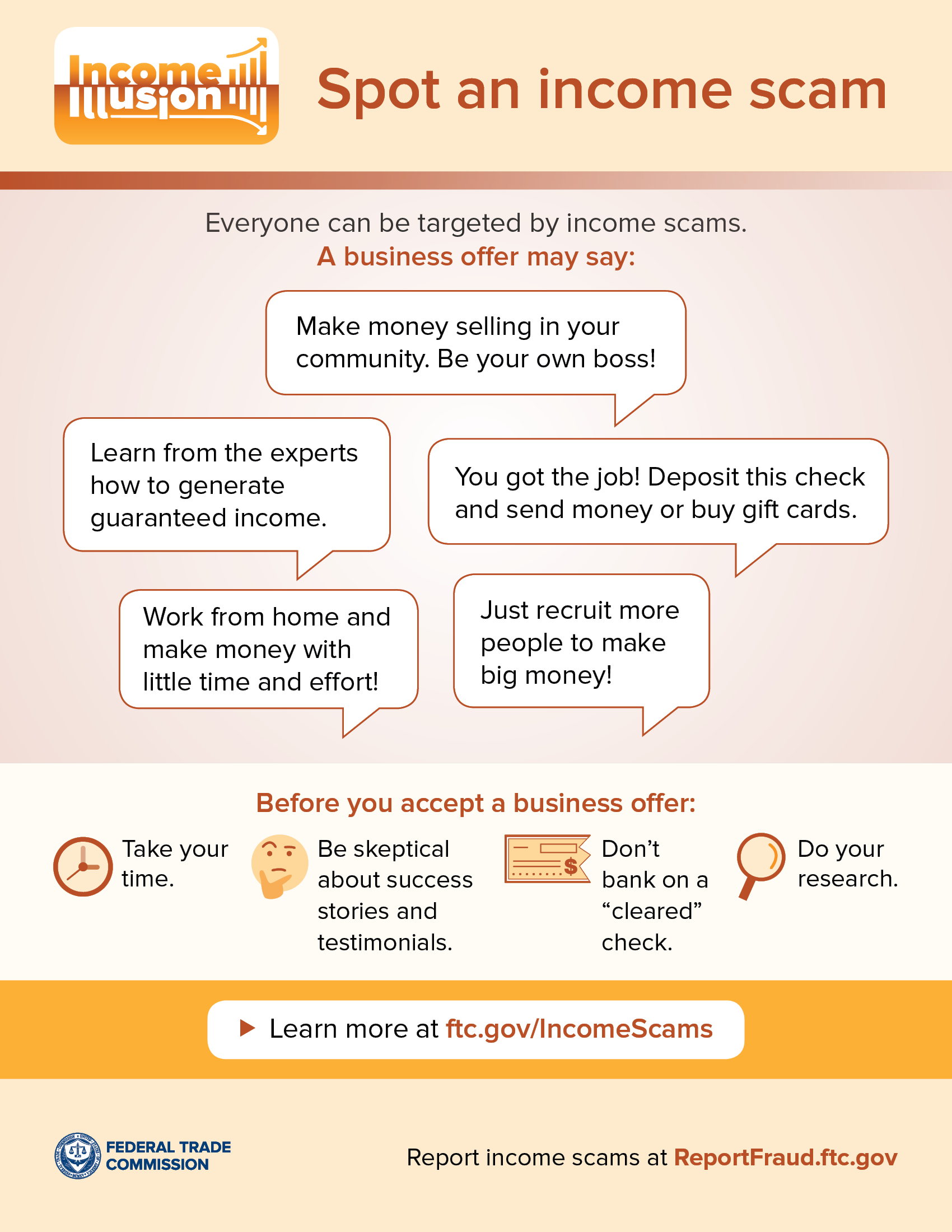
Three patterns deserve particular attention:
A guaranteed-income training funnel. A promoter offers a cheap or free introduction, displays large earnings figures, then says you need increasingly expensive coaching or tools to get the promised results. Before paying, ask what you will learn, the full likely cost, what work you must do, and what evidence supports the earnings claim. You can start learning and testing an organic content approach without buying a promised shortcut.
A recruitment-led scheme. Some legitimate businesses have referral arrangements, and affiliates may recommend tools to other publishers. Recruitment becomes a serious warning sign when the pitch centers on getting new participants to pay to join, rather than selling a useful product to people who want it for its own sake. Ask: Would customers still want this product if it carried no right to recruit or resell it? Do not assume that every course with resale rights is a pyramid scheme; investigate what buyers receive and where the demand comes from.
A fake payment or account setup. Someone claiming to hire you or enroll you as an affiliate may ask you to deposit a check, then send part of the money onward or buy gift cards. Do not do that. Seeing funds in an account does not mean the check is genuine or final. Be equally careful with unexpected requests for account credentials or payments to “unlock” a commission: independently verify who contacted you and what the program actually requires.
An ordinary program may have eligibility checks, a payout threshold, or optional paid tools. Those facts alone do not establish fraud. The concern is an unexplained fee, a concealed condition, an implausible earnings promise, or pressure to transfer money or sensitive information before you can verify the offer.
A practical pause before you promote or pay
When a pitch attracts your attention, separate the product, the promotion method, and the money claim. You can do this before selecting programs or building a large audience.
First, identify what an ordinary buyer receives and why they would want it. Next, ask what you would actually have to do to reach those buyers; “the system runs itself” is not an explanation of traffic. Then identify who pays whom, for which qualifying action, and what costs or refund conditions apply. Finally, examine the proposed promotional message: could you repeat its claims honestly, explain its limitations, and make your commission relationship clear?
If the answers remain vague, pause rather than filling the gaps with optimistic assumptions. Search for independent information and complaints, check the seller’s stated credentials and terms, and give yourself time to decide. Absence of complaints is not proof of legitimacy, but credible complaints can reveal problems. In particular, do not let a countdown or a success screenshot replace an explanation of the underlying business.
This pause also protects the audience you hope to reach globally. A buyer who discovers an undisclosed commission or an exaggerated claim may reasonably distrust your next recommendation, even if the next product is good. Trust is not an optional extra to affiliate marketing; it affects whether people can use your content to make informed decisions.
Key takeaways
Unrealistic pitches promise predictable income while leaving out audience-building, buyer demand, costs, and uncertainty. Deceptive promotion hides financial incentives or uses false experiences, unsupported results, or invented urgency. Common scam patterns include escalating coaching fees, recruitment-centered earnings, and fake payment requests.
You do not need to label every questionable offer a scam to protect yourself. Ask what is sold, who buys it for its own value, how a commission is earned, what the full costs are, and whether the claims are supportable. In the next lesson, you’ll turn that caution into a realistic zero-budget affiliate workflow that fits a short daily schedule.