Recommended resources
The freely available resources this lesson will direct you to.
- The ONLY Free Traffic Affiliate Marketing Video You’ll Ever Needwww.youtube.com
- How to Start Affiliate Marketing With No Experience or Money (4 Free Tools!)www.youtube.com
- Free Traffic for Affiliate Marketing: The Ultimate How-To Guide for 2026 | ClickBankwww.clickbank.com
- How To Start Affiliate Marketing With No Money (2026) - Shopifywww.shopify.com

Hello! Last lesson, you learned to pause when an affiliate opportunity promises income without explaining how it will reach buyers. Now you can replace that vague promise with a workable routine.
This lesson gives you a zero-budget workflow for 30 minutes a day. You will see what to set up first, what to do each week, and how to tell whether your efforts are producing useful signals. The aim is not to post links everywhere. It is to help a specific audience with a specific problem, consistently enough to learn what works.
Define what “zero budget” can—and cannot—mean
A zero-budget approach avoids paid ads, a paid website, subscriptions, and purchased traffic. It uses a free publishing account, tools already available to you, and the device and internet access you already have. It is not free of time, and organic reach is not guaranteed. A useful post may attract attention later, but it may also receive little attention.
The first constraint is therefore your time: 30 minutes daily is 3½ hours a week. That is enough to research one question, make one useful content item, publish it, and review the response. It is not a realistic starting allowance for mastering five platforms, testing many products, and making a new video every day.
Watch the closing portion of ClickBank’s The ONLY Free Traffic Affiliate Marketing Video You’ll Ever Need for its compact starting sequence. Treat it as a framework for choosing work, not a promise that repeating it will produce commissions.
The ONLY Free Traffic Affiliate Marketing Video You’ll Ever Need
ClickBank summarizes the core actions behind an organic affiliate approach and emphasizes starting with one channel.
Watch the three priorities for the roles of buyer understanding, subject knowledge, and content ideas. Then watch the starting actions. Notice how selecting one channel and one problem keeps the workload bounded.
Your starter system needs just four components: one audience problem, one primary channel, a small record of ideas and results, and—only when verified—an offer relevant to that problem. For example, “people trying to keep charging cables organized on a small desk” is more workable than “everyone who buys home products.” A post can answer their question even before you have an affiliate link.
Shopify’s How To Start Affiliate Marketing With No Money describes free traffic options and the basic results an affiliate can track. Read only the indicated subsections; you do not need its paid-tool suggestions or a full website setup for this routine.
How To Start Affiliate Marketing With No Money (2026) - Shopify
Read Shopify's overview of free publishing and basic tracking so you can distinguish the minimum workflow from optional tools.
In “How to start affiliate marketing with no money,” go to subsection “3. Select a free traffic source.” Read the channel options, beginning with the paragraph about free platforms and ending at its sentence about creating content. Then go to subsection “8. Track your results.” Read the tracking basics, from its opening paragraph through the paragraph about identifying which content drives sales. Focus on the small number of actions and measurements you could maintain without extra software.
For now, choose one channel where your intended audience already looks for answers and where you can make a helpful item in the time available. A visual, searchable question might suit a static image post; a question best shown in motion might suit short video; another might suit a text-based platform. You will compare channels more carefully later. Today’s decision is provisional: choose one you can use consistently rather than trying to be present everywhere.
Use a setup week before trying to promote
A link is useful only if you are permitted to share it and the person clicking can reasonably use the offer. Give your first week to building that foundation. Keep each day to 30 minutes; if a check takes longer, continue it the next day rather than rushing it.
| Day | Main task for the day | What you should have afterward |
|---|---|---|
| 1 | Write down one audience and one practical problem you could help solve. | A one-sentence focus. |
| 2 | Choose one free channel and inspect a few questions people ask there. | A channel choice and three audience questions. |
| 3 | Look for potential solutions, including non-product solutions. | Notes on what would genuinely help. |
| 4 | Find a possible affiliate program and check its published eligibility and promotion rules. | Either a candidate worth investigating or a reason to keep looking. |
| 5 | Check one offer’s usefulness, limitations, and availability in the market you intend to reach. | Evidence you can state honestly—and uncertainties you cannot yet resolve. |
| 6 | Draft one helpful answer to an audience question. | An original content draft, with no purchase claim you cannot support. |
| 7 | Edit and publish that answer, or finish the checks it requires. | One useful post, even if it contains no affiliate link. |
Do not make approval or a commission the deadline for day seven. Programs differ in who they accept, where customers can buy, and which promotional placements they allow. If you have not confirmed those conditions, publish helpful content without the affiliate link. You can still learn which questions draw attention.
Suppose your question is, “How can I stop charging cables falling behind a small desk?” A useful first post could explain two ways to route cables using things already at home, then note when a cable organizer might help and when its adhesive might be unsuitable. You do not need to pretend you bought or tested an organizer. If you later verify an appropriate offer, your recommendation can explain the product’s size, surface requirements, and likely fit, rather than merely saying “buy this.”
For global reach, resist writing to “the whole world” in your first post. Start with one audience problem and a market in which your prospective buyer can actually access the offer. Check availability before recommending it. You will work on country and language differences in a later module; the immediate rule is simpler: do not send people toward something you have not checked they can use.
Make 30 minutes a repeatable working block
After setup, use the same three-part time boundary each day:
- Five minutes: look at the next task. Open your notes, read yesterday’s progress, and choose one question to work on. This prevents the whole session disappearing into browsing.
- Twenty minutes: do the main task. Research, draft, edit, publish, or review—whichever the day requires. One focused task is more achievable than switching among accounts.
- Five minutes: record and respond. Save a source, note an uncertainty, answer a genuine question, or log a result. If there is nothing to respond to, prepare the first action for tomorrow.
This is a time limit, not a production quota. Some topics need more than one 20-minute block to research responsibly. A week with one accurate post is better than a week of seven thin recommendations.
Here is a steady weekly rhythm once your channel and initial offer checks are in place:
| Day | Focus for the 20-minute block |
|---|---|
| Monday | Find one real audience question and note what the person needs to know. |
| Tuesday | Check sources and, if relevant, recheck the offer’s claims, access, and rules. |
| Wednesday | Draft the answer or outline the visual or video. |
| Thursday | Finish the content; remove unsupported claims and add any needed disclosure. |
| Friday | Publish and test that the intended destination works. |
| Saturday | Respond helpfully to comments or collect follow-up questions. |
| Sunday | Review the week’s available results and choose one improvement for next week. |
If no one comments, Saturday is not a failed day: use it to find a better question. If a post takes longer to make, publish on Saturday or Sunday instead. The rhythm protects the essential work—research, creation, checking, and learning—without demanding a fixed posting streak.
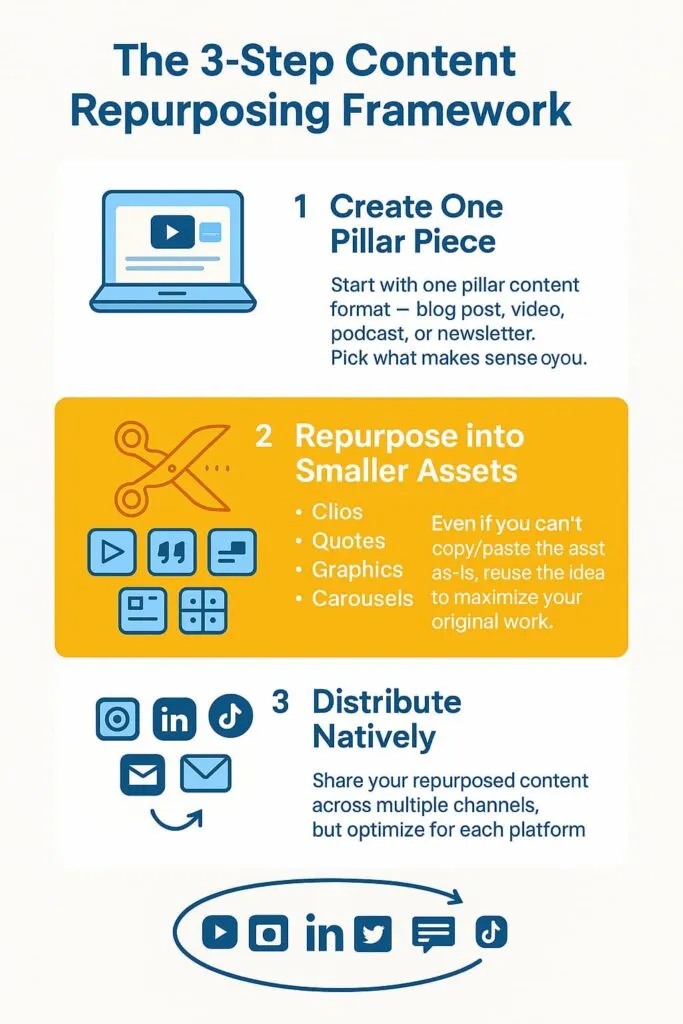
You may eventually reuse a researched idea in different formats, as ClickBank’s illustration suggests. For this schedule, do not treat every pictured asset and platform as a requirement. A modest version is to keep your notes from one question and use them to answer a related follow-up on your same channel another week.
Connect content to an offer without turning the routine into link-dropping
When an offer is approved and suitable, the link should serve the answer—not replace it. Give the viewer information they can use even if they never click. If the post discusses a purchase, explain who the product fits, a meaningful limitation, and where to check the details. Include a clear disclosure where people will see it before interacting with a promotional link, such as: “I may earn a commission if you buy through this link.”
Check both the affiliate program’s and the publishing platform’s rules before placing a link. A caption may not support a clickable link; a program may restrict particular placements. In that case, use a permitted destination or continue publishing informational posts while you resolve the issue. A paid website, email system, or link-shortening service is not a prerequisite for answering useful questions. Nor should you put unsolicited links into communities that prohibit promotion.
This makes the workflow resilient. If you have no approved offer today, you can research and publish. If you have an offer but no convincing evidence that it fits the question, you can leave it out. If a post attracts a new question, you have a strong candidate for next week’s content.
Keep a record small enough to maintain
Use a simple note or free spreadsheet. For each published item, record its date, audience question, channel, content title, and whether it contains a verified offer. Once a week, add the numbers your platform and affiliate program actually provide: views or impressions, meaningful interactions, link clicks, eligible sales, and commissions. Do not invent a number when a platform does not report it, and do not count a click as a sale.
In the beginning, the record is mainly a diagnostic aid. If a post receives little reach, you cannot yet judge the offer from its sales. If people ask questions but do not click, your answer may need clearer information about whether the offer fits. If clicks appear but no sales do, there may be a mismatch between the audience and offer—or simply too little data to conclude anything. Change one small part of the next post based on what you can observe, rather than rebuilding the entire system after a quiet week.
Your first month’s realistic targets are therefore process targets: keep the 30-minute boundary, publish a small number of genuinely useful items, verify offers before linking, and preserve notes on what your audience asks. Earnings are possible, but neither daily effort nor global availability guarantees them.
Key takeaways
A workable zero-budget affiliate workflow uses one audience problem, one primary channel, one useful item at a time, and basic weekly review. Spend your first week setting up and checking suitability; then use a repeatable 5-minute planning, 20-minute focus, and 5-minute recording block each day. Publish without an affiliate link when approval, product fit, or placement rules remain uncertain.
Next, you will learn how to collect evidence of what people currently want to buy. That will help you replace an initial niche guess with better-informed choices.