Recommended resources
The freely available resources this lesson will direct you to.
Hello, and welcome. This course examines how private-fund administration works before assessing where AI and distributed ledgers can materially improve it. We begin with the operating map: who the legal parties are, what connects them, and why “the fund” is not one organisation but a coordinated set of entities, contracts, records, and controls.
In this lesson, you will build a workable diagram of a typical Luxembourg private equity or venture capital fund. The aim is not to memorise every Luxembourg structure, but to distinguish ownership, governance, regulated management, administration, independent oversight, audit, and legal advice.
Start with three layers, not one “fund”
A private fund structure can be understood through three overlapping layers:
- The ownership and governance layer: investors provide commitments; the fund vehicle receives and holds capital; the general partner governs a limited partnership.
- The regulated management layer: an authorised Alternative Investment Fund Manager, or AIFM, carries formal management and regulatory responsibilities where the structure requires one.
- The service-provider layer: the administrator, depositary, auditor, and lawyers each perform defined functions under separate appointments and contracts.
The term fund is therefore ambiguous. It may mean:
- the legal vehicle that owns investments;
- the commercial strategy marketed to investors;
- the entire arrangement of manager, service providers, portfolio entities, and documents.
For administration, being precise matters. The administrator may maintain the fund’s books and investor records, but does not normally decide what the fund buys. The depositary may oversee assets and cash movements, but is not the investment manager. The auditor tests the financial statements independently, but does not prepare them.
The core structure: investors, vehicle, and manager
A common Luxembourg private-markets structure uses a limited partnership, often an SCSp (Special Limited Partnership) or SCS (Common Limited Partnership). It has at least two kinds of participant:
- Limited partners (LPs) are the investors. They commit capital to the fund and have limited liability, generally up to their committed or invested amount. LPs receive economic rights: distributions, reporting, and the return generated by the portfolio.
- The general partner (GP) is the managing partner of the limited partnership. The GP is responsible for managing the partnership under its limited partnership agreement. Because a GP can bear liability for partnership obligations that the partnership itself cannot satisfy, it is often a separate Luxembourg company, such as a SARL.
The LPs invest in the fund vehicle, not directly in the GP, administrator, or portfolio company. The fund vehicle then makes investments itself or through holding companies and special-purpose vehicles.
Luxembourg offers several legal forms and regulatory regimes, which should not be confused:
| Category | Examples | What it answers |
|---|---|---|
| Legal form | SCSp, SCS, SA, SARL, SCA | What is the fund legally? Who owns and governs it? |
| Regulatory wrapper | RAIF, SIF, SICAR | What fund regime and regulatory conditions apply? |
| Investment arrangement | Single fund, umbrella fund with sub-funds, feeder, master | How are assets and investor pools organised? |
| Holding structure | Holdco, SPV, acquisition vehicle | How does the fund hold a particular investment? |
For example, a fund might be an SCSp structured as a RAIF, managed by an external authorised AIFM, with one or more Luxembourg holding companies beneath it. That is not several competing “funds”; it is one architecture with different layers.
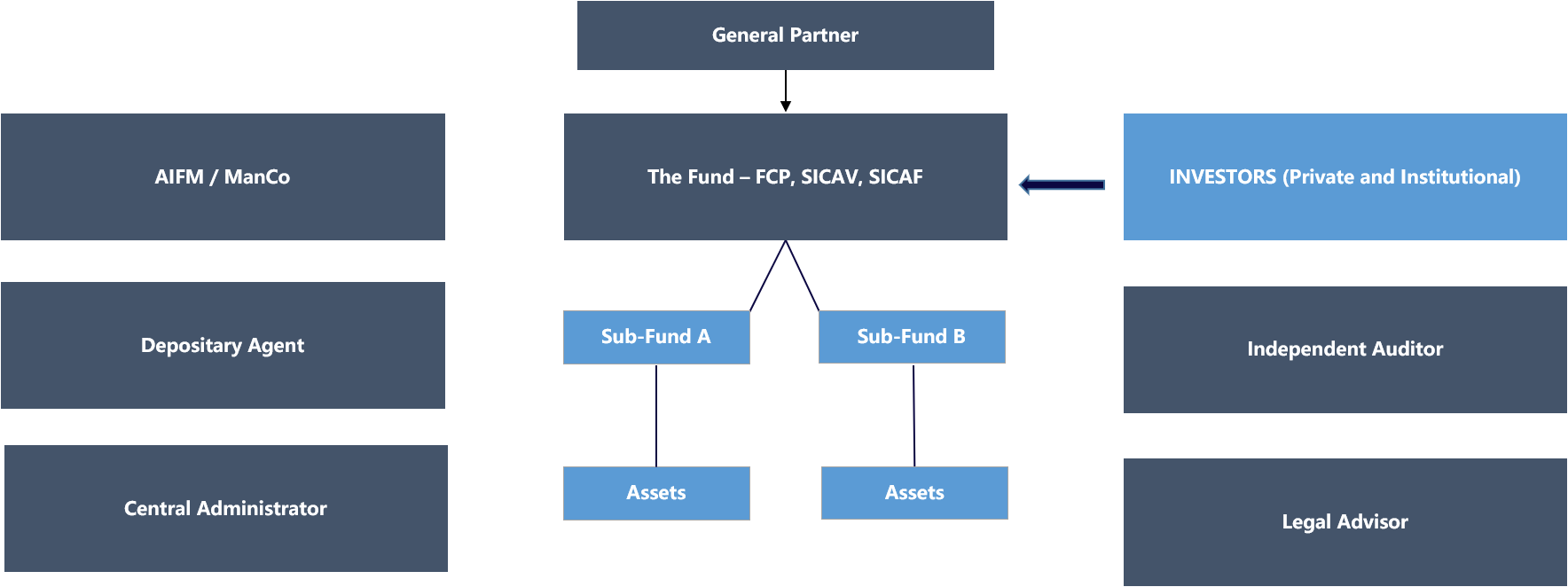
The following diagram gives the essential relationships. It is deliberately simplified: actual structures may add investment advisers, banks, transfer agents, tax advisers, portfolio-company SPVs, and governance committees.
Read the arrows as legal or operational relationships, not as a complete cash-flow diagram. Capital movements, investment payments, and distributions will be mapped in a later lesson.
The GP, fund manager, and AIFM: related, but not interchangeable
These titles are often used loosely in conversation, yet they describe distinct positions.
The GP
In a Luxembourg limited partnership, the GP is a legal and governance role. It manages the partnership under the partnership agreement and typically signs or causes the fund’s contracts to be entered into. The GP may be a relatively lean entity: it does not need to employ everyone performing investment, compliance, accounting, or administration work.
The fund manager or investment manager
“Fund manager” is often a commercial label. It can refer to the sponsor group that raises the fund, chooses investments, oversees portfolio companies, and communicates the strategy to LPs. In formal documentation, investment management may be performed by an investment manager, an adviser, or delegated personnel.
The AIFM
The AIFM is a formal regulatory role under the Alternative Investment Fund Managers Directive framework. In broad terms, it is responsible for managing the alternative investment fund, including portfolio-management and risk-management functions, as well as required oversight and compliance arrangements. Some functions may be delegated, but delegation does not simply eliminate the AIFM’s accountability for proper oversight.
A practical relationship often looks like this:
- the GP governs the partnership and makes appointments under the fund documents;
- the AIFM provides the regulated management framework;
- an investment manager or adviser, if separately appointed, supplies investment expertise or carries out delegated investment activity;
- the administrator turns approved activity into controlled books, registers, calculations, and reports.
In some fund groups, the GP and AIFM are affiliated. In others, the GP appoints an independent third-party AIFM. A RAIF, for instance, is not directly authorised as a fund by Luxembourg’s CSSF in the same way as certain regulated vehicles, but it must be managed by an authorised external AIFM. That makes the AIFM central to the structure even when the GP remains central to partnership governance.
[PDF] LUXEMBOURG PRIVATE EQUITY AND VENTURE CAPITAL
Read the Luxembourg for Finance brochure to ground the GP’s delegation powers and the distinction between central administration and depositary oversight in a private-markets setting.
In Section 2.2, “General partners/management,” read the delegation passage. Notice that the GP can appoint an AIFM, adviser, administrator, and depositary; appointment does not mean that all of those parties perform the same task. Then move to Section 2.4.1, “Administration,” and read the administration description. Continue into Section 2.4.2.1, “Monitoring function,” and read why oversight matters. Focus on the distinction between producing the fund’s records and independently monitoring the fund’s assets and activity.
Where the administrator sits
The fund administrator is an operationally central party, but normally not the legal decision-maker. It is appointed under an administrative agreement, often by the fund vehicle, GP, AIFM, or a combination reflected in the contractual chain.
For a closed-end PE or VC fund, the administrator commonly supports:
- fund and SPV accounting;
- maintenance of the general ledger and financial records;
- capital-account records for each investor;
- calculation support for capital calls, distributions, management fees, and carried interest;
- preparation of financial statements and periodic investor reporting;
- corporate, domiciliation, company-secretarial, tax, and regulatory support, depending on the mandate;
- maintenance and controlled storage of transaction documents and supporting evidence.
The administrator’s work is therefore recording, reconciling, calculating, documenting, and reporting. It has significant operational influence because other parties rely on its data. Yet its mandate does not generally give it authority to approve a new investment, change the investment strategy, or exercise the GP’s governance powers.
There is a useful practical distinction:
| Question | Party principally accountable |
|---|---|
| Should the fund buy Company X? | GP, investment manager, and/or AIFM according to the mandate |
| Has the investment been approved under the fund’s governance process? | GP, board, investment committee, and AIFM oversight where applicable |
| Has the transaction been recorded correctly in the accounts? | Administrator, subject to review and audit |
| Is the fund’s ownership of the unlisted asset documented and verified? | Depositary, within its safekeeping and oversight duties |
| Do the accounts fairly present the fund’s financial position? | Fund/GP prepares them; auditor independently audits them |
| Is the partnership agreement or acquisition document legally sound? | Legal counsel advises; GP or authorised signatories decide and execute |
This separation is a major theme of fund administration. Technology may speed up the administrator’s preparation and reconciliation work, but it must preserve approvals, accountability, confidentiality, and independent controls.
Depositary, auditor, and legal counsel: independent functions around the fund
Depositary
For many Luxembourg alternative investment fund structures managed by an AIFM, a depositary is appointed. In a traditional securities fund, “safekeeping” can suggest holding securities in custody. Private equity and venture capital are different: the key assets are often unlisted shares, partnership interests, shareholder loans, or interests held through SPVs.
The depositary’s role consequently places strong emphasis on:
- verifying ownership or keeping records of assets that cannot be held in custody;
- monitoring cash flows;
- checking that subscriptions, payments, and certain transactions are properly handled;
- overseeing compliance with applicable fund rules and transaction processes;
- escalating issues found through its monitoring.
The depositary is not a replacement for the administrator. The administrator keeps the operational accounting record; the depositary provides an independent control function over assets, cash, and selected activity.
Independent auditor
The auditor is appointed to examine the financial statements and issue an independent audit opinion. The auditor uses evidence from the administrator’s books, the fund’s records, bank evidence, legal documents, portfolio-company data, and valuation material. But it remains independent from both the fund manager and the administrator.
An audit is not a real-time operational control. It is periodic, commonly annual, and retrospective in its testing. This differs from the depositary’s ongoing monitoring and the administrator’s day-to-day record keeping.
Legal counsel
Legal counsel advises the GP, fund, AIFM, or other parties on the legal structure, fund documentation, investor terms, regulatory questions, acquisitions, disposals, and disputes. Counsel may draft the limited partnership agreement, private placement memorandum, subscription documents, AIFM agreement, depositary agreement, and administration agreement.
Counsel’s role is advisory rather than managerial. A legal adviser may identify what is permitted, required, or risky; authorised parties still make the relevant commercial or governance decisions.
A guide to setting up alternative investment funds in Luxembourg
Use Ocorian’s setup guide to connect the named entities in the diagram with the appointments and contracts that formally establish their relationships.
In “Appointment of key parties,” read the party list, then continue through the entries for legal adviser and auditor. Treat this as an appointment map, not a statement that every provider controls the fund. Next, in “AIF setup list – material contracts,” read the material-contract list. Focus especially on the AIFM, investment-management, depositary, administrative, and transfer-agency agreements: these create the legal boundaries that the operational diagram alone cannot show.
How to read the structure as a legal and operational map
When you encounter a fund structure chart, use four questions in order.
First: What is the fund vehicle?
Identify whether it is a partnership, company, or contractual fund. In an SCSp or SCS, look for GP and LP. In a corporate fund, look for a board of directors. In an FCP, look for the management company because an FCP is a contractual co-ownership arrangement rather than a separate corporate entity.
Second: Who has authority to manage?
Find the GP, board, AIFM, and any investment manager or adviser. Do not assume that the party with the most prominent brand name is the party with the formal AIFM role.
Third: Which parties provide services and controls?
The administrator provides operational records and reporting; the depositary performs safekeeping and oversight duties; the auditor independently audits financial statements; legal counsel advises on documents and legal issues.
Fourth: Where do the investments sit?
The fund may own assets directly, but private-market structures frequently use holding companies and SPVs. If an umbrella fund has sub-funds, each sub-fund may have its own investment pool, economics, and investor base. The diagram’s “Fund” box may therefore conceal a substantial structure beneath it.
A good diagram labels both the legal appointment and the actual work. For example:
- “Fund appoints administrator under administrative agreement” is a legal relationship.
- “Administrator receives approved investment documents and books the transaction” is an operational relationship.
Both are essential. A chart that only shows legal lines conceals how information moves. A chart that only shows operational handoffs conceals who is authorised and accountable.
Key takeaways
A typical Luxembourg PE or VC fund is a coordinated structure rather than a single company:
- LPs provide capital commitments and hold economic interests in the fund.
- The fund vehicle owns investments, often through holding companies or SPVs.
- The GP governs and manages a limited partnership, while the AIFM carries the formal regulated management role where required.
- The administrator keeps the operational and accounting machinery running, but does not normally make investment decisions.
- The depositary provides asset safekeeping or verification and oversight, particularly important where private assets cannot be conventionally held in custody.
- The auditor independently audits financial statements.
- Legal counsel structures, documents, and advises, without assuming the manager’s decision-making authority.
Next, we will sharpen these distinctions by separating the fund administrator’s responsibilities from those retained by the GP, AIFM, depositary, auditor, and other providers. That boundary-setting is necessary before evaluating which activities AI or blockchain can credibly change.