Recommended resources
The freely available resources this lesson will direct you to.
Introduction
Welcome back. In our last lesson, we conducted a strategic analysis of the titanium sponge industry using Porter's Five Forces. We concluded that while the industry is protected by formidable barriers to entry like capital cost and aerospace certification, incumbent producers face intense rivalry, often from state-backed competitors.
Today, we shift our focus from the broad industry structure to the operational level of a single plant. Your goal is to evaluate the impact of feedstock quality (e.g., rutile vs. ilmenite) and energy price volatility on the profitability of a titanium production operation.
This analysis is a crucial step in building the techno-economic model we've discussed. In the previous module, you learned to perform mass and energy balances. Now, we will examine how the inputs to those balances—specifically the primary titanium ore and the cost of energy—are not fixed parameters but strategic variables that directly drive a plant's cost structure and profitability.
The Core Inputs: A Mass Balance Perspective
Let's begin with a simplified view of the key raw materials required for the Kroll process.
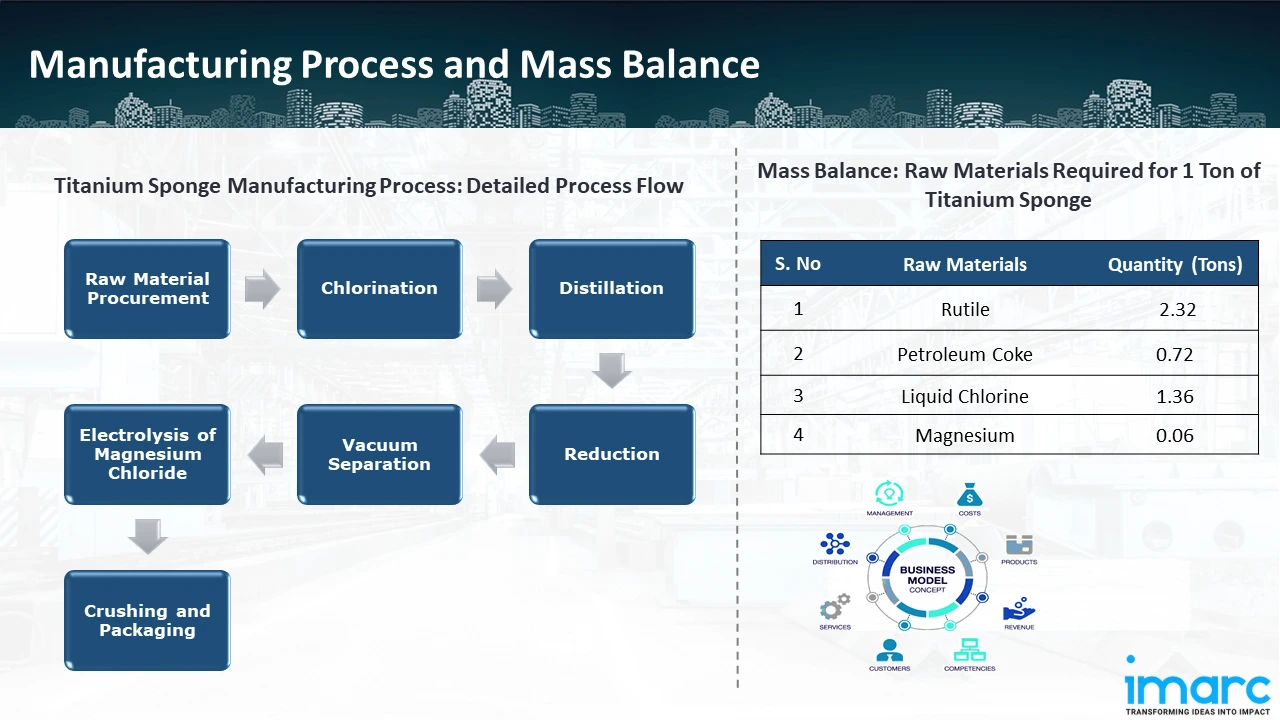
The table indicates that to produce 1 ton of titanium sponge, you need approximately 1.65 tons of rutile, along with petroleum coke, liquid chlorine, and magnesium. This provides a clear, first-order approximation of your variable costs.
However, this is an idealized scenario. The term "rutile" here represents a high-quality TiO₂ feedstock. In practice, a producer has a choice of several feedstocks with varying levels of TiO₂ and impurities, such as:
- Natural Rutile: Typically >95% TiO₂.
- Synthetic Rutile (SR): Upgraded from ilmenite, ~92-95% TiO₂.
- Upgraded Slag (UGS): A co-product of pig iron smelting, ~85-95% TiO₂.
- Ilmenite: The raw mineral, 45-60% TiO₂. While not typically used directly in modern chloride processes for metal, it is the ultimate source for SR and slag.
The central question for an operator is not simply the price per ton of these materials, but how their quality impacts the entire process. A cheaper, lower-grade feedstock might increase the consumption of other expensive reagents or create costly operational problems.
Feedstock Quality and Value-in-Use (VIU)
To properly evaluate feedstock, we need to go beyond the purchase price and analyze its Value-in-Use (VIU). This concept, which should be familiar from your economics background, quantifies the total economic impact of using a particular input in a specific process. A feedstock's VIU is a function of its price plus or minus its effect on other costs, such as reagent consumption, waste disposal, and process efficiency.
To understand the technical drivers behind VIU in titanium production, we'll start by examining the details of the chlorination stage.
[PDF] Value-in-use model for chlorination of titania feedstocks - SAIMM
This paper from the South African Institute of Mining and Metallurgy (SAIMM) provides an excellent techno-economic model for the chlorination process. It details precisely how feedstock impurities create operational and economic challenges.
Please read the following sections: Process description (part of the 'Process analysis' section): Focus on the description of the chlorination reactor and the role of impurities. Note how high boiling-point chlorides like CaCl₂ and MgCl₂ can cause problems. Material descriptions > TiO₂ feedstock: This short section lists the key quality specifications for feedstocks. Pay close attention to the impact of alkali oxides (MgO, CaO), silica, and iron.
As the reading shows, the chlorination process is highly sensitive to feedstock quality. Here’s a summary of the key takeaways:
- Lower TiO₂ content means more impurities per ton of feed, which must be chlorinated and dealt with. This increases consumption of chlorine and coke and generates more waste.
- Alkali Oxides (CaO, MgO) are particularly problematic. They form chlorides (CaCl₂, MgCl₂) that are liquid at the reactor's operating temperature (~1000°C). These sticky liquids can cause the fluidized bed particles to agglomerate, leading to "clogging" and forcing reactor shutdowns.
- Silica (SiO₂) and Zirconia (ZrO₂) tend not to chlorinate and accumulate in the bed as solids, which must be periodically removed ("bled").
- Iron (Fe) increases chlorine consumption and generates iron chloride waste, which has associated disposal costs.
Now, let's see how these technical factors are quantified in an economic analysis.
[PDF] Value-in-use model for chlorination of titania feedstocks - SAIMM
Let's return to the same SAIMM paper. The 'Modelling studies' section provides two concrete examples of VIU calculations, translating feedstock quality directly into dollars and cents.
Please read the section 'Modelling studies', focusing on 'Example 1: production cost versus customer benefit' and 'Example 2: relative feedstock values'. For each example, analyze the waterfall graphs (Figures 5 and 6) to understand which cost components (coke, chlorine, waste) are most affected by the change in feedstock.
These examples provide powerful insights:
- In Example 2, comparing an 86% TiO₂ slag to a 95% TiO₂ natural rutile, the model shows that using the higher-grade rutile leads to:
- Slightly higher petroleum coke consumption.
- Significantly lower chlorine consumption.
- Significantly lower waste generation and treatment costs.
- The net result is that the natural rutile has a VIU that is 6.7% higher than the slag, based on the prices assumed in the study. The single largest contributor to this higher value is the savings on chlorine costs.
This explains why a rational plant operator would be willing to pay a substantial price premium for a higher-quality feedstock. The price tag on the raw material is only one part of the total cost equation.
Let's look at what those price premiums are in the real world.
[PDF] TiO2 Forecast: Feedstocks - TiPMC Consulting
This feedstock forecast from TiPMC Consulting provides market prices for various titanium feedstocks.
Please review the two tables on the first page. Compare the 'Mid' forecast price for 'Rutile' and 'Chloride Slag' for 2024. This will give you a sense of the market premium for high-grade ore.
The TiPMC forecast for 2024 shows Rutile at $1475/t and Chloride Slag at $950/t. A producer is willing to pay over $500/t more for rutile precisely because of the VIU effects we just analyzed—primarily lower chlorine consumption and waste disposal costs.
The Impact of Energy Price Volatility
This brings us to the second part of our learning outcome. The VIU analysis highlighted chlorine as a major cost driver. Chlorine production itself is an extremely energy-intensive process, making its price sensitive to electricity costs. This means energy price volatility impacts a Kroll plant's profitability in two ways:
- Directly: Through the cost of electricity consumed by the plant's own reactors, furnaces, and pumps.
- Indirectly: Through the price of energy-intensive reagents, most notably chlorine.
Let's examine the strategic implication of this relationship.
[PDF] TiO2 Forecast: Feedstocks - TiPMC Consulting
The TiPMC report contains an excellent discussion on how North American chlorine prices directly influence feedstock selection strategy.
Please read the section titled 'TiO2 Chloride Feedstock: Value in Use'. Focus on the explanation of the merchant chlorine market and the explicit connection the author makes between high chlorine prices and the demand for high-grade feedstocks.
The key insight from this reading is that high or volatile chlorine prices amplify the Value-in-Use of high-grade feedstocks.
When chlorine is cheap, the cost savings from using rutile instead of slag are modest. However, when chlorine prices skyrocket (as they have in North America due to structural market changes and energy costs), the savings become dramatic. This creates a powerful incentive for producers, particularly those reliant on merchant chlorine, to prioritize securing high-grade feedstocks to minimize their exposure to chlorine price volatility.
A company's feedstock procurement strategy is therefore not static; it is a dynamic calculation that must account for regional energy and reagent market conditions. A plant in a region with access to cheap, stable power and integrated chlorine production might favor a lower-cost feedstock, whereas a plant exposed to a volatile merchant chlorine market will find high-grade ore a crucial strategic investment.
Activity: Strategic Decision-Making
Imagine you are the COO of a titanium sponge plant in the US that relies on merchant chlorine. You are presented with the VIU analysis from the SAIMM paper's "Example 2," which showed natural rutile being 6.7% more valuable than slag. Your team informs you that due to tightening supply and rising electricity costs, they project merchant chlorine prices will increase by 40% over the next 18 months.
- How does this forecast change your assessment of the relative value of natural rutile vs. upgraded slag?
- What immediate action might you recommend for your procurement team?
Take a few minutes to formulate your response before reading the sample answer below.
Sample Answer
-
Assessment: The projected 40% increase in chlorine price will significantly increase the Value-in-Use of natural rutile relative to slag. In the original analysis, chlorine savings were the single largest contributor to rutile's higher value. A 40% increase in this cost component will magnify those savings, making the VIU gap between rutile and slag much larger than the original 6.7%. The high price of rutile now looks less like a cost and more like a necessary hedge against extreme chlorine price volatility.
-
Recommended Action: I would direct the procurement team to immediately pursue long-term supply contracts for natural rutile. The goal is to lock in volume and price for our highest-grade feedstock, insulating our operation from the expected spike in chlorine costs. Even if this means paying a premium on the rutile contract compared to today's spot price, it is a strategically sound decision to mitigate a much larger future cost risk.
Conclusion
Today we have moved from high-level strategy to the core operational economics of titanium production. By connecting feedstock chemistry to process costs, you can now perform a much more sophisticated analysis of a plant's profitability.
Key Takeaways:
- Feedstock quality is a critical profit driver. Its value is not its purchase price, but its "Value-in-Use," which accounts for its impact on reagent consumption (especially chlorine), waste generation, and operational stability.
- Higher-grade feedstocks (like rutile) command a significant market premium because their use minimizes the consumption of expensive chlorine and reduces costly waste disposal, justifying the higher initial cost.
- Energy price volatility hits profitability twice: directly through plant electricity costs and indirectly through the price of energy-intensive reagents like chlorine.
- High and volatile chlorine prices make high-grade feedstocks more valuable, influencing a company's strategic decision to favor feedstock quality as a hedge against reagent price risk.
In our previous lessons, we've examined the Kroll process from ore to sponge. But the sponge itself is not the final product. In our next module, "From Sponge to Ingot: Melting Technologies," we will explore how this raw sponge is consolidated into usable metal. The first lesson will focus on Vacuum Arc Remelting (VAR), the workhorse technology for producing the high-quality titanium ingots required by the aerospace industry.