Recommended resources
The freely available resources this lesson will direct you to.
Welcome back. In our previous lesson, we established a robust mental model for defining agent roles, categorizing them as Orchestrators, Supervisors, and Workers, and using architectural and instructional constraints to enforce their responsibilities. You now have the principles to design an individual agent's purpose and boundaries.
In this lesson, we will zoom out from the individual agent to the system as a whole. We will focus on designing the overall "org chart" of your agentic system—its topology. You will learn how to take a complex problem, decompose it, and map it onto a hierarchy of specialized supervisor and worker agents. This blueprint is the critical next step in architecting the production-grade infrastructure that is your goal.
1. The Supervisor-Worker Pattern
The hierarchical structure we've been discussing is a well-established agentic design pattern, often called the Supervisor-Worker Pattern or Orchestrator-Worker Pattern. It formalizes the idea of a lead agent coordinating a team of specialized sub-agents. This approach is fundamental to building systems that can handle complex, multi-step tasks efficiently.
For a concise, high-level overview of this pattern, its benefits, and its trade-offs, please review the following resource.
Supervisor-Worker Pattern (SVW) - Agentic Design
This document from Agentic Design provides a clear, structured summary of the Supervisor-Worker pattern.
Please read the sections titled 30-Second Overview, Quick Implementation, Do's & Don'ts, and When to Use. As you read, focus on the core concepts: task decomposition, dynamic spawning of workers, and the synthesis of results. Pay particular attention to the "When to Use" section, as it provides crucial guidance for applying this pattern appropriately.
As the article highlights, this pattern excels at tasks requiring parallel exploration and diverse expertise but comes at a higher token cost. The key is breaking down a query and assigning the pieces to workers that operate in their own, isolated contexts.
2. Visualizing the Coordination Flow
To see this pattern in action, let's watch a demonstration from LangChain that illustrates the handoff mechanism between a supervisor and its workers. While the implementation uses LangGraph (a Python library), the concepts of routing, delegation, and response aggregation are universal and apply directly to the system you'll build with the Vercel AI SDK.
Hierarchical multi-agent systems with LangGraph
This video, "Hierarchical multi-agent systems with LangGraph," provides a clear, practical demonstration of a supervisor agent coordinating two specialized worker agents.
Please watch the segment from the introduction of the example. Focus on understanding the flow of information: How the supervisor receives a user request and routes it to the appropriate worker (the research expert). How the first worker's result is passed back to the supervisor. How the supervisor then delegates a new task to a different worker (the math expert) using the intermediate result. The concept of the agent's message history being inherited from the supervisor.
This video makes the abstract pattern concrete. The supervisor isn't just a router; it's a project manager that maintains the state of the overall task, sequences the steps, and synthesizes the final result from the contributions of its team.
3. Common Hierarchical Topologies
The Supervisor-Worker pattern can be arranged into several common topologies. The choice of topology depends on the complexity of the task.
a) Hub-and-Spoke Topology
This is the most straightforward implementation of the pattern, where a single supervisor acts as a central "hub" delegating tasks to multiple specialist "spokes." The appointment booking system we reviewed in the last lesson is a perfect example of this.
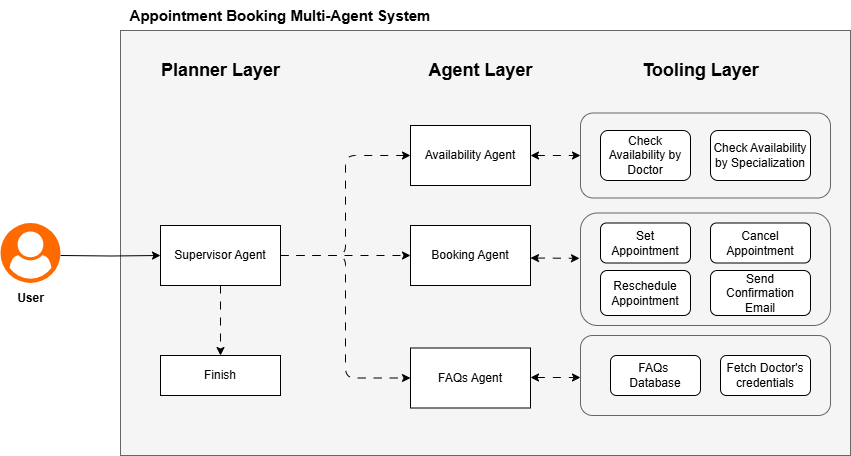
This topology is ideal for tasks where a central point of coordination can manage a set of independent or loosely coupled sub-tasks.
b) Multi-Layered "Org Chart" Topology
For highly complex problems, you can nest supervisor patterns to create a multi-layered hierarchy, much like a corporate org chart with a CEO, department heads, and team members.

The LangChain video you watched earlier also demonstrates how to build such a structure.
Hierarchical multi-agent systems with LangGraph
This next clip from the same video shows how to extend the basic pattern into a deeper hierarchy.
Now, watch the segment on building a more complex system from hierarchical supervisors. Note how a top-level supervisor doesn't manage workers directly but instead manages other supervisors (the math supervisor and weather supervisor), who in turn manage their own teams of specialist agents.
This layered approach allows you to model and solve extremely complex problems by composing teams of agents, where each team is responsible for a major sub-domain of the overall problem.
4. Designing in Your Tech Stack
These orchestration patterns are not just theoretical. They are first-class concepts in modern agentic frameworks, including the Vercel AI SDK that you will be using. The following resource from the creators of the AI SDK showcases patterns that map directly to the hub-and-spoke and orchestrator-worker models.
AI Agent Orchestration - Multi-Agent Coordination & Sub-Agent ...
This guide demonstrates several powerful orchestration patterns available for TypeScript developers using the Vercel AI SDK.
Please read the descriptions for the Sub-Agent Orchestrator and the Orchestrator-Worker Pattern. As you read, notice the terminology and concepts: a "hub-and-spoke architecture," a central coordinator that "delegates to specialists," and an orchestrator that "plans the work, assigns tasks, tracks progress, and synthesizes the final deliverables." These directly mirror the principles we've discussed.
This shows that the design principles you are learning are directly implementable with the tools you've chosen for your project.
5. Practical Design Exercise
Let's apply these concepts. Imagine your SaaS application needs to generate a comprehensive quarterly business report for a client. The request is simple: "Generate the Q2 report for Client X."
The final report must contain:
- User engagement metrics (e.g., daily active users, feature adoption rates).
- Subscription and revenue data (e.g., new MRR, churn, LTV).
- A qualitative summary of major themes from support tickets.
- A concluding executive summary synthesizing all points.
How would you design the agent topology to solve this?
Step 1: The Top-Level Orchestrator
- Agent:
QuarterlyReportOrchestrator - Responsibility: Receives the initial request. Its primary job is task decomposition. It knows that a quarterly report requires three types of data and a final synthesis step. It does not fetch any data itself.
Step 2: Sub-Task Delegation and Worker Agents
The orchestrator breaks the task down and delegates to specialized workers. This could be a flat hub-and-spoke model.
- Worker 1:
UserMetricsAgent- Specialty: Analytics data.
- Tools: Access to your analytics database (e.g.,
query_daily_active_users,query_feature_adoption).
- Worker 2:
BillingAgent- Specialty: Financial data.
- Tools: Access to your payment processor's API (e.g., Stripe) or internal billing database (
query_mrr,query_churn_rate).
- Worker 3:
SupportAnalysisAgent- Specialty: Qualitative text analysis.
- Tools: Access to support ticket data (e.g., Zendesk API) and a tool for topic modeling (
summarize_ticket_themes).
Step 3: Synthesis
After the workers return their structured data (e.g., JSON objects with the metrics), the orchestrator needs to synthesize it. It could delegate this to a final worker.
- Worker 4:
ReportWriterAgent- Specialty: Narrative generation.
- Responsibility: Receives the structured data from all other workers and the initial prompt. Its task is to write the full report, including the executive summary.
The Resulting Topology (Hub-and-Spoke):
User Request -> [QuarterlyReportOrchestrator]
                     |
         +-----------+-----------+
         |           |           |
    [UserMetrics] [Billing] [SupportAnalysis]
         |           |           |
         +-----------+-----------+
                     | (Aggregated Data)
              [ReportWriterAgent]
                     |
                Final Report
This design effectively separates concerns. Each worker has a narrow domain and specialized tools, making the system modular, testable, and easier to debug. The orchestrator focuses solely on project management, not execution.
Conclusion
You have now progressed from defining individual agent roles to designing the complete hierarchical structure that connects them. This ability to architect an agent topology is the cornerstone of building sophisticated, multi-agent systems.
Key Takeaways:
- The Supervisor-Worker pattern is a formal method for orchestrating specialized agents to solve complex problems.
- Hierarchical topologies range from simple hub-and-spoke models to complex, multi-layered "org charts," allowing you to match the architecture to the problem's complexity.
- The design process involves three key steps: Decomposition (breaking down the problem), Delegation (assigning tasks to specialists), and Synthesis (aggregating results).
- Modern frameworks like the Vercel AI SDK provide built-in support for implementing these orchestration patterns.
With this high-level design phase complete, we are ready to start building the foundational components. In the next module, we will get hands-on and move from design to implementation. Our first lesson will focus on defining a standardized schema for the tools that your worker agents will use to interact with the world.