Recommended resources
The freely available resources this lesson will direct you to.
- SENTENCES, FRAGMENTS, & RUN-ONS | English Lessonwww.youtube.com
- Sentence Fragments & How to Fix Them | How to Write Complete Sentences | English Writing Essentialswww.youtube.com
- Fragments and Run-ons – The Writing Centerwritingcenter.unc.edu
- 2.3 GRAMMAR: The Four Most Common Errors in ESOL Writing — and How to Fix Them – Synthesisopenoregon.pressbooks.pub
Hello! This course starts with the mechanics that make writing easy to follow. In this module, you will learn to check sentence structure, punctuation, capitalization, and other details that matter in professional drafts. Later, you will use those skills in articles, scripts, and other writing samples.
Today’s goal is to tell three things apart: a complete sentence, a fragment, and a run-on. This is a useful first editing skill because punctuation can make a group of words look finished even when it is not—and a long sentence can be perfectly sound. For now, focus on recognizing the boundaries. The next lesson will give you more practice correcting them.
What makes a sentence complete?
Consider “The writer replied.” It is short, but nothing essential is missing. The writer is the subject: who or what the sentence is about. Replied is the main verb: it tells us what the subject did. Together, they express a thought that can stand on its own. This is an independent clause.
A complete sentence ordinarily needs all three:
- A subject.
- A main verb.
- A thought that can stand on its own.
The third point does not mean that readers must know every detail. “The writer replied” does not say when or to whom, yet it is complete. It means the sentence does not leave us waiting for another clause to finish its grammatical idea.
Fragments and Run-ons – The Writing Center
Read this explanation from the UNC Writing Center to see why sentence length and end punctuation are unreliable tests of completeness.
In “The basics,” begin with the paragraph explaining that a capital letter and end punctuation do not, by themselves, create a complete sentence. Read the complete-sentence examples through the end of that section. Notice how “They waited” remains the main clause even as the author adds detail around it.
That last observation gives you a practical test: find the core statement. In “Before noon, the writer sent the revised draft to the client,” the core is “the writer sent the draft.” The opening phrase and other details add information; they do not have to stand alone.
There is one common exception to the visible-subject test. A command such as “Check the links.” is a complete sentence: its subject, you, is understood. This is why it helps to look for a complete statement rather than applying a word-count rule.
Fragments: something essential is missing
A fragment is a group of words presented as a sentence even though it cannot stand alone as one. It may be missing a subject, missing a main verb, or dependent on another clause to finish its thought.
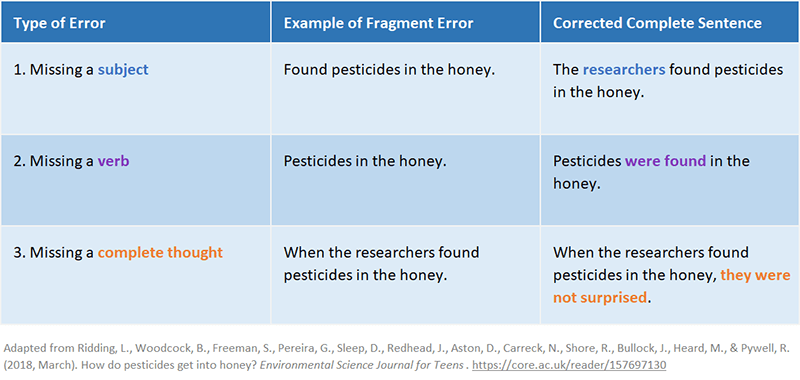
The first two kinds are often fairly visible. “Sent the revised draft.” has a main verb, but it does not say who sent it. “The revised draft on the desk.” names something but gives it no main verb: what about the draft? By contrast, “The revised draft is on the desk.” makes a complete statement. Is counts as a verb; a sentence does not need an action verb.
The trickier kind can contain both a subject and a verb:
Because the client requested changes.
Here, the client is the subject and requested is the verb. But because makes the clause dependent: because the client requested changes, what happened? If you add an independent clause, the whole sentence becomes complete: “The writer revised the opening because the client requested changes.”
Words such as because, if, when, and although often introduce dependent clauses. They are useful words, not errors. The problem arises when the dependent clause is left on its own with a period.
Sentence Fragments & How to Fix Them | How to Write Complete Sentences | English Writing Essentials
Watch “Sentence Fragments & How to Fix Them” from Sparkle English for examples of each fragment type, especially the less obvious dependent-clause fragment.
Watch three fragment types. As the examples change, keep asking which part is missing: a subject, a main verb, or an independent clause that completes the thought. The video also shows possible fixes; today, concentrate on recognizing why each original is incomplete.
One extra detail is worth watching for in your own drafts: an -ing word does not always supply the main verb. “The writer drafting the introduction.” is a fragment; drafting describes the writer here, but the statement lacks a complete main verb. “The writer is drafting the introduction.” is complete.
Fragments are not forbidden everywhere. A heading or short advertising line may deliberately omit sentence parts. But when you are writing ordinary explanatory prose for a reader or client, identify those fragments deliberately rather than letting them appear by accident.
Run-ons: complete thoughts without a sound boundary
A fragment does not contain enough to stand alone. A run-on presents the opposite boundary problem: it pushes two or more independent clauses together without properly separating or joining them.
Look at these two statements:
The writer finished the draft. The client requested a revision.
Each has its own subject, main verb, and complete thought. Now remove the boundary:
The writer finished the draft the client requested a revision.
This is a run-on, sometimes called a fused sentence. The issue is not its length. It is that one complete clause ends at draft, and another begins at the client, with no proper boundary between them.
A comma by itself does not solve the problem:
The writer finished the draft, the client requested a revision.
This is a comma splice—two independent clauses joined only by a comma. It is closely related to a fused run-on; both require a better boundary in standard professional prose. In the next lesson, you will work through the choices for making that boundary. For now, notice the difference between these forms and two sentences separated by a period.
SENTENCES, FRAGMENTS, & RUN-ONS | English Lesson
Watch the run-on explanation in Kevin Spaans’s “Sentences, Fragments, & Run-ons” to hear how two complete thoughts can create a sentence-boundary problem.
Watch run-on boundaries. Focus on locating where the first independent clause finishes and the second begins. Notice the warning that a comma alone cannot join two complete sentences.
Not every sentence containing two clauses is a run-on. “The writer finished the draft, and the client requested a revision.” joins two independent clauses with both a comma and and. “Because the client requested a revision, the writer changed the opening.” contains a dependent clause followed by an independent clause. Neither has the missing boundary shown in the run-on examples.
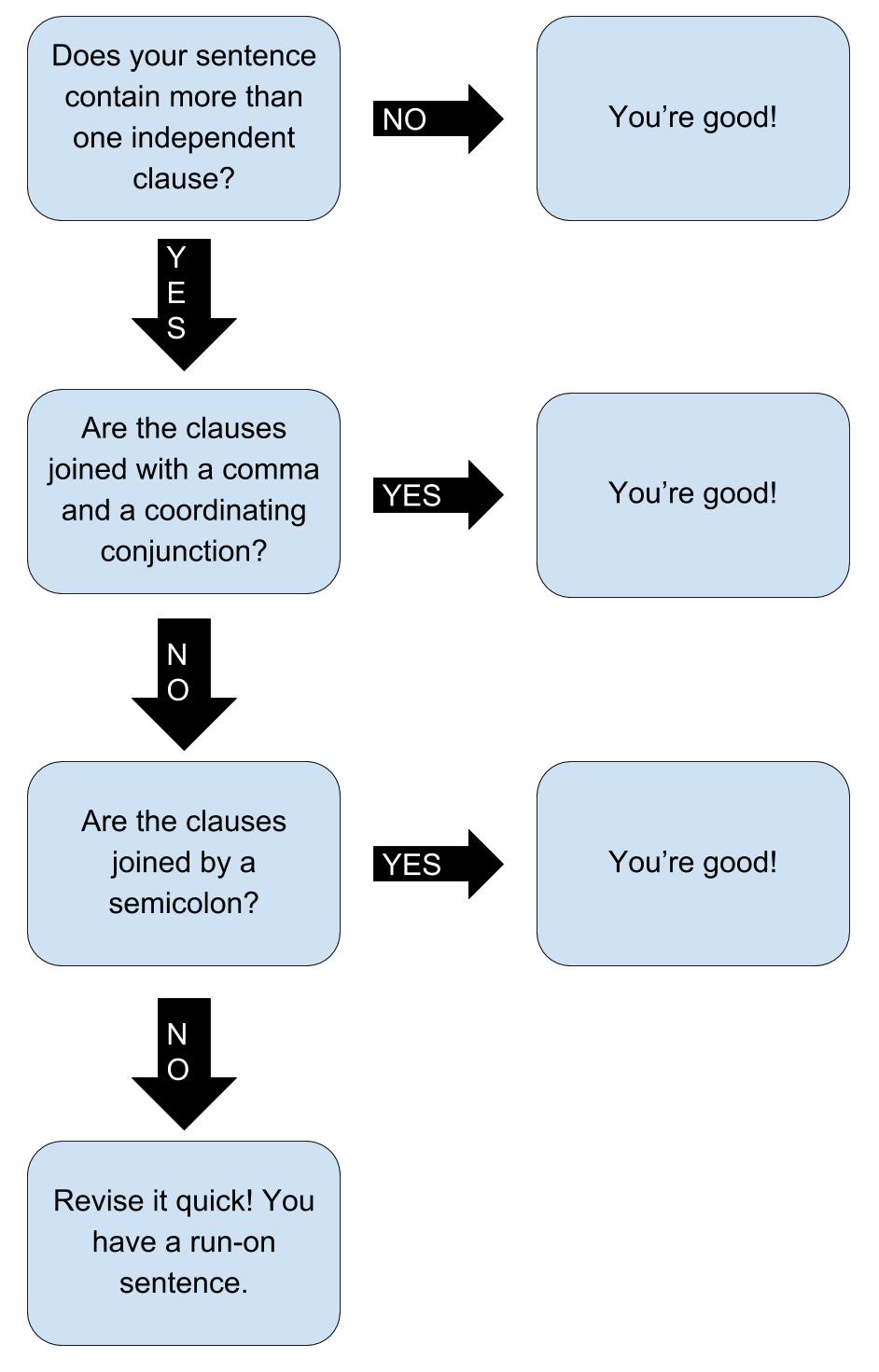
The chart is helpful once you have found more than one independent clause. It does not answer the earlier question, “Is this group of words a complete sentence at all?” Use the fragment test first when a clause seems unfinished. Also remember that a period can separate two clauses into two sentences; the chart focuses on ways to keep them within one sentence.
A reliable way to tell the three apart
When a passage feels awkward, do not decide by how long it looks or where the writer put a period. Read it clause by clause.
First, locate each possible subject and main verb. Then ask whether that clause could stand alone as a statement or command. Finally, if you find two independent clauses within what is written as one sentence, inspect the boundary between them.
Watch how that approach handles similar-looking lines:
- “After the client replied.” has a subject and verb, but after leaves the thought dependent. It is a fragment.
- “After the client replied, the writer revised the draft.” includes a dependent clause and an independent clause. It is a complete sentence.
- “The client replied the writer revised the draft.” contains two independent clauses with no proper boundary. It is a run-on.
- “The client replied, the writer revised the draft.” has the same two independent clauses joined only by a comma. It is a comma splice.
A long sentence provides a useful final check on the method: “When the client replied, the writer revised the opening, checked the examples, and sent the updated draft before noon.” It has several details and verbs, but the writer revised, checked, and sent forms the main statement; the opening when clause depends on it. Length alone does not make a run-on.
In professional writing, this distinction helps you diagnose the actual problem before you edit. If a thought is incomplete, look for what it depends on or what essential part is missing. If two complete thoughts collide, look at their boundary. Those are different jobs, even if both produce a sentence that feels wrong on first reading.
Takeaways
A complete sentence can stand on its own; it normally has a subject, a main verb, and a finished grammatical thought. A fragment cannot stand on its own, even if it has a capital letter and a period. A run-on contains independent clauses that have not been properly separated or joined; a comma splice uses a comma alone at that boundary.
The most useful habit is to identify clauses before judging punctuation. Next, you will use periods, commas, conjunctions, and semicolons to correct the boundaries you have learned to spot.