Recommended resources
The freely available resources this lesson will direct you to.
Hello! Last lesson, you learned to spot the difference between a fragment, a run-on, and a comma splice. The key was to find each clause and ask whether it could stand alone. Now you can use that diagnosis to edit: should you separate two complete thoughts, join them, or attach an unfinished thought to a complete one?
This matters when you revise an article or other piece of client-facing writing. A reader should be able to follow your ideas without stopping to work out where one sentence ends. In this lesson, you’ll make those boundaries clear with periods, commas, conjunctions, and semicolons.
Find the boundary before choosing punctuation
The three examples in this image look similar, but they need different repairs.
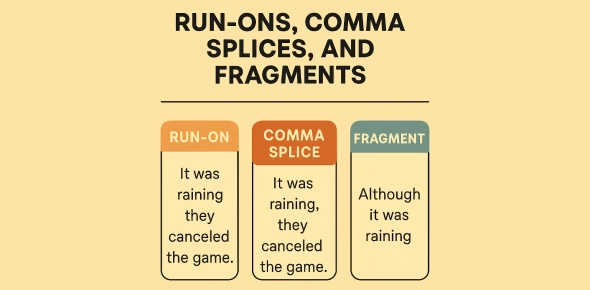
In “It was raining they canceled the game,” both It was raining and they canceled the game can stand alone. The missing boundary makes it a fused run-on. Adding only a comma—“It was raining, they canceled the game”—creates a comma splice. “Although it was raining” has a subject and verb, but although leaves us waiting for the main statement. It is a fragment.
That gives you an editing rule: first identify which clauses can stand alone; then decide how their meanings relate. Punctuation alone cannot tell you whether and, but, or so expresses what you intend.
Run-on Sentences and Comma Splices and How to Fix Them
Watch “Run-on Sentences and Comma Splices and How to Fix Them” from Writing Better for a compact demonstration of the main repairs.
Watch the explanation, beginning with the two independent clauses and continuing through the period, comma-splice, conjunction, and semicolon examples. Notice that the speaker checks whether each side can stand alone before changing the punctuation.
Three ways to handle two complete clauses
Suppose a draft contains this line:
The opening is clear the conclusion needs work.
The opening is clear is a complete statement. So is the conclusion needs work. You have three reliable ways to correct the boundary.
Use a period when each point deserves its own sentence.
The opening is clear. The conclusion needs work.
A period is often the simplest choice. It gives the reader a clean stop, especially when the two points will be discussed separately.
Use a comma plus a coordinating conjunction when you want to name the relationship.
The opening is clear, but the conclusion needs work.
But signals contrast. Other useful coordinating conjunctions include and for addition, or for an alternative, and so for a result:
The article includes a checklist, and readers can use it after reading.
The instructions are brief, so readers can find the next step quickly.
For two independent clauses, the dependable pattern in professional prose is complete clause, comma + coordinating conjunction, complete clause. The comma alone is not enough: “The opening is clear, the conclusion needs work” is still a comma splice. A connecting word also has to fit the meaning. So would suggest that a clear opening somehow caused the conclusion to need work, which is not the claim here.
Use a semicolon when the two complete statements are closely related and neither needs a conjunction.
The opening is clear; the conclusion needs work.
A semicolon is stronger than a comma but keeps the points together more closely than a period does. Put it between two independent clauses. Do not use it to attach an unfinished clause:
Incorrect: The conclusion needs work; because it repeats the introduction.
Correct: The conclusion needs work because it repeats the introduction.
You do not need a semicolon simply because a sentence seems long or formal. A period is usually a safe choice; choose a semicolon when keeping the related statements together helps the reader.
One useful caution: however does not work like but after a comma. “The opening is clear, however, the conclusion needs work” is a comma splice. Write “The opening is clear. However, the conclusion needs work” instead. You may also write “The opening is clear; however, the conclusion needs work.” The semicolon, not however, makes the boundary sound.
Attach an unfinished clause to a complete one
Periods and semicolons solve a problem involving two independent clauses. They do not turn a dependent clause into a complete sentence. Consider the fragment:
Because the steps are easy to follow.
Because tells the reader a reason is coming, but not what the reason explains. Supply a main statement and join the clauses:
Readers can try the method because the steps are easy to follow.
Because the steps are easy to follow, readers can try the method.
Both sentences are complete. When the because clause comes after the main statement, it usually needs no comma before it. When it comes first, place a comma after the dependent clause to mark where the main statement begins.
Combining Clauses to Avoid Comma Splices, Run-ons, and ...
Read this part of the George Mason University Writing Center’s guide to see how the position of a dependent clause affects its boundary.
In “Structuring Sentences with Dependent Clauses,” read OPTION 1 and OPTION 2, from the two arrangements through the explanation of fragments. Compare the example with because in the middle to the one that begins with Because. Focus on where the comma appears and why the dependent clause cannot be left as a separate sentence.
This also helps you repair the image’s fragment, “Although it was raining.” To keep although, add a main statement that makes sense with it: “Although it was raining, they played the game.” If your intended meaning is that the rain caused a cancellation, change the connecting word instead: “Because it was raining, they canceled the game.” A boundary edit should preserve—or deliberately clarify—the meaning, not just make the punctuation look correct.
Make a sentence-boundary pass
When proofreading a paragraph, treat sentence boundaries as a separate pass. Read slowly enough to notice where each subject and main verb begins a new clause. For every questionable boundary, use this sequence:
- Check each side. Can both parts stand alone, or does a word such as because or although make one part dependent?
- If both stand alone, choose the relationship. Use a period for separate statements, a comma with a fitting coordinating conjunction to state the relationship, or a semicolon for closely related statements.
- If one part is dependent, attach it to a main clause. Then check whether its position calls for a comma.
Watch that method at work in a short article note:
Before: The article explains a morning routine it also gives readers a checklist. Because the steps are easy to follow. The opening is clear, the ending needs a stronger takeaway.
A revised version could read:
After: The article explains a morning routine, and it gives readers a checklist. Because the steps are easy to follow, readers can try them today. The opening is clear; the ending needs a stronger takeaway.
The first repair uses comma + and to join two complete statements. The second gives the Because fragment a main clause and puts a comma after the opening dependent clause. The third replaces a comma splice with a semicolon between two related observations. Periods would also have worked for the first and third boundaries; the revision keeps each pair together.
Finally, do not add a boundary where there are not two clauses. “The writer outlined the article and checked its links” has one subject doing two things. It does not need a comma before and under the two-independent-clauses rule. Your goal is not to insert more punctuation; it is to mark the boundaries your sentences actually have.
Takeaways
To correct a sentence boundary, identify the clauses first. Two independent clauses can become separate sentences with a period, remain together with a semicolon, or be joined with a comma and an appropriate coordinating conjunction. A dependent clause needs an independent clause—not a semicolon or a period of its own. After the repair, reread for meaning: the best boundary makes both the grammar and the relationship between ideas clear.
Next, you’ll turn to American English capitalization in titles and prose.