Recommended resources
The freely available resources this lesson will direct you to.
Welcome back! In our last lesson, we implemented a cross-encoder re-ranking stage to improve the precision of our retrieval, ensuring the documents passed to the LLM are as relevant as possible. This optimization, along with others like query expansion, makes our RAG pipeline more sophisticated. But it also raises a crucial question for any engineer: "How do we prove these changes are actually improvements?"
Merely "eyeballing" a few example answers is not a scalable or reliable way to measure performance in a production system. This is where systematic evaluation comes in.
In this lesson, you will learn to evaluate the retrieval component of a RAG system using the core metrics of context precision and context recall. Mastering this skill is fundamental to metric-driven development, allowing you to objectively measure the impact of any change to your retrieval pipeline—be it a new chunking strategy, a different embedding model, or a re-ranking stage. This is a non-negotiable skill for a professional AI Engineer and a frequent topic in system design interviews.
Separating Retrieval from Generation
A RAG pipeline has two main stages, and a failure in one can be mistaken for a failure in the other:
- Retrieval: The process of finding and ranking relevant context documents from your knowledge base.
- Generation: The process where the LLM uses the retrieved context to synthesize a final answer.
A bad answer could be because the retriever failed to find the right information (a retrieval problem) or because the LLM misinterpreted or ignored the provided context (a generation problem). To debug effectively, we must evaluate them separately.
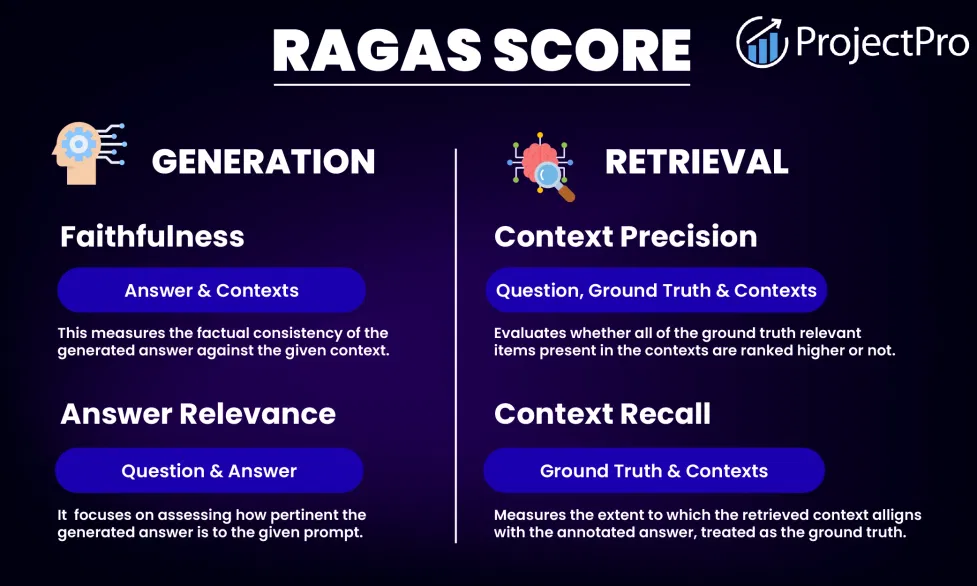
Today, we focus entirely on the retrieval stage. The core question we're trying to answer is: "How good is our system at finding the right evidence?"
The Prerequisite: A "Ground Truth" Test Set
To measure performance, we need a benchmark—a set of questions for which we already know the correct information. This is called a test set or evaluation dataset. At a minimum, each entry in this dataset needs:
question: The user's query (e.g., "What is the capital of France?").ground_truth_context: A list of the specific text chunks from your database that contain the necessary information to answer the question. This is our "source of truth" for what the retriever should find.ground_truth: The ideal, factually correct answer. This will be used later to evaluate the generation step.
Creating this dataset can be time-consuming, but it's essential. For getting started, frameworks like ragas can help you generate a synthetic test set automatically, which is a great way to bootstrap your evaluation process.
The following video demonstrates how to use ragas to generate such a test set and prepare for evaluation.
RAGAS - Evaluate your LangChain RAG Pipelines
This video from Coding Crash Courses provides a practical walkthrough of using the Ragas framework. Watch this first segment to understand how a test dataset is generated.
Focus on the section that shows creating a test set. Notice how it takes raw documents and uses an LLM to generate question/context/ground-truth triplets. This is the data we need to perform our evaluation.
The Core Retrieval Metrics: Precision and Recall
With our test set in hand, we can now measure the performance of our retriever using two classic information retrieval metrics: Context Precision and Context Recall.
The following diagram from the ragas framework shows how these metrics relate the Query, the retrieved Context, and the Ground Truth Answer.
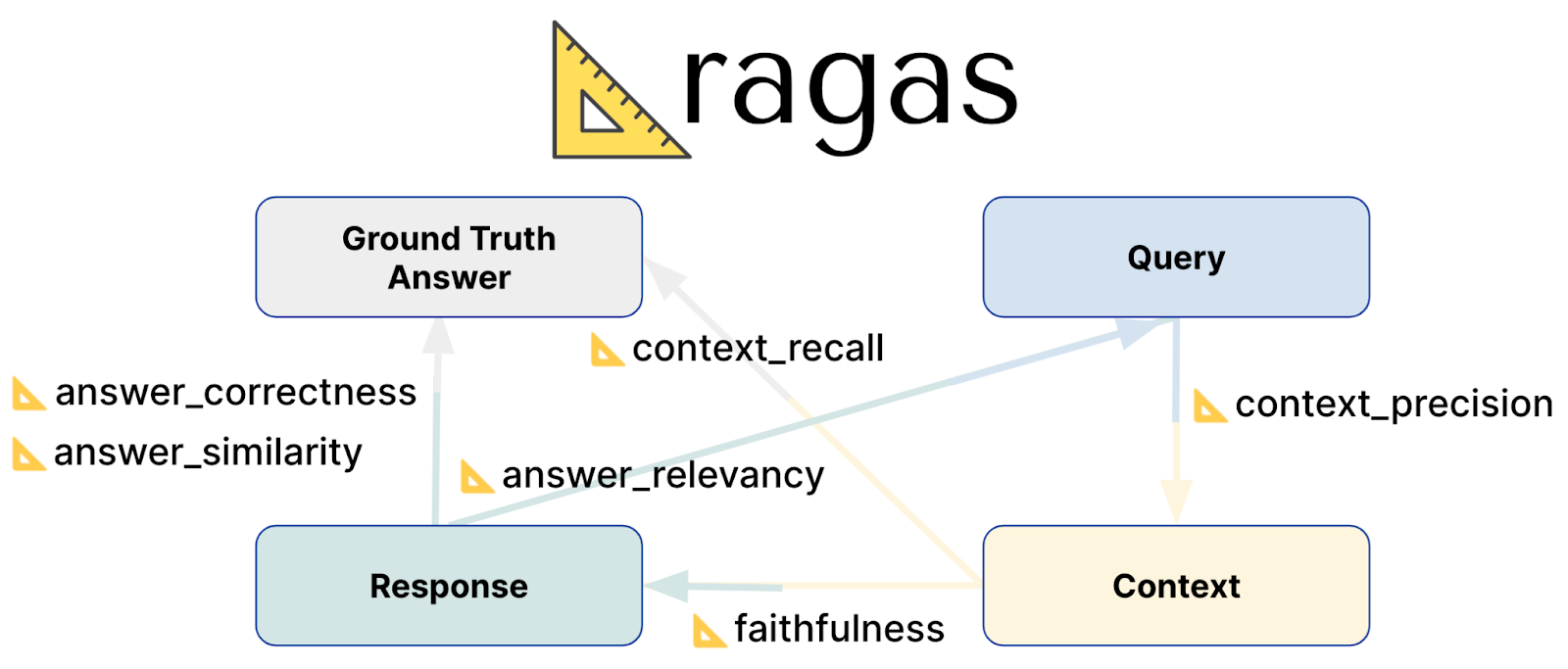
To understand these metrics intuitively, it's helpful to think in terms of True Positives, False Positives, and False Negatives. The video below gives an excellent conceptual breakdown.
AI Agent Evaluation with RAGAS
In this video, James Briggs explains the core concepts behind retrieval evaluation.
Watch the segment from retrieval metrics. Pay close attention to the explanation of actual vs. predicted conditions (positive/negative), which forms the basis for defining true positives, false positives, and false negatives. This will clarify the formulas for recall and precision that follow.
Now, let's dive into the definitions and why each metric is important.
RAG Evaluation Metrics Explained: A Complete Guide with ...
This guide provides clear, practical explanations of the core RAG metrics. We'll read the sections on our two key retrieval metrics.
First, read section 1. Context Precision. Focus on the definition and formula. This metric answers the question: "Of the documents we retrieved, how many were actually useful?" It's a measure of signal vs. noise. Next, read section 2. Context Recall. Study the definition and visual example. This metric answers: "Of all the information we should have found, how much did we actually retrieve?" It's a measure of completeness. Pay special attention to the Precision vs Recall Trade-off graphic. As an engineer, you'll constantly be balancing these two. For example, retrieving more documents (k) might increase your recall (you're less likely to miss something) but could decrease your precision (you're more likely to include junk).
From Theory to Code: Evaluating with ragas
Now let's apply these concepts. The ragas library makes it straightforward to run these evaluations. The general process is:
- Prepare a test set with
questionandground_truth_contextcolumns. - For each
question, run your RAG pipeline's retrieval step to get the list ofretrieved_contexts. - Combine these into a single dataset.
- Call the
ragas.evaluatefunction, specifying thecontext_precisionandcontext_recallmetrics.
Here's a conceptual Python script showing how you would set this up. It assumes you have a retriever object (like the one we've built in previous lessons) and an evaluation dataset.
from datasets import Dataset
from ragas import evaluate
from ragas.metrics import context_precision, context_recall


# 1. Assume you have your evaluation dataset loaded
# This would typically come from a file or a synthetic generator
eval_data = {
    'question': [
        "What is the difference between recursive and fixed-size chunking?",


        # ... more questions
    ],
    'ground_truth_context': [
        ["Fixed-size chunking involves splitting text into chunks of a specific character length...", "RecursiveCharacterTextSplitter tries to keep paragraphs, sentences, and words whole..."],


        # ... more ground truth contexts
    ]
}
eval_dataset = Dataset.from_dict(eval_data)


# 2. Run your retriever for each question to get the retrieved contexts
# Your retriever is the function/object from your RAG pipeline
# (e.g., the one that queries ChromaDB and uses the re-ranker)
retrieved_contexts = []
for question in eval_dataset["question"]:


    # This is your actual RAG system's retrieval function
    docs = your_retriever_function(question, k=5)
    retrieved_contexts.append([doc.page_content for doc in docs])


# 3. Add the results to the dataset
eval_dataset = eval_dataset.add_column('contexts', retrieved_contexts)


# 4. Run the evaluation
result = evaluate(
    dataset=eval_dataset,
    metrics=[
        context_precision,
        context_recall,
    ],
)


# The 'result' object will contain the scores
print(result)


# Expected output might look like:
# {'context_precision': 0.85, 'context_recall': 0.90}
This workflow provides a repeatable, objective way to benchmark your retriever's performance.
Interpreting Scores and Driving Improvements
Getting a score is just the first step. The real value comes from using those scores to diagnose problems and guide improvements. This is a critical skill you'll be expected to demonstrate in an AI engineering role.
Top Interview Questions on RAG for Data Science and AI Engineer ...
This article frames RAG evaluation from the perspective of an interview, which is perfect for your goals. It provides a structured way to think about debugging.
Read the section that answers the question "How would you evaluate a RAG system...", stopping after the discussion of retrieval precision. Notice how the first step is always to measure retrieval recall and precision before even looking at the generated answer. This isolates the problem.
Here’s a practical troubleshooting guide based on your retrieval scores:
-
If
context_precisionis low:- Symptom: Your retriever is returning a lot of irrelevant "noise" alongside the correct documents. This wastes context space and can confuse the LLM.
- Potential Solutions:
- Add/Tune a Re-ranker: This is the most direct solution. A cross-encoder is specifically designed to improve precision. (We did this last lesson!)
- Improve the Embedding Model: Your model might not be capturing the semantic nuances of your domain. Consider fine-tuning it or switching to a domain-specific model.
- Optimize Chunking: If your chunks are too large, they may contain mixed topics, causing them to be retrieved for irrelevant queries. Try smaller chunk sizes.
- Implement Query Rewriting: Use an LLM to transform the user's raw query into a more precise search query for the vector database.
-
If
context_recallis low:- Symptom: Your retriever is failing to find all the necessary pieces of information. The final answer will likely be incomplete or incorrect.
- Potential Solutions:
- Increase
k: Retrieve more documents in the initial search (e.g., retrieve 20 instead of 10) to increase the chance of capturing all relevant chunks. This is often a trade-off with precision. - Use Hybrid Search: Combine dense (vector) search with sparse (keyword) search like BM25. This helps find documents that match exact terms, which vector search can sometimes miss.
- Implement Query Expansion: Use an LLM to break a complex question into multiple sub-questions, run a retrieval for each, and combine the results.
- Increase
Conclusion
You now have a robust framework for evaluating and improving the most critical part of your RAG system: the retriever. By moving from subjective spot-checking to metric-driven development, you are operating like a true AI Engineer.
Key Takeaways:
- Isolate and Evaluate: Always evaluate the retrieval and generation components of your RAG system separately to effectively diagnose issues.
- Precision vs. Recall: These two metrics provide a comprehensive view of your retriever's performance.
Context Precisionmeasures noise, whileContext Recallmeasures completeness. - Ground Truth is Key: Systematic evaluation is impossible without a well-defined test set containing questions and their corresponding ground truth contexts.
- Use Tools: Frameworks like
ragasautomate the calculation of these metrics, letting you focus on interpreting the results and improving your system. - Scores Guide Action: Low precision or recall scores are not just numbers; they are signposts pointing you toward specific, actionable solutions like re-ranking, query expansion, or hybrid search.
In our next lesson, we will shift our focus to the other side of the pipeline. Now that we have a method for ensuring our retrieved context is high-quality, we'll learn how to evaluate the LLM's generated answer using metrics like faithfulness and answer relevance.