Recommended resources
The freely available resources this lesson will direct you to.
Welcome back! In the last lesson, we focused on evaluating the retrieval stage of our RAG pipeline. By using context_precision and context_recall, we established a systematic way to ensure that the information we pass to our Language Model is as relevant and complete as possible. This is a crucial first step, as a great generator can't salvage poor-quality context.
Now that we have a process to verify our retriever is doing its job, we must turn our attention to the second major component: the generator. Even with perfect context, the LLM can still produce a subpar answer. In this lesson, we will complete our RAG evaluation framework by learning to evaluate the generation component using the core metrics of faithfulness and answer relevance.
Mastering these metrics allows you to pinpoint whether a bad response is due to the LLM hallucinating, ignoring the context, or simply failing to answer the user's question directly. For an AI Engineer, this ability to diagnose and fix issues at every stage of the pipeline is essential for building trustworthy and effective production systems.
Why Evaluate the Generator?
The generator's job is to synthesize a coherent answer from the user's question and the retrieved context. However, this process can fail in several ways, even if the retrieved context is perfect.
RAG Evaluation Metrics: Assessing Answer Relevancy ...
This article from Confident AI neatly outlines why both retrieval and generation can fail.
Focus on the second half of the section "Ways In Which Your RAG Pipeline Can Fail". The bullet points under "generator can still fail" highlight the exact problems we aim to detect with generation metrics.
As the article points out, the LLM might ignore key information, focus on the wrong details, or even disregard the context entirely in favor of its own internal knowledge. To systematically detect these issues, we rely on two key metrics: Faithfulness and Answer Relevance.

Faithfulness: Is the Answer Grounded in Facts?
Faithfulness measures the factual consistency of the generated answer against the provided context. In simple terms, it answers the question: "Does the answer stick to the context?" A low faithfulness score is a strong indicator of hallucination, where the model invents information that wasn't in the source documents. This is arguably the most critical metric for building user trust.
RAG Evaluation Metrics Explained: A Complete Guide with ...
This guide provides an excellent, in-depth look at the Faithfulness metric.
Read section 4. Faithfulness, paying close attention to the "What is it?" and "Visual Representation" parts. The claim verification table is a perfect illustration of how this metric works. Then, study the "Faithfulness Calculation Process" diagram to understand the step-by-step logic.
The core idea behind calculating faithfulness is to treat the LLM's output like a set of claims that need to be fact-checked against the retrieved context. The process is:
- Decompose: Break down the generated answer into individual factual statements or claims.
- Verify: For each claim, check if it is directly supported by the information present in the
retrieval_context. - Score: The faithfulness score is the ratio of supported claims to the total number of claims.
(
\text{Faithfulness} = \frac{\text{Number of Supported Claims}}{\text{Total Number of Claims}}
)
A score of 1.0 means every part of the answer is backed by the context, while a score less than 1.0 indicates some degree of hallucination.
Answer Relevance: Does the Answer Help the User?
While faithfulness ensures the answer is factually correct based on the context, it doesn't guarantee the answer is actually useful. An answer can be 100% faithful but completely miss the point of the user's question.
Answer Relevance measures how well the generated answer addresses the user's original question. It answers: "Is the answer on-topic and helpful?"
RAGAS: How to Evaluate a RAG Application Like a Pro for Beginners
This short video from Mervin Praison provides a concise explanation of faithfulness and a related metric, answer correctness, which is conceptually similar to answer relevance when a ground truth is available.
First, watch the clear explanation of faithfulness. Then, watch the segment on answer correctness, which compares the generated answer to the ground truth. Answer relevance is similar but compares the generated answer back to the original question.
The calculation for answer relevance is clever. It typically involves using an LLM to work backward:
- Generate Questions: Given the generated answer, an LLM is prompted to create a few questions that this answer would be perfect for.
- Compare: The semantic similarity between these newly generated questions and the user's original question is calculated.
- Score: The average similarity score becomes the answer relevance score. A high score means the answer is a good fit for the original question.
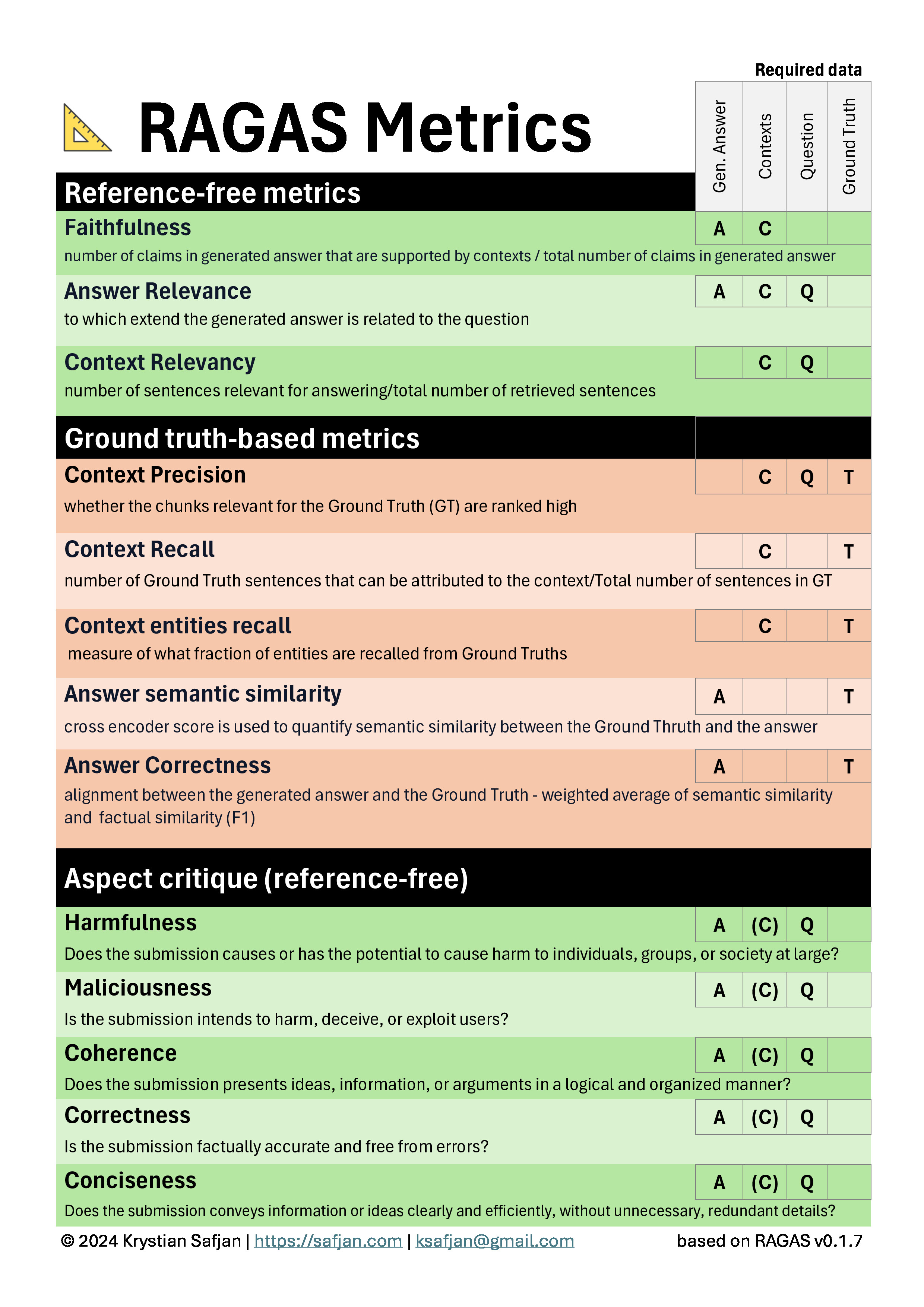
These two metrics, Faithfulness and Answer Relevance, are considered "reference-free" in the sense that they don't require a pre-written ground_truth answer to be calculated. They only need the question, the retrieved contexts, and the generated answer.
From Theory to Code: "LLM as a Judge"
Under the hood, libraries like ragas and deepeval implement these metrics using a powerful pattern known as "LLM as a Judge." Instead of complex algorithms, they use another powerful LLM (like GPT-4) with a carefully crafted prompt to perform the evaluation.
The following video provides an excellent walkthrough of how you would build these evaluation functions from scratch, which is exactly what frameworks like ragas do for you. Since you're focused on building production systems, understanding this underlying mechanism is incredibly valuable.
Mastering LLM Chatbots And RAG Evaluation Crash Course
This crash course by Krish Naik dives deep into chatbot and RAG evaluation. We'll focus on the sections where he builds custom evaluators for a RAG application.
First, watch the segment on Answer Relevance. He defines a custom evaluator from Relevance vs. Response/Input. Notice how the prompt asks the LLM to grade whether the "student answer" (the RAG output) is concise and relevant to the question. Next, see how Faithfulness (termed "Groundness" here) is implemented. Watch the segment from Groundness: Response vs. Docs. The prompt instructs the LLM to check if the answer is based only on the provided facts ("student does not contain hallucinated information"). Finally, watch how all these custom evaluators are brought together to run a full evaluation from Run the Evaluation. This shows the complete workflow, which is what ragas.evaluate() automates.
As you saw, the logic is encapsulated in functions that take the input (question), output (generated answer), and retrieval_context as arguments and return a score. This "LLM as a Judge" approach is powerful because it can evaluate nuanced aspects of language that are hard to capture with traditional metrics.
Interpreting Scores and Driving Improvements
Just like with retrieval metrics, the scores for faithfulness and answer relevance are not just for reporting; they are diagnostic tools that guide engineering decisions.
RAG Evaluation Metrics Explained: A Complete Guide with ...
We'll return to this guide to read its excellent troubleshooting section.
Find the "Debugging Guide" table and read the last two sections: the troubleshooting guide for Low Faithfulness and Low Answer Relevancy. This connects the metric scores directly to actionable solutions.
Here's a summary of how to react to low scores:
-
If
faithfulnessis low:- Symptom: Your answers contain made-up facts. The LLM is hallucinating.
- Potential Solutions:
- Strengthen the Prompt: Make your instructions more explicit. Add phrases like: "Answer the question based only on the provided context. If the information is not in the context, say 'I don't know'."
- Use a Different Model: Some models are more prone to hallucination than others. A smaller, more "obedient" model might be better than a larger, more "creative" one for some RAG tasks.
- Implement Citations: Force the model to cite which part of the context supports each part of its answer. This makes it harder for the model to invent facts.
-
If
answer_relevancyis low:- Symptom: The answer is factually correct but off-topic.
- Potential Solutions:
- Check Retrieval First: Low answer relevance is often a symptom of poor retrieval (
context_precision). If the context is full of irrelevant noise, the LLM can get distracted. Always fix your retriever first. - Improve Prompt Engineering: You can add instructions to the prompt to keep the model focused, such as "Your answer must directly address the user's question."
- Context Filtering: Before passing all retrieved chunks to the LLM, you could implement a filtering step to remove any chunks that seem less relevant to the original question.
- Check Retrieval First: Low answer relevance is often a symptom of poor retrieval (
Conclusion
Congratulations! You now have a complete, two-part framework for evaluating a RAG system. By measuring the retriever with context_precision and context_recall, and the generator with faithfulness and answer_relevance, you can move beyond anecdotal testing and adopt a true metric-driven development process. This is a critical skill that separates hobbyists from professional AI Engineers.
Key Takeaways:
- Generator evaluation is crucial: Even with perfect context, the LLM can fail by hallucinating (
faithfulness) or providing irrelevant answers (answer_relevance). - Faithfulness fights hallucination: It measures if the generated answer is factually grounded in the retrieved context.
- Answer relevance ensures utility: It measures if the answer actually helps the user by addressing their specific question.
- "LLM as a Judge" is the core pattern: Modern evaluation frameworks use a powerful LLM with specific prompts to score these nuanced metrics.
- Scores are diagnostic: Use low scores in faithfulness or relevance to guide specific improvements in your prompt engineering, model selection, or overall RAG logic.
In the next module, we'll take a significant step forward. We'll move beyond systems that just answer questions and start building autonomous AI agents that can reason and take actions in the world. Our first topic will be the foundational ReAct (Reasoning and Acting) pattern, which forms the basis for many modern agentic workflows.