Recommended resources
The freely available resources this lesson will direct you to.
Introduction
In our last lesson, we explored a crucial divide in libertarian thought by contrasting Robert Nozick's rights-based philosophy with F.A. Hayek's consequentialist approach. We saw that one can argue for liberty based on inviolable moral rules (deontology) or based on which system produces the best outcomes for society. This brings us to Murray Rothbard, a towering figure in 20th-century libertarianism who represents the most consistent and radical application of the rights-based tradition.
This lesson delves into Rothbard's powerful case for anarcho-capitalism. While Nozick used rights to justify a minimal "night-watchman" state, Rothbard argued that if you take individual rights seriously, you must reject the state entirely. We will follow his logic from its Lockean roots to its anarchist conclusion, and then examine the unique arguments he and his followers developed to prove that these rights are not just appealing, but are undeniable axioms of human reason.
From Natural Rights to Anarchism
Like John Locke and Robert Nozick, Rothbard's entire system begins with the principle of self-ownership. Every individual is the absolute owner of their own body. From this, he derives the right to property through homesteading: mixing one's labor with previously unowned resources.
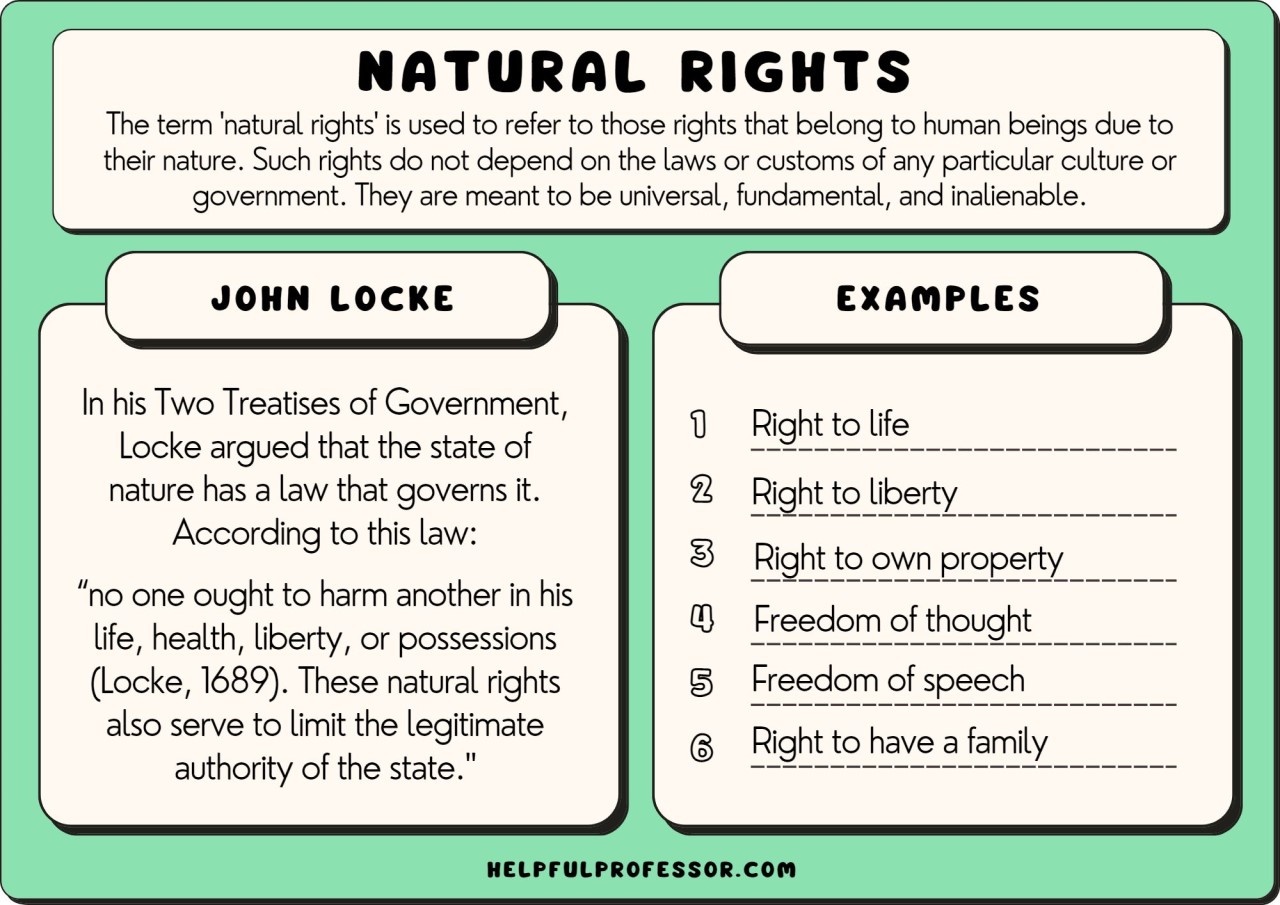
Rothbard argues that all human rights are, in essence, property rights. For example, the right to "free speech" is simply a consequence of your property right in your own body (your vocal cords) and your right to be on your own land (or on someone else's with their permission). The right to privacy is your right to control access to your own property.
Book Review: The Ethics of Liberty, By Murray N. Rothbard
This book review by Walter Block, a prominent student of Rothbard, clearly explains the idea that all human rights can be understood as property rights.
Please read the section that begins with this paragraph and continue through to the end of the chapter where it discusses boycotts. Focus on how Rothbard applies property rights to resolve complex issues like free speech, libel, and privacy.
This exclusive focus on property rights leads Rothbard to a startling conclusion that separates him from Locke and Nozick. If self-ownership and property rights are absolute, then any infringement upon them is an act of aggression. The single, universal moral law is the Non-Aggression Principle (NAP): no one may initiate force or fraud against another person's body or property.
What, then, is the state? Rothbard defines the state as an organization that does two things private citizens are not allowed to do:
- It acquires its revenue through coercion (taxation), which he considers theft.
- It asserts a compulsory monopoly on the use of defensive force and ultimate decision-making (law and courts) over a given territory.
For Rothbard, this makes the state an inherently criminal institution.
Book Review: The Ethics of Liberty, By Murray N. Rothbard
This review powerfully summarizes Rothbard's argument against the state.
Read the short section titled Section III. The key sentence to focus on is: "If it would be a crime for one individual to 'tax' i.e., rob another, then, too, it should be considered lawbreaking for a group of people with fancy nomenclature to do so as well."
This strict adherence to the Non-Aggression Principle is the core of Rothbard's natural-rights case for anarcho-capitalism—a society where all services, including law and protection, are provided by competing firms on a free market.

Proving the Axioms: Why Self-Ownership?
At this point, you might be asking: why should we accept self-ownership and the Non-Aggression Principle as our starting point? Rothbard and his intellectual heir, Hans-Hermann Hoppe, were not content to simply assert these as "self-evident." They developed rigorous arguments to demonstrate that these principles are undeniable truths.
1. Proof by Elimination
Rothbard’s first line of argument is to show that any alternative to self-ownership is either nonsensical or monstrous. He presents three logical possibilities for the ownership of any person, let's call her Alice:
- Universal and equal self-ownership: Alice owns herself.
- Partial ownership by a specific class: A group of people, the "elite," owns another group, the "commoners." Alice is owned by Bob.
- Universal co-ownership: Everyone owns an equal share of everyone else. Alice and Bob have an equal share in both Alice and Bob.
He argues that we must reject alternatives 2 and 3.
Murray N. Rothbard and the Ethics of Liberty - HansHoppe.com
In this essay, Hans-Hermann Hoppe lays out Rothbard's "proof by elimination" for the principle of self-ownership.
Please read the four paragraphs starting from the beginning of this section. As you read, make sure you understand why Rothbard rejects both the "slavery" option and the "universal co-ownership" option.
To summarize the argument:
- The second alternative (class rule or slavery) cannot be a universal ethic. It creates two separate sets of rules for two classes of people, which means it isn't a "law" at all, just a rule of power.
- The third alternative (universal co-ownership) sounds egalitarian but is a practical impossibility. If everyone owned a tiny fraction of you, you could not perform any action—not even breathing or thinking—without first securing the permission of every other person on Earth. It would lead to the instant extinction of the human race.
Therefore, Rothbard concludes, we are left with only the first option: the principle of self-ownership.
2. The Ultimate Proof: Argumentation Ethics
While the proof by elimination is powerful, Rothbardians believe they have an even stronger, more fundamental proof known as argumentation ethics. The core idea is that the very act of engaging in a rational argument presupposes certain norms, and one of those norms is the Non-Aggression Principle. To argue against the NAP is to fall into a "performative contradiction"—your actions (engaging in a peaceful, rational debate) contradict the content of your argument (that violence is a legitimate way to resolve disputes).
This is a complex idea, so we'll watch a video that breaks it down step-by-step. The video first dismisses other ethical systems before building the case for the NAP based on the logic of argumentation itself.
Anarcho-Capitalism: The Solution To Law
This video from the channel LiquidZulu provides a detailed explanation of argumentation ethics. It begins by critiquing other systems, then presents the core proof.
First, watch the critique of utilitarianism, Rawlsianism, and other ethical theories (critiques of other ethics). This provides context for why a different kind of justification is sought. Next, see how the video introduces the NAP as a consent-based ethic built on homesteading (NAP introduction). Finally, and most importantly, watch the explanation of the proof from argumentation (the core proof). Pay close attention to the idea that argumentation is a conflict-free activity and that to argue against the NAP, you must first accept the norms of peaceful persuasion inherent in arguing.
The argument, in essence, is this:
- Argumentation is a process of peaceful persuasion, not violent coercion.
- By choosing to argue, you have demonstrated that you believe disputes should be resolved through reason, not force.
- This act presupposes a respect for the other person's bodily autonomy and control over their own mind—their self-ownership. After all, you are trying to convince them, not attack them.
- Therefore, the right to be free from aggression (the NAP) is a precondition for the very process of argumentation. You cannot argue that the NAP is false without using the very norms of the NAP to make your case, thus contradicting yourself.
This makes the NAP, in the view of Rothbard and Hoppe, an undeniable axiom of rational discourse.
Conclusion
In this lesson, we have traced the arc of Murray Rothbard's natural-rights argument for anarcho-capitalism. You have seen how he begins with the familiar Lockean principles of self-ownership and homesteading but takes them to a conclusion that even most libertarians find radical.
Here are the essential takeaways:
- Radical Lockeanism: Rothbard's system is built on an absolute commitment to self-ownership and the Non-Aggression Principle (NAP). All legitimate rights are derived from property rights.
- The State as a Criminal Organization: By applying the NAP universally, Rothbard concludes that the state, which relies on coercive taxation and a monopoly on force, is an inherently illegitimate institution.
- Proof by Elimination: Rothbard argues that the only workable and universalizable ethical principle is self-ownership, as the alternatives—slavery or universal co-ownership—are logically and practically defunct.
- Argumentation Ethics: This is the ultimate justification, holding that the NAP is a non-negotiable presupposition of rational argument itself. To argue against it is to fall into a performative contradiction.
We have now seen why Rothbard believes a stateless society is the only just society. But this raises an obvious and pressing question: how would such a society actually function? In our next lesson, we will explore Rothbard's answer, examining his vision for how law, order, and protection could be provided by the free market.