Recommended resources
The freely available resources this lesson will direct you to.
Hello! In our last lesson, we saw how the arrow operator (->) is crucial for working with pointers to structs, especially when we get a pointer back from a function like malloc(). That brief preview of dynamic allocation sets the stage perfectly for today's topic.
Today, we will take a step back from writing code to understand a fundamental concept that governs how your C programs use memory. We're going to explore the two primary memory regions where your data lives: the stack and the heap. Understanding the "what," "why," and "how" of these two regions is essential for writing efficient, correct, and bug-free C programs, especially when dealing with dynamic memory.
By the end of this lesson, you will be able to explain the critical differences between stack and heap memory allocation, preparing you to master malloc() and free() in our upcoming lessons.
1. A Program's Memory Blueprint
When your C program starts running, the operating system gives it a block of virtual memory. This memory isn't just one big empty space; it's organized into several distinct segments, each with a specific purpose. While there are a few segments (like for your compiled code and global variables), the two most important for our discussion are the stack and the heap.
A common way to visualize this layout is to imagine the stack at one end of the memory block and the heap at the other, growing towards each other.
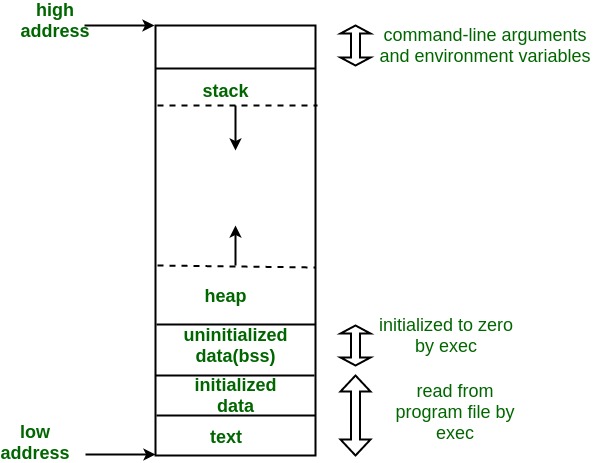
Let's now dive into the details of each of these dynamic regions.
2. The Stack: Fast and Automatic
The stack is a highly organized region of memory that manages data for function calls. Think of it like a stack of plates: you can only add a new plate to the top, and you can only remove the top plate. This is known as a Last-In, First-Out (LIFO) principle.
Every time a function is called, a block of memory called a stack frame is "pushed" onto the top of the stack. This frame holds all the data for that function's execution:
- Its local variables (
int x;,char name[20];, etc.). - The arguments passed to the function.
- A "return address" telling the CPU where to go back to when the function finishes.
When the function returns, its entire stack frame is "popped" off the stack, and the memory becomes available for the next function call.
The following video provides an excellent visualization of this process.
Pointers and dynamic memory - stack vs heap
Watch this segment from "Pointers and dynamic memory - stack vs heap" by mycodeschool to see how the call stack works in action.
Pay close attention to the animation from function calls. Observe how a new stack frame is created for main, then for SquareOfSum, and then for Square. Notice how each frame is destroyed as the function it belongs to returns.
The key characteristics of the stack are:
- Speed: Allocation and deallocation are incredibly fast. "Allocating" memory is just a single CPU instruction to move the stack pointer.
- Automatic Management: The compiler and CPU manage all this for you. You never have to manually free memory from the stack.
- Scoped Lifetime: Data on the stack only exists for the duration of the function call. As soon as the function returns, the data is gone.
3. The Limitations of the Stack
The stack's speed and simplicity come with some significant limitations, which is why we need an alternative.
Limitation 1: Fixed Size
The stack is a finite resource, typically only a few megabytes. If you have too many nested function calls (a common symptom of a runaway recursive function), you will run out of stack space. This is a classic error called a stack overflow.
Limitation 2: Scoped Lifetime
Because stack variables disappear when a function returns, you can never safely return a pointer to a local variable. The memory address you return will point to garbage, or worse, memory that has been reused by another function. This leads to unpredictable behavior and crashes.
The following reading provides a fantastic code example of this exact bug.
The Stack, The Heap, and Dynamic Memory Allocation - CS 3410 ...
This section from Cornell's CS 3410 notes clearly explains the most critical limitation of the stack.
Read the section titled "Limitations of the Stack." Focus on the buggy create_exp function. Understand why returning a pointer to the local array dest is a serious error. The diagram showing the print_floats frame overwriting the create_exp frame is a perfect illustration of the problem.
Limitation 3: Compile-Time Size
The compiler must know the exact size of all stack variables before the program runs. This means you cannot create a local array whose size is based on user input or some other runtime calculation.
4. The Heap: Flexible and Dynamic
When the stack's limitations are too restrictive, we turn to the heap. The heap is a large, less organized pool of memory that you, the programmer, can control directly. It's often called the "free store."
Here’s how it works:
- Your program asks the memory manager for a certain number of bytes. In C, this is done with
malloc()(memory allocation). - The memory manager finds a suitable free block on the heap, marks it as used, and returns a pointer to the start of that block.
- Your program can use this memory for as long as it needs.
- Crucially, when you are finished with the memory, you must explicitly tell the memory manager to release it. In C, this is done with
free().
The following video introduces the heap as the solution to the stack's problems.
Pointers and dynamic memory - stack vs heap
Let's continue with the mycodeschool video to see how the heap addresses the stack's limitations.
First, watch the discussion on stack limitations which recaps the issues we just discussed. Then, watch the introduction to the heap as the flexible alternative.
A very important point made in the video is to not confuse the heap memory region with the heap data structure. The stack memory region is, in fact, implemented as a stack data structure. However, the heap memory region is just a generic pool of memory; it has no relation to the heap data structure (which you will learn about later as a way to implement priority queues).
5. Stack vs. Heap: A Direct Comparison
The stack and heap are designed as complementary opposites. Choosing the right one for your data is a fundamental skill in C programming.
The video below gives a quick and clear summary of their differences.
What are Stack and Heap Memory?
Watch this short video from Boot.dev, "What are Stack and Heap Memory?", for a concise comparison.
Watch from the beginning to the end. It effectively summarizes the speed, complexity, and use cases for both stack and heap, reinforcing what we've learned.
Let's consolidate everything into a single table.
| Aspect | Stack | Heap |
|---|---|---|
| Speed | Very fast allocation and deallocation (a single instruction). | Slower; malloc() must search for a free block of memory. |
| Management | Automatic by the compiler. | Manual by the programmer (malloc() and free()). |
| Lifetime | Scoped to the function call; destroyed when the function returns. | Persists until free() is called, regardless of scope. |
| Size | Small and fixed (a few MB). | Large, limited only by available virtual memory (gigabytes). |
| Data Sizing | Size must be known at compile time. | Size can be determined at runtime. |
| Common Use | Local variables, function arguments, short-lived data. | Large data structures, arrays of unknown size, data that must persist across functions. |
| Potential Errors | Stack Overflow (too many function calls). | Memory Leaks (forgetting to free()) & Dangling Pointers (using memory after it has been freed). |
Your Turn: A Thought Exercise
Before you learn the syntax for malloc() and free(), let's practice thinking about where data should live. For each scenario below, decide if the primary data structure should be allocated on the stack or the heap, and briefly explain why.
- You are writing a function that takes two
doubles, adds them, and returns the result. Where are the two input arguments and the local variable holding their sum stored? - You are writing a program to manage a music library. The program needs to load all song titles from a file into an array. You won't know how many songs there are until you read the file. Where should you store this array of song titles?
- Inside a
mainfunction, you declare astructvariable likePoint p1;to represent a single 2D coordinate. Where is the memory forp1located?
Take a moment to think through your answers before revealing the solutions below.
Click to see solutions
- Stack. The function's arguments and its local variables are small, have a fixed size known at compile time, and are only needed while the function is running. The stack is the perfect, high-performance choice for this.
- Heap. Because the number of songs is unknown at compile time, you cannot declare a stack-based array of the correct size. You must wait until the program is running, count the songs (or read them one by one), and then dynamically allocate a sufficiently large block of memory from the heap.
- Stack. Just like any other local variable (
int i;), astructvariable declared directly inside a function (Point p1;) has its memory allocated within that function's stack frame.
Conclusion
Today, you've learned one of the most important conceptual distinctions in systems programming: the difference between the stack and the heap.
Key Takeaways:
- The Stack is for fast, temporary, automatically-managed data whose size is known at compile time. Its lifetime is tied to function scope.
- The Heap is for larger, long-lived, dynamically-sized data that you must manage manually.
- Understanding this trade-off between speed/convenience (Stack) and size/flexibility (Heap) is key to making good design decisions in C.
- Incorrectly managing these memory regions leads to critical bugs like stack overflows and memory leaks.
Preview of the Next Lesson:
Now that you understand the "why" and "where" of dynamic memory, you're ready to learn the "how." In our next lesson, we will get our hands dirty with the malloc() and free() functions, learning the syntax to allocate and deallocate memory on the heap.