Recommended resources
The freely available resources this lesson will direct you to.
- AI Agent Evaluation with RAGASwww.youtube.com
- Find the BEST RAG Strategy with Domain Specific Evalswww.youtube.com
- RAGVue: Diagnostic Evaluation That Tells You Why Your RAG System Fails - AI Research Analysis | Tekta.ai | Tekta.aiwww.tekta.ai
- GitHub - Arnav-Ajay/rag-failure-modes: Failure-first analysis of retrieval-augmented and agentic systems, focused on isolating and attributing failures across retrieval, planning, execution, memory, and policy layers.github.com
Hello! Welcome back.
In our last lesson, we identified the common failure modes of RAG systems—irrelevant retrieval, missing context, and conflicting sources—and introduced high-level metrics like Context Precision and Context Recall to detect them. This gave us the "what." Today, we focus on the "how" and the "why."
The goal of this lesson is to equip you with the techniques to diagnose retrieval quality issues by analyzing chunk relevance and context completeness. We'll move beyond looking at a single aggregate score and learn how to perform a forensic analysis of your retrieval system's output. For your objective of delivering agentic AI as a service, this ability to conduct a rigorous, evidence-based diagnosis is what separates a prototype from a production-grade, reliable solution that clients will trust.
1. The Anatomy of Retrieval Metrics
In the previous lesson, we introduced Context Precision and Context Recall as key performance indicators for your retriever. To use them for diagnosis, we need to understand their formal definitions and what they reveal about your system's behavior.
Given your background, you'll be familiar with the concepts of true positives, false positives, true negatives, and false negatives from classification tasks. These concepts are directly applicable here, but at the level of retrieved text chunks.
AI Agent Evaluation with RAGAS
This video from James Briggs provides an excellent, technically precise explanation of how RAGAS calculates its core retrieval metrics. It grounds the concepts of Context Precision and Context Recall in a clear mathematical framework.
Watch the segment from 03:24 to 15:45. Pay close attention to: The required data format for evaluation, including the concept of a ground_truth context (05:20). The definitions of Context Recall and Context Precision based on true positives, false positives, and false negatives (09:40 - 15:45).
As the video explains, these metrics give us a powerful starting point for our investigation:
-
Context Recall: Measures the retriever's ability to find all the necessary information. It is calculated as:where TP are the relevant chunks you retrieved, and FN are the relevant chunks you failed to retrieve. A low
Context Recallscore signals a problem of missing context. Your diagnostic task is to identify the False Negatives—the crucial pieces of information left behind in the vector database. -
Context Precision: Measures the signal-to-noise ratio of the retrieved context. It is calculated as:where FP are the irrelevant chunks you retrieved. A low
Context Precisionscore signals a problem of irrelevant retrieval. Your diagnostic task is to analyze the False Positives—the noise that is polluting your context window and potentially misleading the generator.
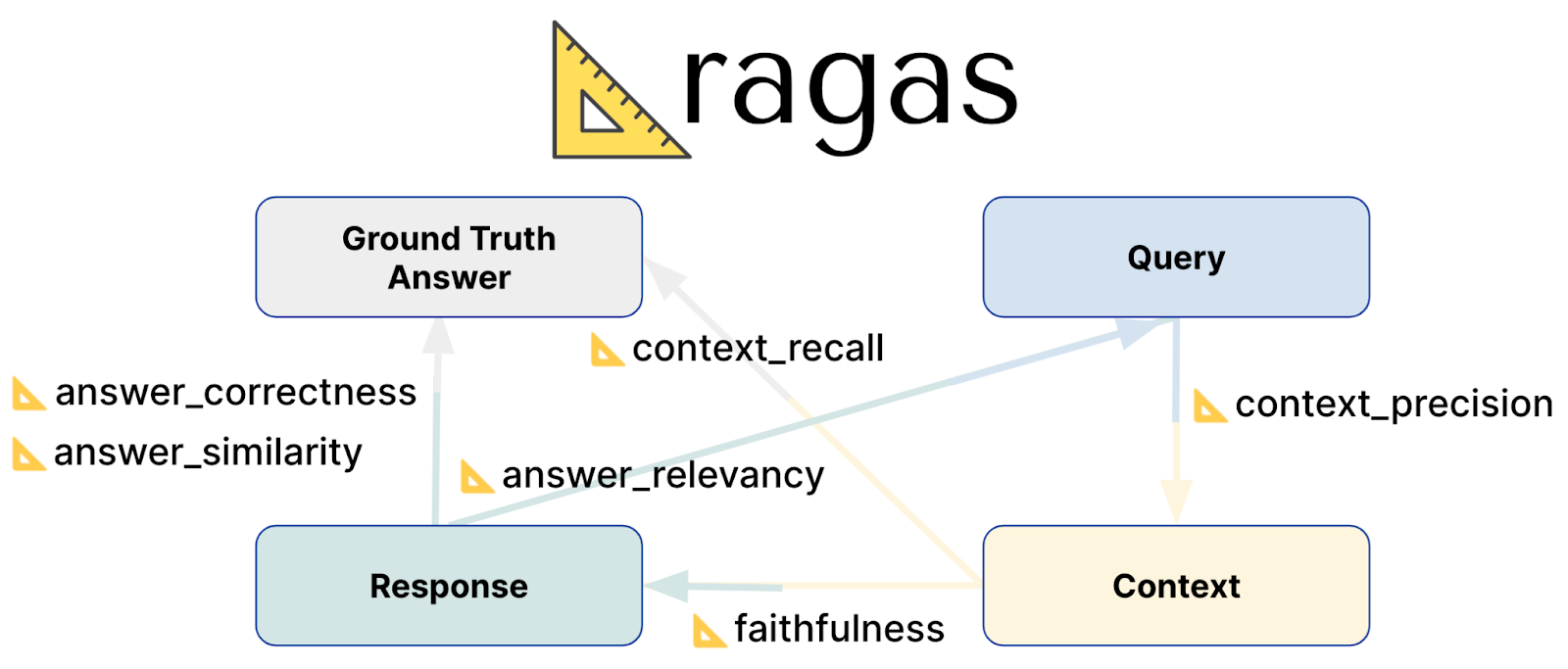
The key takeaway is that a score is not an answer; it's a pointer. It tells you where to look. A low recall score of 0.7 means 30% of the necessary information is missing. Your job is to find it and understand why your retriever missed it.
2. Decomposing Failure: Chunking vs. Retrieval
Imagine your Context Precision is low. You've retrieved a lot of irrelevant text. Is this because your embedding model is failing to find the right chunks, or is it because your chunking strategy is flawed, forcing the retriever to pull in large, noisy chunks that are only partially relevant?
To diagnose this, we need more nuanced metrics that can help us decouple these two potential causes.
Find the BEST RAG Strategy with Domain Specific Evals
This video from Adam Lucek, based on research from Chroma DB, introduces a sophisticated evaluation framework that helps us answer this very question. It presents metrics that evaluate the chunking strategy almost independently of the retrieval step.
Watch the first part of the video, from 00:00 to 13:18. Focus on the definitions of these four key metrics: Recall (token-level): Measures what fraction of the relevant text is captured. Precision (token-level): Measures how much of the retrieved text is actually relevant. Precision Omega: Measures the theoretical best possible precision for a given chunking strategy, assuming perfect recall. This is a critical metric for our diagnostic purposes. Intersection over Union (IOU): A single metric that balances precision and recall.
The introduction of Precision Omega is a significant step forward in our diagnostic capability. It answers the question: "If my retriever was perfect and fetched every chunk containing even a tiny piece of relevant information, how much irrelevant noise would I be forced to include because of my chunking strategy?"
Here’s how you can use this in your analysis:
- If
Precisionis low butPrecision Omegais high: This suggests your chunking strategy is sound. The chunks themselves are well-defined and not overly noisy. The problem likely lies in your retrieval or embedding model, which is failing to select the correct, clean chunks. Your next step would be to experiment with different embedding models or a reranker. - If both
PrecisionandPrecision Omegaare low: This points to a fundamental problem with your chunking strategy. The chunks are inherently too large or poorly defined, containing excessive irrelevant information. Even a perfect retriever would be forced to pull in noise. Your next step should be to revisit your chunking strategy (as we discussed in Lesson 6.4), perhaps using smaller chunks or a more context-aware chunking method.
This level of analysis allows you to make targeted, evidence-based decisions about which part of the system architecture to modify, saving significant time and effort.
3. The Need for Granular, Explainable Diagnostics
While metrics give us quantitative signals, a truly robust diagnostic process requires qualitative, human-readable explanations. Why was a chunk considered irrelevant? Is the context complete enough to answer all parts of a multi-faceted question?
This is where more advanced evaluation frameworks like RAGVue come into play, which are designed to produce debugging reports, not just scores.
RAGVue: Diagnostic Evaluation That Tells You Why Your RAG System Fails
The research analysis for RAGVue provides a glimpse into the next generation of RAG evaluation. It focuses on turning opaque scores into actionable diagnostics, which is exactly what's needed for professional-grade systems.
Please read these three sections from the analysis: The Evaluation Gap: Focus on the problem of 'Component confusion' where retrieval failures are blended with generation errors. RAGVue's Seven Diagnostic Metrics: Specifically, read the descriptions for the 'Retrieval dimension' metrics: Retrieval Relevance and Retrieval Coverage. The debugging workflow: Note the systematic, retrieval-first approach to debugging.
RAGVue introduces two crucial concepts for diagnosing retrieval quality:
-
Retrieval Relevance (Per-Chunk Scoring): Instead of one aggregate precision score, this approach scores each retrieved chunk individually. This allows you to immediately pinpoint the specific noisy chunks (the False Positives) that are dragging down your performance. Your analysis then becomes: "Chunks 1 and 2 are highly relevant (score > 0.9), but chunk 3 is noise (score < 0.3). Why did the retriever fetch chunk 3?"
-
Retrieval Coverage (Context Completeness): This metric directly addresses the problem of context completeness. It assesses whether the retrieved set of chunks, as a whole, contains enough information to address all sub-parts of the user's query.
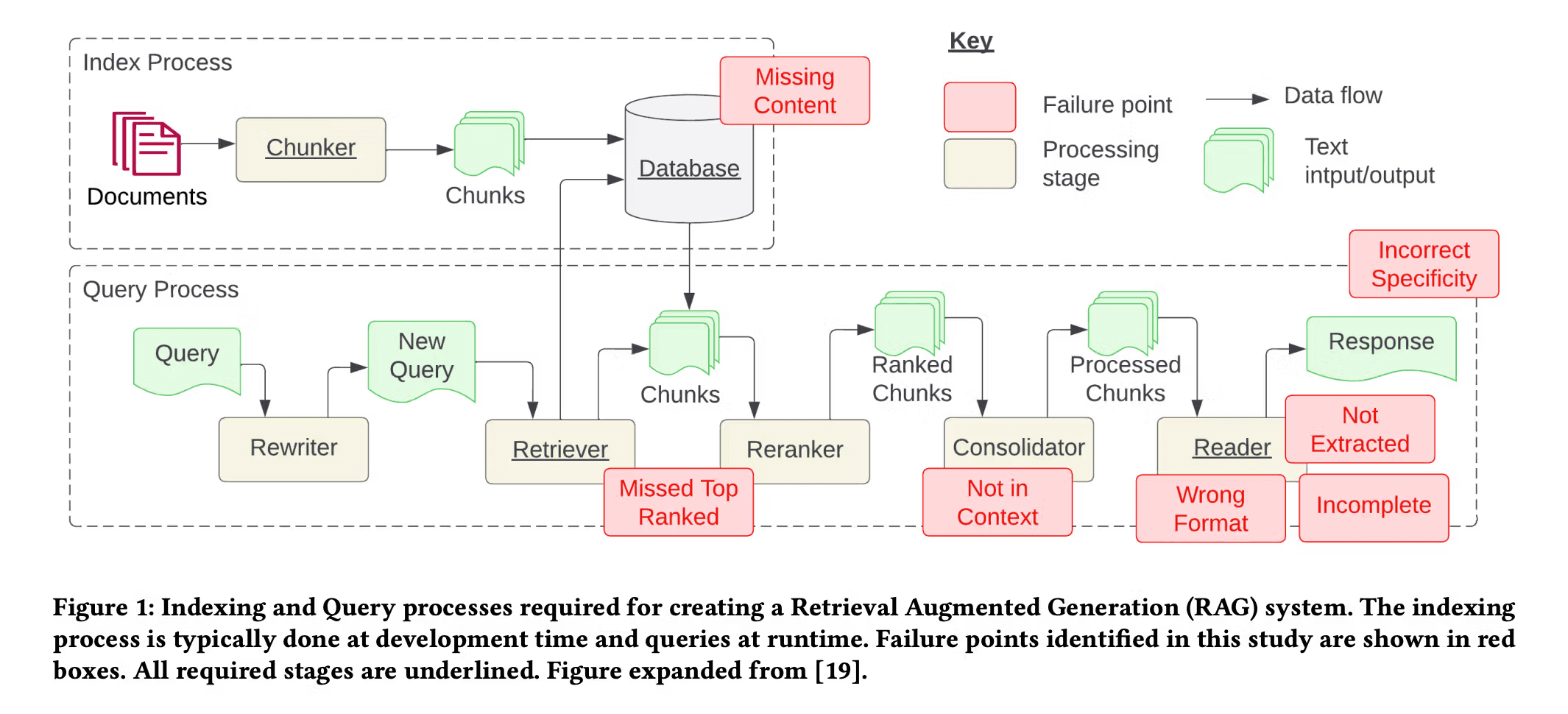
A failure in Retrieval Coverage means that even with 100% relevant chunks (Context Precision = 1.0), the final answer will be incomplete. This is a classic "missing context" failure that can be invisible to precision metrics alone. This is the kind of subtle but critical failure you need to catch before deploying a system for a client. The "failure-first" mindset, which we discussed in the last lesson (from the rag-failure-modes repository), emphasizes isolating exactly these kinds of layer-specific issues.
4. Creating Domain-Specific Evaluation Sets
Finally, to diagnose issues for a client's specific use case, you need to evaluate the system on their data. General-purpose benchmarks are useful for comparing models, but they won't tell you how your system will perform on a corpus of internal legal documents or engineering specs.
A key skill in delivering AI as a service is the ability to create a high-quality, domain-specific evaluation dataset.
Find the BEST RAG Strategy with Domain Specific Evals
Let's return to Adam Lucek's video. It contains an excellent section that demonstrates a practical, LLM-assisted workflow for generating a synthetic evaluation dataset from any custom document set.
Watch the section from 23:22 to 26:57. Focus on the high-level process: using an LLM to generate question/reference pairs from your documents and then filtering them for quality. This is a powerful technique for bootstrapping your evaluation process.
This synthetic generation process allows you to create the necessary (question, ground_truth_context) pairs that are the foundation of a rigorous diagnostic evaluation. By running your RAG system against this custom-tailored dataset, you can calculate the precise, domain-specific metrics we've discussed today. This provides concrete evidence of system performance and allows you to diagnose failures directly relevant to your client's needs.
Conclusion
In this lesson, we moved from high-level failure detection to granular, evidence-based diagnosis. You now have a systematic framework for investigating retrieval quality issues, which is a cornerstone of building reliable and trustworthy agentic systems.
Key Takeaways:
- Metrics as Pointers: Use
Context PrecisionandContext Recallnot as final scores, but as pointers to investigate specific failure instances (False Positives and False Negatives). - Decouple Failure Causes: Employ more advanced metrics like
Precision Omegato distinguish between a retrieval problem and a fundamental chunking problem. This is a key system design diagnostic. - Analyze for Completeness: Go beyond chunk relevance and analyze for context completeness using concepts like
Retrieval Coverage. A set of individually relevant chunks may still be insufficient to answer the user's query fully. - Build Domain-Specific Proof: For client engagements, the ability to synthetically generate a domain-specific evaluation dataset is a critical skill. It allows you to test, diagnose, and ultimately prove the value of your system on the data that matters.
In our next module, we will shift our focus from the agent's "knowledge" component (RAG) to its "action" component. The next lesson will cover how to define tools (APIs, functions, data lookups) an agent can invoke and write clear tool descriptions that guide correct usage. This is the first step in building agents that can not only answer questions but also perform tasks in the digital world.