Recommended resources
The freely available resources this lesson will direct you to.
Hello! Welcome to your next lesson on Spanish real estate investment.
In our recent lessons, we have built a detailed understanding of the Spanish tax system as it applies to real estate. We've calculated capital gains tax (ganancia patrimonial), plusvalía municipal, and even analyzed the tax impact for non-resident owners.
Today, we will synthesize this knowledge to address a crucial part of the investment lifecycle: the exit. An exit strategy is not just about selling; it's about selling smart. A well-planned exit can significantly increase your net return by legally minimizing your tax burden. Our goal is to evaluate tax-efficient exit strategies for Spanish real estate investments, covering scenarios for both personally-held properties and those owned through a company.
1. Exit Strategies for Personally-Held Property
For an individual investor, selling a property triggers two main taxes we've discussed: IRPF on the capital gain and the local plusvalía municipal. While calculating these is straightforward, the Spanish tax code provides several powerful exemptions (exenciones) that can reduce or even eliminate the IRPF liability. Knowing these is the key to a tax-efficient exit.
Cuidado al VENDER tu CASA | Estos son los IMPUESTOS a Pagar
To begin, let's watch an excellent summary from the YouTube channel 'Pau Antó' that details the main IRPF exemptions available when selling a property.
Watch the segment from 00:31 to 04:50. Pay close attention to the three main exemptions discussed: reinvestment in a primary residence, the age-related exemption, and the lifetime annuity option.
Let's break down these three key strategies:
A. Reinvestment in a New Primary Residence (Vivienda Habitual)
This is the most well-known tax exemption. If you sell your primary residence (vivienda habitual) and reinvest the full proceeds into a new primary residence, the capital gain is completely exempt from IRPF.
Key Conditions:
- The property sold must have been your primary residence for at least three years.
- The reinvestment into a new primary residence must occur within a two-year window (either before or after the sale).
- You must inhabit the new property within 12 months of purchase and live there for at least three years.
This is a powerful strategy for homeowners, but it is less applicable for an investor selling a rental property, as the exemption applies only to the vivienda habitual.
B. Exemption for Individuals Over 65
The tax law provides significant benefits for older individuals:
-
Sale of Primary Residence: If you are over 65 years old (or in a situation of severe dependency), the capital gain from the sale of your vivienda habitual is fully exempt from IRPF. No reinvestment is required.
-
Sale of Other Assets (e.g., Rental Property): If you are over 65 and sell a property that is not your primary residence, you can still achieve a full exemption by constituting a lifetime annuity (renta vitalicia) with the proceeds.
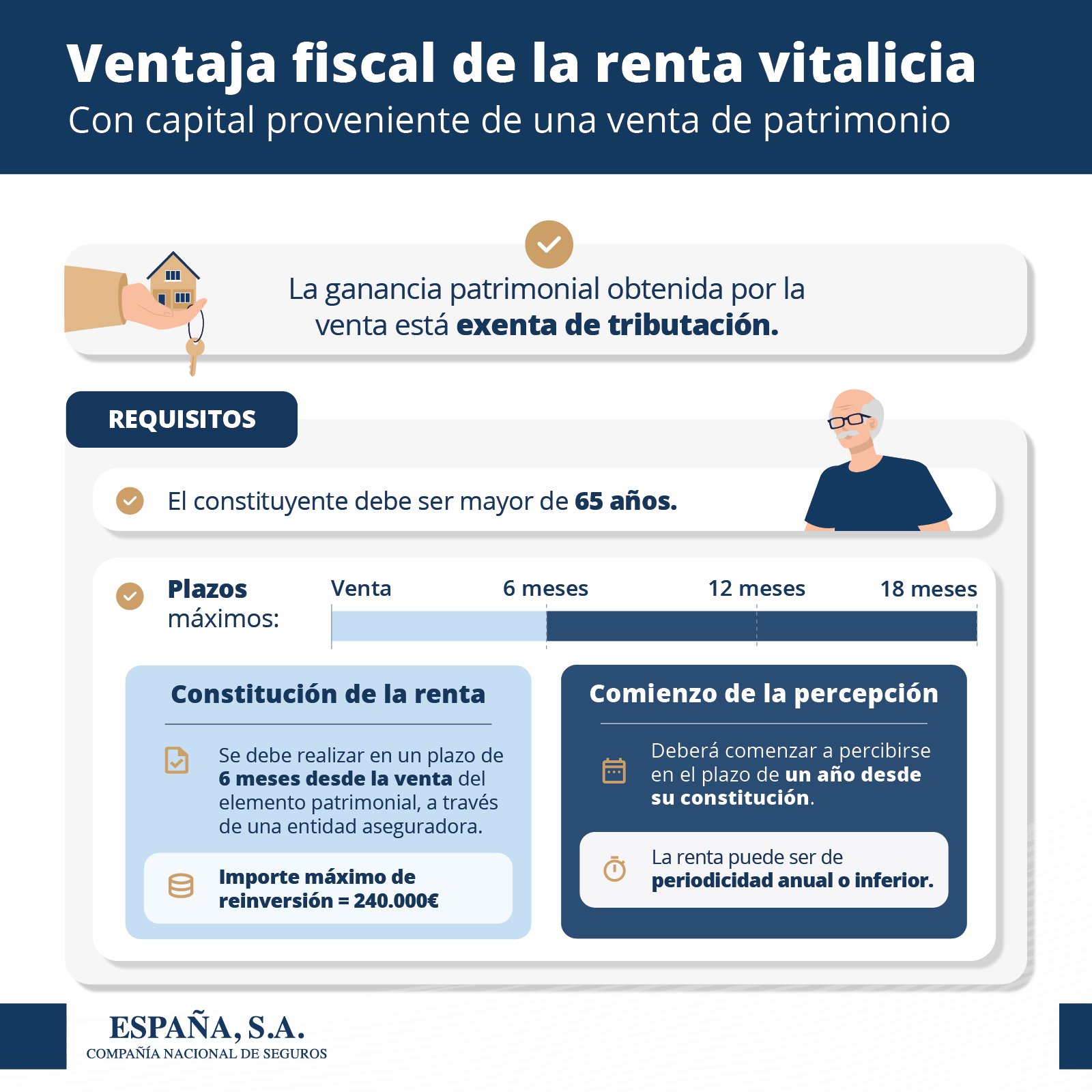
This strategy allows you to convert a capital asset into a tax-free stream of income for life, making it a powerful tool for retirement planning.
C. The Inherited Property Strategy
When a property is inherited, the heir pays Inheritance Tax (Impuesto de Sucesiones y Donaciones), and the property's acquisition value for future tax purposes is reset to the value declared in the inheritance deed. This creates a strategic opportunity.
Cuidado al VENDER tu CASA | Estos son los IMPUESTOS a Pagar
Let's return to the 'Pau Antó' video, which explains a 'trick' related to valuing inherited properties.
Watch the segment from 08:45 to 10:47. Focus on how the value declared during inheritance directly impacts the future IRPF capital gain calculation upon sale.
As the video explains, in regions where inheritance tax is low (like Madrid or Andalusia for direct heirs), it can be highly advantageous to declare a higher, market-rate value for the property during the inheritance process. While this might slightly increase the inheritance tax, it significantly "steps up" the acquisition cost basis.
Example:
- A property was bought for €100,000.
- It is inherited when its market value is €250,000.
- Scenario 1 (Low Valuation): You declare €180,000 in the inheritance. You sell it later for €260,000. Your taxable gain is €260k - €180k = €80,000.
- Scenario 2 (High Valuation): You declare €250,000 in the inheritance. You sell it later for €260,000. Your taxable gain is €260k - €250k = €10,000.
By paying a bit more in inheritance tax (if any), you can save a substantial amount on the future IRPF capital gains tax. This is a critical planning point if you intend to sell an inherited property.
2. Exit Strategies for Property Held in a Sociedad Limitada (SL)
When a property is held within a company, the exit strategies become more complex. You are no longer just selling a piece of real estate; you are dealing with a corporate structure. There are three primary paths for the owner to "cash out."
To understand these paths, we'll first explore a crucial legal and tax distinction: selling the company's assets versus selling the company's shares.
Compraventa de Activos o Participaciones de una Sociedad
The law firm Giménez-Salinas provides a clear article explaining the two main ways to structure a company sale: an 'asset deal' versus a 'share deal'.
Please read the sections 'Objeto de la compraventa: ¿Sociedad o Activos?', 'Partes en la transacción...', and most importantly, 'Fiscalidad de la compraventa'. Focus on understanding the fundamental difference between the two transaction types and their very different tax consequences for the seller.
Based on this reading, let's analyze the three exit routes.
Path A: The Company Sells the Property ("Asset Deal")
In this scenario, your SL sells the property to a buyer.
- Tax Event 1 (Company Level): The SL calculates the capital gain (Sale Price - Net Book Value) and pays 25% Corporate Tax (Impuesto de Sociedades) on this profit.
- The cash proceeds are now inside the company. To get them out, you (the shareholder) must distribute them.
- Tax Event 2 (Shareholder Level): You receive the money as a dividend, which is taxed as savings income in your IRPF (19%-28%).
This path results in double taxation and is generally the least tax-efficient for the seller.
Path B: The Shareholder Sells the Company Shares ("Share Deal")
Here, you don't sell the property itself. You sell the shares of the SL that owns the property.
- Tax Event 1 (Shareholder Level): You calculate your capital gain (Sale Price of shares - Acquisition cost of shares) and pay tax once in your IRPF (19%-28%).
The company and its assets (the property) are transferred to the new owner. This structure avoids the double taxation of the Asset Deal, making it far more tax-efficient for the seller. However, the buyer inherits the entire company, including any hidden liabilities, so they will perform extensive due diligence.
Path C: Company Dissolution and Liquidation
What if you can't find a buyer for the asset or the shares, and you simply want to unwind the company and take personal ownership of the property? This is done through dissolution and liquidation. Unfortunately, this is typically the most tax-costly option.
Fiscalidad en la disolución y liquidación de empresas con inmuebles
The article 'Fiscalidad en la disolución y liquidación de empresas con inmuebles' from Briones Abogados breaks down the multiple layers of tax that are triggered in this process.
Read the sections listing the five taxes that come into play: Impuesto sobre Sociedades, ITP-AJD, Plusvalías municipales, IRPF, and the associated costs. This will give you a clear picture of the significant tax burden of this exit strategy.
As the article details, liquidation triggers four separate tax events simultaneously:
- Corporate Tax (IS): The company is taxed at 25% on the deemed capital gain (Market Value - Net Book Value), as if it had sold the property.
- Transfer Tax (ITP-AJD): You, the shareholder, pay a 1% "Operaciones Societarias" tax on the market value of the property you receive.
- Plusvalía Municipal: The company must pay this tax to the local council upon transferring the property to you.
- Personal Income Tax (IRPF): You, the shareholder, have a capital gain, calculated as the difference between the market value of the property received and the original cost of your shares. This is taxed at 19%-28%.
Test your understanding!
An investor owns 100% of an SL. The only asset is a property.
- Property Net Book Value (in SL): €150,000
- Investor's Share Acquisition Cost: €50,000
- Property Market Value / Sale Price: €300,000
From a tax-efficiency perspective for the seller, rank the three SL exit strategies (Asset Deal, Share Deal, Dissolution) from best to worst. You don't need to calculate the exact tax, but explain the reasoning based on the number and type of taxation events.
Show answer
- Best: Share Deal. The investor sells the shares for €300,000. The gain is (€300,000 - €50,000) = €250,000, which is taxed once in the investor's IRPF. This is the most direct and tax-efficient route.
- Middle: Asset Deal. The company sells the property for €300,000. It pays Corporate Tax on a gain of (€300,000 - €150,000) = €150,000. Then, when the remaining profit is distributed to the investor as a dividend, it is taxed again in IRPF. This clear double taxation makes it inferior to the Share Deal.
- Worst: Dissolution. This triggers a cascade of taxes. The company pays Corporate Tax, the company pays Plusvalía, the investor pays ITP (Operaciones Societarias), and the investor pays IRPF on their gain. It involves multiple layers of taxation, making it the most expensive option.
Conclusion
Your exit strategy should be an integral part of your investment plan from day one. As we've seen, the choices you make can have a dramatic impact on your final take-home profit.
Key Takeaways:
- For Personal Owners: Your tax efficiency hinges on leveraging exemptions. Reinvesting in a primary residence or being over 65 offers pathways to zero IRPF. For inherited property, strategic valuation at the time of inheritance is paramount.
- For SL Owners: The exit is a corporate transaction. A Share Deal is generally the most tax-efficient strategy for the seller, as it avoids double taxation. An Asset Deal is simpler for the buyer but financially painful for the seller. Dissolution is a complex and costly unwind, usually considered a last resort.
- Planning is critical. The optimal strategy depends on your personal circumstances (age, residency), ownership structure, and investment goals. A consultation with a tax advisor (asesor fiscal) before making any moves is always a wise investment.
Preview of the Next Lesson:
This lesson concludes our deep dive into advanced tax and ownership structures. We are now equipped with the tools to analyze an investment from acquisition through operation to disposition. In the final module of the course, we will zoom out to the portfolio level. Our next lesson will introduce the core concepts of portfolio management, starting with how to describe the role of diversification and correlation in managing real estate portfolio risk.