Recommended resources
The freely available resources this lesson will direct you to.
Hello! Welcome to the next lesson in our course on real estate investment analysis.
In our previous lessons, we dove deep into the tax implications of different ownership structures for a resident investor in Spain, comparing the trade-offs between personal ownership and a Sociedad Limitada for both rental income and capital gains.
Today, we shift our perspective to address a different, but equally important, scenario. We'll explore the tax landscape for a non-resident who owns property in Spain. This is critical for anyone considering investing in Spanish real estate while living abroad. Our goal for this lesson is to learn how to calculate the tax impact of non-resident property ownership in Spain. We will focus on the two main taxes you'll face: the Non-Resident Income Tax (IRNR) and the Wealth Tax (Impuesto sobre el Patrimonio).
1. Are You a Non-Resident for Tax Purposes?
First, we need to establish who is considered a "non-resident" in the eyes of the Spanish Tax Agency (Agencia Tributaria). This is not determined by your visa or residency permit, but by specific criteria.
💰 IMPUESTO sobre la RENTA de NO RESIDENTES (IRNR) 🇪🇸 Impuestos en España para No Residentes
To start, let's watch a brief clip from Balcells Group that clearly defines the primary rule for determining tax residency in Spain.
Watch the first 46 seconds of the video. The key takeaway is the '183-day rule,' which is the main criterion the Spanish tax authorities use.
As the video explains, you are generally considered a tax resident if you spend more than 183 days in Spain during a calendar year. If you spend 183 days or less, you are a tax non-resident, and a different set of tax rules applies to any income you generate or assets you own in Spain.
For a more detailed clarification that distinguishes tax status from immigration status, the following article is very helpful.
Non-Resident Tax (IRNR) in Spain – 2025 Guide
The article 'Non-Resident Tax (IRNR) in Spain' by SpainEasy provides further detail on this crucial distinction.
Please read the first two main sections: 'What Is IRNR and Who Needs to Pay It?' and 'Are You Considered a Non-Resident for Tax Purposes?'. Focus on the clear separation between your immigration status (like a Golden Visa) and your tax residency status defined by the 183-day rule.
With this definition clear, let's move on to the primary tax that affects non-resident property owners.
2. The Non-Resident Income Tax (IRNR)
The main tax you must manage as a non-resident owner is the Impuesto sobre la Renta de No Residentes (IRNR). The way this tax is calculated depends entirely on how you use your property. We'll use the following summary table as a roadmap for this section.
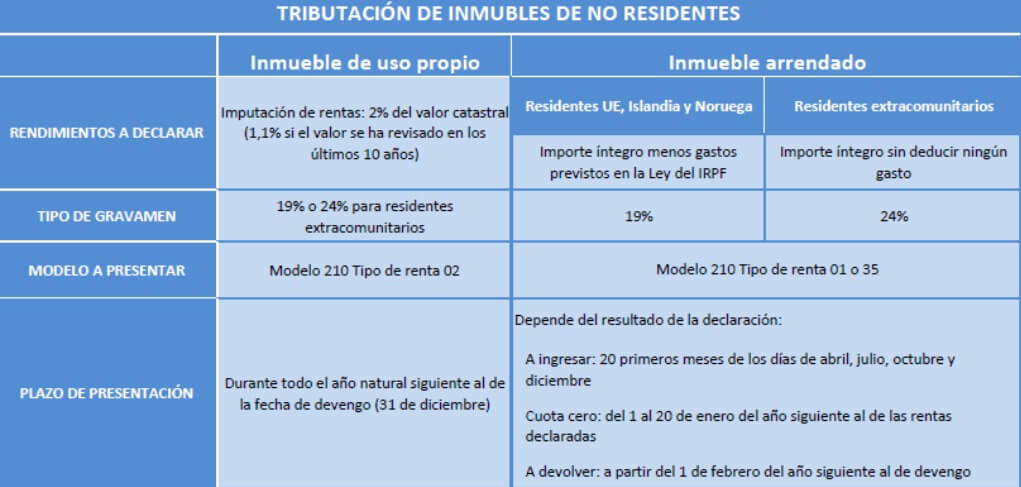
As you can see, there are two fundamental paths:
Path A: The Property is for Your Personal Use (Not Rented)
Even if your property is vacant or you only use it for holidays, the Spanish government considers that you receive an "imputed income" from it. You are taxed on this theoretical benefit.
To understand how this is calculated, let's watch a practical explanation.
IRNR 💼 Impuesto sobre la Renta de no Residentes [VIVIENDA] 🏠
The video 'IRNR 💼 Impuesto sobre la Renta de no Residentes' by Amigo Inversor breaks down the calculation for properties used for personal use.
Watch from 00:55 to 03:01. Pay close attention to the concepts of 'valor catastral' (cadastral value), the 1.1% or 2% rate applied to it, and the final tax rates of 19% or 24%.
Let's formalize that calculation.
Step 1: Calculate the Imputed Income (Tax Base)
The tax base is a percentage of the property's valor catastral, which you can find on your IBI tax receipt.
- 1.1% of the valor catastral if it has been revised in the last 10 years.
- 2% of the valor catastral if it has not been revised in the last 10 years.
Step 2: Calculate the Tax Due
You apply the IRNR tax rate to the imputed income calculated in Step 1. The rate depends on where you are a tax resident:
- 19% for residents of the EU, Iceland, and Norway.
- 24% for residents of all other countries (including the UK, US, Canada, etc.).
Example:
- An American citizen owns a flat in Madrid for personal use.
- Valor Catastral: €100,000 (revised recently).
- Step 1 (Tax Base): €100,000 * 1.1% = €1,100
- Step 2 (Tax Due): €1,100 * 24% = €264 per year.
This tax is declared annually using Modelo 210, with the deadline being December 31st of the following year.
Path B: The Property is Rented Out
If you rent out your property, the tax is based on your actual rental income. Here, the distinction between being an EU/EEA resident and a non-EU/EEA resident has a massive financial impact.
IRNR 💼 Impuesto sobre la Renta de no Residentes [VIVIENDA] 🏠
Let's return to the 'Amigo Inversor' video, which highlights the critical difference in tax treatment for rented properties.
Watch from 03:01 to 05:46. The speaker refers to the situation for non-EU residents as a 'sablazo' (a big hit/rip-off). Focus on understanding exactly why: the inability to deduct expenses.
This is the most important rule to understand for non-resident landlords:
- EU/EEA Residents: Can deduct all expenses related to the rental activity (IBI tax, community fees, insurance, maintenance, mortgage interest, etc.) from the gross rental income. They pay 19% tax on the net profit.
- Non-EU/EEA Residents: Cannot deduct any expenses. They pay 24% tax on the gross rental income.
This difference is substantial. For a detailed list of deductible expenses available to EU/EEA residents, you can consult the following resource.
Non-Resident Tax (IRNR) in Spain – 2025 Guide
The SpainEasy guide provides a clear list of deductible expenses.
Read the section titled 'Can You Deduct Expenses?'. This will give you a concrete idea of the costs that can be offset against rental income if you are an EU/EEA resident.
When a property is rented, IRNR must be filed quarterly via Modelo 210.
Test your understanding!
Two non-resident investors, one from Germany (EU) and one from Canada (non-EU), own identical apartments in Valencia. In one year, each apartment generates €12,000 in gross rental income and incurs €3,000 in deductible expenses (IBI, insurance, community fees).
Calculate the annual IRNR tax bill for both the German and the Canadian investor.
Show answer
-
German Investor (EU Resident):
- Net Income (Tax Base): €12,000 (Gross Income) - €3,000 (Expenses) = €9,000
- Tax Due: €9,000 * 19% = €1,710
-
Canadian Investor (Non-EU Resident):
- Gross Income (Tax Base): €12,000 (No deductions allowed)
- Tax Due: €12,000 * 24% = €2,880
The Canadian investor pays over €1,100 more in tax on the exact same economic performance, highlighting the significance of the EU/non-EU distinction.
3. Wealth Tax (Impuesto sobre el Patrimonio)
Beyond income tax, high-value property owners may also be subject to Spain's Wealth Tax.
💰 IMPUESTO sobre la RENTA de NO RESIDENTES (IRNR) 🇪🇸 Impuestos en España para No Residentes
The Balcells Group video provides a concise introduction to how the Wealth Tax applies to non-residents.
Watch from 02:23 to 03:29. Note the general threshold of €700,000 and the fact that this tax is regulated by the autonomous communities.
Key points for non-residents regarding Wealth Tax:
- It applies only to the net value of your assets located in Spain.
- The general state-level allowance is €700,000. You are taxed on the net wealth exceeding this amount.
- The tax is progressive, with rates typically ranging from 0.2% to 3.5%.
- Crucially, some autonomous communities offer much better terms. Madrid, for example, provides a 100% exemption, meaning you pay zero Wealth Tax. Andalusia has also recently implemented a 100% exemption.
This makes the property's location a critical factor in your total tax burden.

4. Capital Gains Tax on Sale
Finally, what is the tax impact when you sell your property?
When a non-resident sells a Spanish property, the capital gain (Sale Price - Acquisition Value) is taxed under IRNR at a flat rate of 19%, regardless of whether you are an EU resident or not.
A critical mechanism to be aware of is the 3% withholding (retención). When you sell a property to a buyer in Spain, the buyer is legally obligated to withhold 3% of the total sale price and pay it directly to the tax authorities on your behalf. This acts as a down payment against your final capital gains tax liability.
- If your final tax bill (19% of the gain) is more than the 3% withheld, you must file a Modelo 210 to pay the difference.
- If your final tax bill is less than the 3% withheld (or if you made a loss), you can file a Modelo 210 to claim a refund of the excess amount.
This ensures that non-resident sellers meet their tax obligations before taking the proceeds out of the country.
Conclusion
You now have a comprehensive framework for understanding the tax obligations of owning property in Spain as a non-resident.
Key Takeaways:
- IRNR is the primary tax. Its calculation depends on whether the property is for personal use (imputed income based on valor catastral) or rented out (income-based).
- For rented properties, there is a major tax disadvantage for non-EU/EEA residents, who are taxed on gross income at 24% without deductions, compared to EU/EEA residents who are taxed on net profit at 19%.
- Wealth Tax is an additional consideration for portfolios with a net value over €700,000, with tax liability varying significantly by region.
- Upon selling, capital gains are taxed at 19%, with a mandatory 3% withholding on the sale price to ensure compliance.
Preview of the Next Lesson:
Now that we understand the taxes involved in holding and selling property, we can start thinking strategically. In our next lesson, we will evaluate tax-efficient exit strategies for Spanish real estate investments, building directly on the capital gains concepts we introduced today to explore how to optimize your financial outcome at the end of an investment cycle.