Recommended resources
The freely available resources this lesson will direct you to.
- What Marketing Science Says About Growing a Brand | Professor Byron Sharp (Ehrenberg-Bass Institute)www.youtube.com
- “Lessons in Building and Managing Strong Brands.” – Kevin Lane Keller of Dartmouth Collegewww.youtube.com
- [PDF] Conceptualizing, Measuring, and Managing Customer-Based Brand ...people.duke.edu
- [PDF] Building Customer-Based Brand Equity: A Blueprint for Creating ...thearf-org-unified-admin.s3.amazonaws.com

Welcome back. Last lesson separated the choices a business makes about growth from the choices a brand makes about what people should understand and expect. This lesson asks what happens on the customer’s side of that equation: how can what people remember, recognize, believe, and trust affect what they buy?
You’ll examine four connected ideas—salience, associations, distinctiveness, and trust—using the hypothetical home-repair membership from the previous lesson. The aim is to explain a plausible route from brand-building to commercial performance, without assuming that a memorable brand automatically makes a sale.
First, the brand has to come to mind
Imagine someone deciding how to handle recurring home repairs. They might compare memberships, book individual tradespeople, ask a neighbour, or put the decision off. Before your hypothetical membership can be chosen, the person must encounter it or think of it at a relevant moment.
In this short lecture segment, Kevin Lane Keller explains why awareness, differentiation, and expectations matter to buyers.
“Lessons in Building and Managing Strong Brands.” – Kevin Lane Keller of Dartmouth College
Watch “Lessons in Building and Managing Strong Brands” by Kevin Lane Keller, hosted by Iowa State University Ivy College of Business, for a concise starting point: brands help people recognize an option and form expectations about it.
Watch brand fundamentals. Notice the two customer questions beneath the discussion: “Which option is this?” and “What can I expect from it?”
Brand salience is about how readily a brand comes to mind or is recognized in situations where it could be chosen. Knowing its name is only part of the story. Someone might recognize the membership’s logo when shown an advert but never think of it when arranging an annual maintenance plan. It is salient for that buying situation only if the relevant need or occasion helps bring it to mind.
The distinction between depth and breadth makes this more precise. Depth concerns how easily people recall or recognize the brand. Breadth concerns how many relevant situations bring it to mind. A brand could be recalled quickly for emergency repairs yet overlooked when someone wants predictable, ongoing maintenance. That gap matters if memberships, rather than emergency bookings, are the business’s growth priority.
Read Keller’s explanation of salience, then his introduction to what people associate with a brand. You can skim the detailed lists of product attributes and imagery examples; the passages identified below carry the central argument for this lesson.
[PDF] Building Customer-Based Brand Equity: A Blueprint for Creating ...
Kevin Lane Keller’s Building Customer-Based Brand Equity, published by the Marketing Science Institute, explains both when a brand enters consideration and what customers may believe about it.
In “Brand Identity,” read the “Brand Salience” and “Key Criteria for Brand Identity” subsections on pp. 8–9, from salience. Focus on consideration sets and the distinction between depth and breadth. Then go to “Brand Meaning” on p. 10. Read its opening discussion from brand meaning, noting the difference between performance and imagery. Finally, find “Key Criteria for Brand Meaning” on p. 13 and read from association quality. Focus on why an association must be recalled and valued to influence choice.
Salience helps an option enter a customer’s consideration set—the small group they might seriously choose. It does not ensure that the option wins. A person could think immediately of the home-repair membership and still reject it because the price is unclear or the service does not cover their needs.
That is where brand associations matter. These are the ideas linked to the brand in a customer’s memory: perhaps “predictable costs,” “helpful staff,” or, less favourably, “difficult claims process.” Some concern functional performance; others concern how using the service feels or what it seems to say about the customer. They can come from communications, but also from actual service, reviews, and other people’s experiences.
For a strategic decision, three properties are especially useful:
- Strength: Does “predictable costs” actually come to mind when the customer considers this membership?
- Favorability: Does that prospect value predictability in this situation?
- Uniqueness: Is the association more closely linked to this brand than to its alternatives?
An unusual association is not necessarily a valuable one. Likewise, “reliable” may be highly valued but offer little basis for preference if every competitor is also regarded as reliable. The customer’s situation matters: speed might dominate during an urgent repair, while predictable costs might matter more when planning a year’s household spending.
Being recognizable is different from offering a distinctive benefit
There are two meanings of distinctive worth keeping separate. A brand may offer a distinctive benefit—a reason to prefer it. It may also have distinctive assets—recognizable cues such as a symbol, colour combination, sound, or character that help people identify whose brand they are seeing. An asset can identify the brand even when it says nothing about why the offer is better.
Professor Byron Sharp draws this distinction in the following podcast excerpt.
What Marketing Science Says About Growing a Brand | Professor Byron Sharp (Ehrenberg-Bass Institute)
Watch the excerpt on distinctive brand assets from “What Marketing Science Says About Growing a Brand,” an Ahrefs Podcast conversation with Professor Byron Sharp. It clarifies the job of an identifiable cue.
Watch recognizable cues for the explanation of how consistent assets help people know which brand they have encountered. Then watch credited encounters for why that recognition matters across touchpoints.
Suppose the hypothetical membership repeatedly uses the same illustrated wrench on its booking page, service vehicles, and emails. The illustration’s intended job is to let people connect those encounters to the membership. It has not earned that job merely by being designed: customers must learn it and link it to the right brand.
The distinctive assets grid offers a way to assess that distinction.
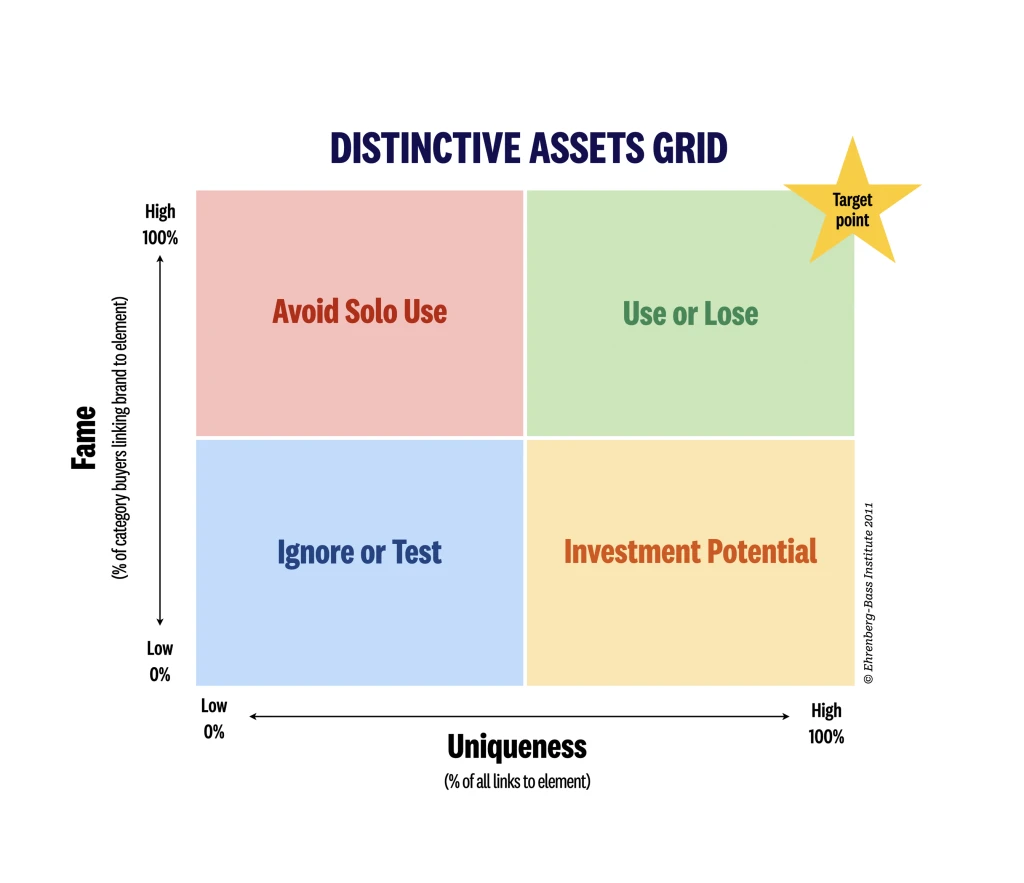
A newly created wrench illustration might be unique but not yet famous: few customers would connect it to the membership. A familiar-looking symbol might receive many brand links but also be confused with competitors’ symbols. Only customer evidence could establish where the hypothetical illustration belongs on this grid; its appearance alone cannot.
The commercial logic is modest but important. If people can identify the brand in an advert, on a vehicle, or during booking, those encounters are more likely to reinforce memory of the same option. Recognition is not preference, though. A perfectly recognized brand can still lose if the offer is wrong, unavailable, or distrusted. Later in the course, you’ll decide which assets are worth using consistently; for now, distinguish their identifying role from the benefits and evidence that might persuade a customer.
Trust makes an expectation usable
Now suppose “no unpleasant surprises” becomes a strong association with the membership. That could make the service attractive to someone worried about repair costs—but only if they believe the promise. Trust is the customer’s judgment that the brand is dependable and will act as expected, especially when the customer cannot verify everything before buying.
Keller discusses trustworthiness as part of broader brand credibility. Read the following passage alongside his account of consideration: being regarded as credible does not by itself mean a customer finds a brand relevant.
[PDF] Building Customer-Based Brand Equity: A Blueprint for Creating ...
Return to Keller’s discussion of how customers judge a brand. This passage helps separate a credible promise from an option the customer would actually consider.
In “Brand Responses,” find “Brand Judgments” on p. 14. Read the “Brand credibility” discussion from credibility, paying particular attention to expertise and trustworthiness. Then read the start of “Brand consideration,” from consideration.
Trust matters acutely when the outcome is uncertain or costly to get wrong. Before subscribing, a homeowner cannot know exactly which repairs will arise or how each visit will go. Clear coverage terms, accurate estimates, dependable appointments, and fair handling of problems can give substance to the membership’s promise. An unexpected fee could do the opposite: it would undermine trust and build an association of “hidden costs,” however polished the advertising.
This also marks a boundary from the previous lesson. Communications can explain coverage clearly; the service and pricing decisions must make that explanation true. Trust is not a line a brand team can write into existence. It develops through evidence and repeated experience—and can be damaged when experience contradicts the claim.
Connecting customer choice to commercial performance
A useful account of brand value must connect these customer effects to business results. Keller calls this customer-based brand equity: customers respond differently to an offer or marketing activity because they know the brand, compared with how they would respond to an otherwise comparable unnamed offer.
Read his definition and the immediate commercial implications before looking at the complete picture.
[PDF] Conceptualizing, Measuring, and Managing Customer-Based Brand ...
In this Journal of Marketing article, Keller defines brand equity through customer response rather than through a logo’s appearance or an unqualified financial claim.
In “Defining Customer-Based Brand Equity” (around pp. 7–8), read from differential response. Focus on what is being compared and why commercial benefits are possibilities rather than guaranteed outcomes. Then, in the following discussion of marketing-mix implications on p. 8, read from commercial implications. Notice the separate claims about choice, repeat buying, and price response.
Keller also summarizes several possible benefits of strong brands in this brief lecture segment. Listen for the difference between a brand influencing choice and a business actually capturing profitable growth.
“Lessons in Building and Managing Strong Brands.” – Kevin Lane Keller of Dartmouth College
Return to Keller’s “Lessons in Building and Managing Strong Brands” for a spoken account of how customer responses can affect loyalty, margins, and resilience to competitors.
Watch business effects. As you listen, distinguish the customer behaviour he describes from the commercial result a business might obtain from it.
For the home-repair membership, the four concepts can work together without being interchangeable. Salience makes the membership more likely to be thought of when maintenance is being planned. Associations such as “predictable costs” give the customer something relevant to evaluate. Recognizable assets help encounters with the brand reinforce the right memory. Trust makes the promised experience credible enough to act on.
Those customer effects can improve commercial performance in several ways: more potential customers may consider the membership; a greater proportion of those considering it may subscribe; satisfied members may renew; and some may accept a price that reflects the value they expect. Strong brand knowledge can also make communications more effective if people know which brand the message belongs to and understand its promise.
None of these results is automatic. A salient, trusted membership still needs an offer people want, a workable price, and a straightforward way to buy. Higher willingness to pay will not improve profit if the cost of delivering the promise rises further. If awareness is high but subscriptions are low, buying friction or poor fit may be a better explanation than insufficient advertising. Brand effects are part of a commercial explanation, not a substitute for one.
What to carry forward
Brand salience concerns whether the brand comes to mind in the right situations. Associations shape what customers think it offers; distinctive assets help them recognize which brand they have encountered; and trust affects whether they believe it will deliver. Together, these can influence consideration, choice, repeat purchase, and willingness to pay—but their commercial value depends on the offer and experience supporting them.
Next, you’ll use this customer-choice perspective to translate a business growth objective into a precise brand problem. Instead of starting with “we need more awareness,” you’ll be able to ask which customers, at which choice moments, are failing to think of, value, recognize, or trust the brand—and what strategic decision might change that?