Recommended resources
The freely available resources this lesson will direct you to.
Hello again. Last lesson examined how salience, associations, distinctiveness, and trust can influence customer choice. This lesson starts at the other end of the chain: a business wants to grow. What, exactly, must change in customers’ minds or choices for the brand to help?
You’ll work from a growth objective to a brand problem and then to a strategic decision. We’ll keep using the hypothetical home-repair membership so you can see where a business goal ends, where a brand decision begins, and where more evidence is needed.
A growth objective is a destination, not a diagnosis
Suppose the home-repair business sets this objective:
Increase new annual membership subscriptions from 10,000 to 12,000 over the next 12 months, while maintaining an acceptable contribution margin per member.
The objective specifies an outcome, a magnitude, a timeframe, and a commercial constraint. It does not tell you why subscriptions are below the desired level. Nor does it tell you whether brand strategy is the most important remedy.
A request such as “we need a new website” is even further from a diagnosis: it proposes a tactic before establishing the problem. Watch how the conversation in What Is Brand Strategy And How To Do It (Step 1), from The Futur, moves from an initial request toward the underlying business goal. The example concerns a different kind of business; pay attention to the questioning, not its particular solution.
What Is Brand Strategy And How To Do It (Step 1)
Watch The Futur’s “What Is Brand Strategy And How To Do It (Step 1)” for a demonstration of how to question a proposed deliverable before accepting it as the answer.
In the opening question, notice why “we need a website” is insufficient. Then watch the client discussion, where questions about the difficulty and the desired customers make the objective more specific. Stop before the numerical funnel estimates; those would require evidence before being used in a real plan.
The same discipline applies when someone asks for “more awareness,” “a stronger purpose,” or “a campaign.” Ask what growth is required, from whom, through which customer behaviour, and what currently prevents it.
Diagnosis comes before strategy. Mark Ritson makes this point in the opening axiom of Three axioms and three questions that summarise all of brand strategy. Read his account of diagnosis and strategic choice now. His language is deliberately forceful; the useful principle here is the sequence of reasoning, not the rhetoric.
Three axioms and three questions that summarise all of brand strategy
In this Marketing Week article, Mark Ritson explains why a brand decision needs a diagnosis and why a strategy must rule out alternatives.
Under “Axiom 1: Diagnosis first, strategy second,” read the diagnosis argument, beginning with the generals’ map and ending with the question about what has been learned from the previous year. Then, under “Axiom 2: Strategy is choosing what you will not do,” read the choice argument, from the explanation of what strategy excludes through the point about concentrating resources. You can stop there.
For the membership, a shortfall in subscriptions might arise because too few people encounter the offer, because interested people do not understand its value, because the coverage is unattractive, because booking is difficult, or because the price does not work for them. Some of these may be brand problems; others are primarily offer, pricing, distribution, or service problems. Calling every growth obstacle an “awareness problem” skips the diagnosis.
Find the customer-choice bottleneck
To translate the objective, first identify whose behaviour must change and at what choice moment. “Households” is too broad to guide this decision. “People planning how to manage routine repairs over the coming year” identifies a relevant situation without yet pretending to have completed a formal segmentation study.
Next, look for the obstacle between that situation and a subscription. The four concepts from the last lesson give you useful possibilities:
- Salience: Do these people think of the membership when planning upkeep, or only when something breaks?
- Associations: Do they connect it with the benefit they need, such as more predictable repair spending?
- Trust: Do they believe the stated coverage and service promise?
- Recognition: Can they tell which brand they have encountered across the places where they research and buy?
These are candidate explanations, not conclusions. You need to compare them with other plausible causes. Imagine an initial investigation finds that many prospective customers recognize the business as an emergency-repair provider, but few think of it when planning annual upkeep. Interviews suggest they did not realize it offers a membership. That pattern makes a brand-memory and meaning problem plausible.
Now change the evidence. Suppose prospects readily understand and want the membership, but abandon sign-up when they discover important repairs are excluded. The priority might instead be product design or coverage terms. Better messaging could clarify the terms, but it should not disguise an offer that fails to meet the need.
A useful diagnostic statement therefore distinguishes observation, interpretation, and uncertainty:
Prospective annual planners appear to know the business for emergency repairs but seldom consider its membership when planning upkeep. Our working explanation is that the brand is not strongly linked to that planning occasion or to the membership’s relevant benefit. We still need to check whether coverage, price, or sign-up friction better explains the lost subscriptions.
Notice what this does not say: it does not claim that a survey response causes a sale, or that changing an association will deliver exactly 2,000 subscriptions. It gives the team a focused hypothesis to investigate.
Ritson’s Planning for marketing planning: 14 steps to an effective presentation describes using customer-choice measures to isolate a weak or promising step rather than setting a vague growth aspiration. Read just the “Pointy objectives” subsection for that distinction.
Planning for marketing planning: 14 steps to an effective presentation
In this Marketing Week article, Ritson connects a commercial goal to a more specific customer response that a plan might seek to change.
Go to the “Pointy objectives” subsection. Read the objectives discussion, starting where it asks which marketing lever needs to move and ending with its advice to keep objectives few. Focus on the distinction between the eventual sales or profit result and the nearer customer response. A funnel can organize questions, but real journeys need not follow one fixed sequence.
In practice, choose a measure that fits the specific suspected obstacle. General name recognition might be a poor lead measure if people already recognize the repair business but do not think of its membership at the planning moment.
Turn the diagnosis into a decision
A precise brand problem names a growth-relevant gap in customer choice. For this case, it could be:
Among people planning routine home upkeep, the business is remembered chiefly for emergency repairs rather than considered as a way to manage repairs across the year. If this pattern is confirmed, it limits the pool of people likely to consider an annual membership.
That is narrower than “we need a stronger brand.” It names the people, the occasion, the current perception, the desired customer response, and the plausible link to growth. The phrase “if this pattern is confirmed” matters: an early diagnosis should not be presented as established fact.
A strategic decision says what the business will prioritize in response—and what it will not prioritize. For example:
Prioritize building consideration for the annual membership among people planning routine upkeep, by making the membership’s genuinely deliverable benefit clear at that planning moment. Do not make additional emergency-repair demand the main brand priority for this growth objective.
The proposed benefit still needs scrutiny. “Predictable costs,” for instance, is only defensible if the coverage and pricing make costs meaningfully more predictable. The team must also establish what competitors offer; otherwise it cannot claim an advantage over them.
The following diagram is a helpful check on that decision. It depicts the relationship among customer wants, what a brand can deliver well, and what a competitor can deliver well. Its “winning zone” is a direction for investigation, not evidence that a brand already owns a position.
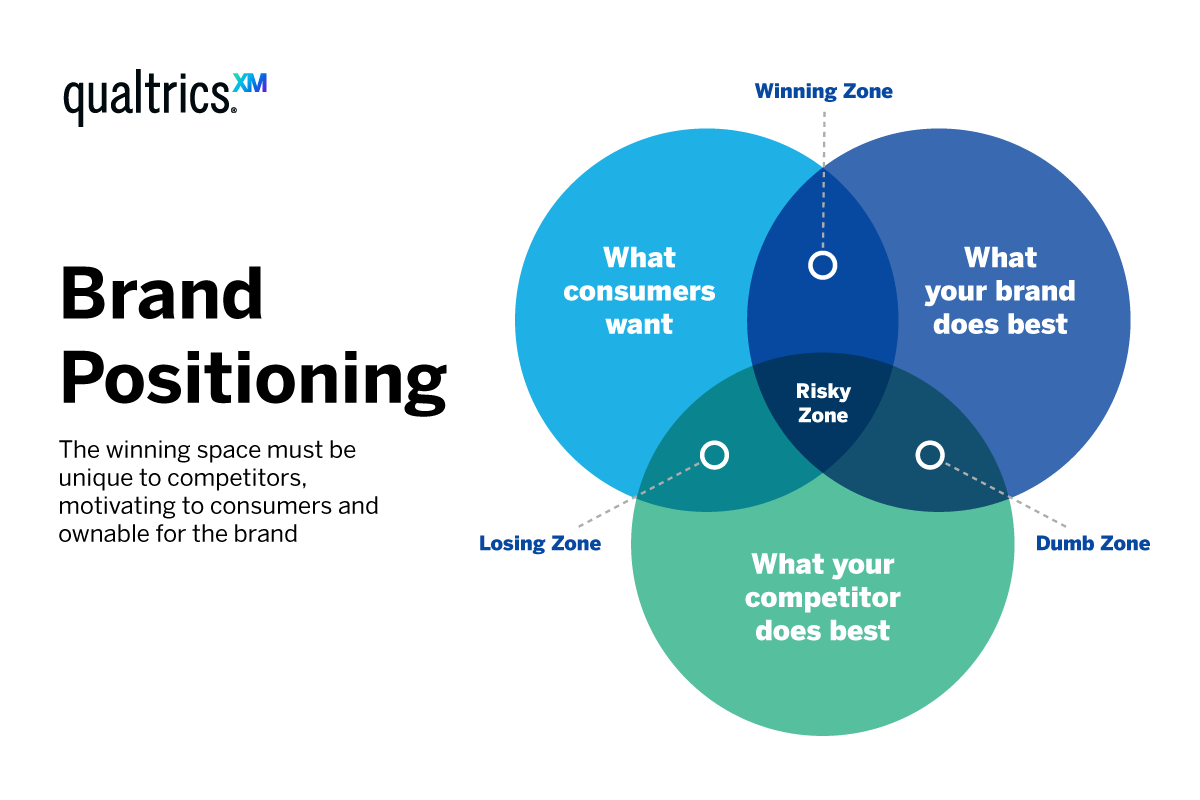
A relevant benefit shared with competitors can still matter to customers. The diagram’s sharp labels should not lead you to reject every shared benefit. The immediate question is more practical: what do customers value, what can this business reliably deliver, and what choice is worth making given the alternatives?
Ritson’s discussion of “what we want to stand for” gives a concise version of that test. Read it for the decision logic; you will develop a full positioning statement later in the course.
Three axioms and three questions that summarise all of brand strategy
Return to Ritson’s article to see how a chosen customer and a defensible customer perception fit together.
Under “Question 2: What do we want to stand for?”, read the positioning argument, beginning with the need to decide whom to address and ending with the test of what customers want, what the brand can deliver, and the alternatives. Keep the emphasis on making a choice; the detailed positioning work comes later.
The decision is not yet a campaign concept, a visual identity, or a list of messages. Those are possible ways to execute it. Stating the decision first lets you assess whether any proposed tactic actually addresses the diagnosed gap.
Make the link to growth testable
The finished translation has three distinct parts:
| Part | Membership example |
|---|---|
| Business objective | Grow new annual subscriptions from 10,000 to 12,000 in 12 months while protecting contribution margin. |
| Brand problem to verify | People planning upkeep know the business for emergency repairs but seldom consider its membership for ongoing repair needs. |
| Strategic decision | Prioritize making the credible membership benefit relevant at the annual-planning occasion, rather than prioritizing additional emergency-repair demand. |
You can then propose a leading measure: for example, the share of people planning upkeep who consider the membership for annual repair needs. Measure it consistently against a credible baseline and alongside subscriptions and margin. If consideration improves but subscriptions do not, revisit the assumed connection. The offer, price, availability, or buying experience may be blocking growth downstream.
This is also where strategic restraint earns its place. The business might still serve emergency customers, and a team might still improve the website. Neither must be the priority brand decision for growing annual memberships. A precise decision gives those activities a test: do they help solve the chosen problem, or are they competing for resources?
What to carry forward
A business growth objective states the commercial result. A brand problem identifies a specific, evidence-backed obstacle in how customers think about or choose the brand. A strategic decision chooses which customer response to change, for whom and when, while making clear what will not be the priority. Keep alternative explanations in view: a brand intervention cannot compensate indefinitely for an unsuitable offer or poor service.
Next, you’ll consider which publicly researchable brand could support this kind of evidence-led strategic work throughout the course.