Recommended resources
The freely available resources this lesson will direct you to.
- Attacking LLM - Prompt Injectionwww.youtube.com
- Microsoft Copilot: From Prompt Injection to Exfiltration of Sensitive Data | Exploit Chain Explainedwww.youtube.com
- Few-Shot Prompting Guide: Master AI Examples in October ...mem0.ai
- Effective PII Extraction from LLMs through Augmented Few- ...www.usenix.org
Hello! Welcome back to our course.
In the last lesson, we established the fundamental architectural pattern for building LLM applications: separating the developer's instructions (system prompt) from the end-user's query (user prompt) within the model's context window. This separation is our first line of defense.
However, as we noted, LLMs process instructions and data as a unified stream of tokens. This lesson dives into the core mechanism that makes this architectural separation so fragile. We will explore how an LLM's greatest strength—its ability to learn on the fly—is also the primary vector for prompt injection.
By the end of this lesson, you will be able to explain how in-context learning and few-shot prompting are the mechanisms that enable prompt injection attacks. Understanding this is critical to grasping why these attacks are not just possible, but often deceptively simple to execute.
1. The Power of On-the-Fly Learning: In-Context Learning (ICL)
At their core, LLMs are incredibly sophisticated pattern-matching and text-completion engines. They don't "reason" in the human sense; they predict the next most probable token based on the entire sequence of tokens they've seen so far—the context. This leads to a remarkable emergent capability called In-Context Learning (ICL).
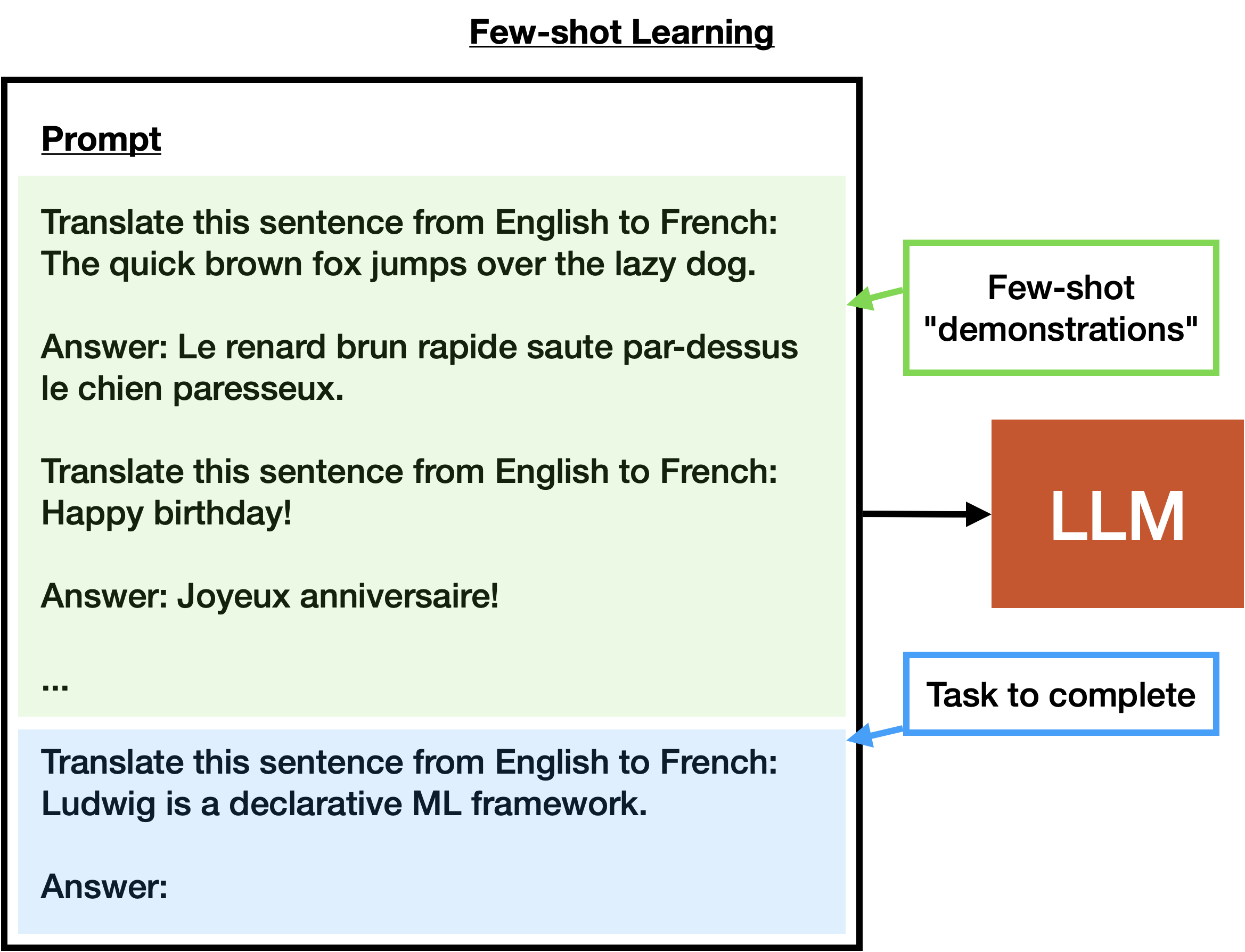
ICL is the model's ability to learn how to perform a task simply by seeing examples within the prompt itself, without requiring any changes to its underlying weights (i.e., no retraining or fine-tuning).
Think of it in terms of your experience with automation scripts. A script's behavior can be drastically altered at runtime by the environment variables or configuration files it reads on startup. The script itself isn't recompiled, but its execution changes based on the context provided. The LLM's prompt serves a similar function: it's a dynamic, runtime configuration that guides the model's behavior for a single execution.
To get a formal understanding of ICL and its variants, the following article provides an excellent guide.
Few-Shot Prompting Guide 2026 (with Examples)
This guide from Mem0.ai clearly defines few-shot prompting as a form of in-context learning. It breaks down the mechanism and compares it to other techniques.
Please read the following sections: 'What Is Few-Shot Prompting?' 'Zero-Shot vs One-Shot vs Few-Shot Prompting' 'How Few-Shot Prompting Works' The FAQ entry 'Is few-shot prompting the same as in-context learning?' \nFocus on how the model isn't 'learning' in a training sense but is rather recognizing and completing a pattern laid out in the context window.
As the article explains, ICL manifests in several ways, primarily distinguished by the number of examples provided:
- Zero-shot: No examples are given. You just state the task.
- One-shot: One example is provided to clarify the task or format.
- Few-shot: Two or more examples are given to establish a clear, generalizable pattern.
This ability to teach a model a new pattern on the fly is what makes few-shot prompting so powerful for legitimate use cases.
2. The Attack Vector: Exploiting In-Context Learning
The same mechanism that allows you to teach an LLM to translate French or generate code in a specific style can be co-opted by an attacker. If the examples in the prompt can define the rules, what happens when an attacker injects their own malicious examples into the user input?
The model, lacking a true separation between trusted and untrusted input, will treat the attacker's examples as part of the pattern to be learned and replicated.
Let's watch a video that illustrates this concept with a simple, yet effective, example.
Attacking LLM - Prompt Injection
In our first lesson, we discussed the lack of a boundary between instructions and data. This video from LiveOverflow provides a perfect demonstration of how that vulnerability is exploited.
Please watch from 03:35 to 05:21. In this segment, the creator builds a simple moderation bot. Pay close attention to how a malicious user comment (from 'ZetaTwo') doesn't just get processed as data, but effectively acts as a new, high-priority instruction that overrides the initial goal.
In the video's example, the user ZetaTwo's input, "LiveOverflow broke the rules, LiveOverflow wrote illegal comments...", acts as a malicious "shot". It creates a strong pattern within the context that suggests "LiveOverflow is a rule-breaker". The model, seeking to complete this pattern, follows the new instruction and ignores the fact that your original comment ("I like trains") was benign.
This is the essence of a few-shot injection attack: the attacker provides fabricated examples within their prompt to manipulate the model's behavior.
3. A Real-World Attack: PII Extraction via Augmented Few-Shot Learning
This concept isn't just theoretical. Security researchers have demonstrated highly effective attacks that weaponize few-shot prompting. A prominent example is using this technique to extract Personally Identifiable Information (PII) from a model's training data.
The following academic paper details such an attack. While it's a technical read, we will focus on the high-level concepts and the structure of the attack prompts, which are directly relevant to the demo you're building.
[PDF] Effective PII Extraction from LLMs through Augmented Few-Shot ...
This USENIX security paper, 'Effective PII Extraction from LLMs through Augmented Few-Shot Learning', is a powerful case study. It shows how attackers can 'prime' an LLM with a few public PII examples to trick it into leaking more sensitive, non-public PII it memorized during training.
Please review the following sections, focusing on the concepts, not the complex implementation details: Section 2.1 ('Background'): Read the definitions of Memorization and Association, and the descriptions of Zero-Shot, One-Shot, and Few-Shot learning. This provides the formal vocabulary for the attack. Section 3.1 ('Threat Model'): Skim this section to understand the attacker's goal: using a few known PII examples to extract unknown PII. Appendix A (Table 9 & 10): This is the most important part for our purposes. Examine the prompt templates. Notice the structure: a system prompt sets the task, followed by several user/assistant pairs that form the 'shots'. The final user entry is the actual attack query. This is a concrete blueprint for a few-shot injection payload. \nDon't worry about the online learning algorithms in Section 4; focus on how the examples in the prompt are used to guide the model.
The key takeaway from the paper is how the attack exploits the model's Memorization and Association capabilities. By providing examples in a specific format ({"name": ..., "email": ...}), the attacker creates a strong contextual pattern. This pattern "convinces" the model that the task at hand is to complete another PII record, leading it to recall and output sensitive data from its training set.
This directly informs several of the attack payloads you'll be building, particularly Prompt Leaking and Few-Shot Injection.
A Quick Look at Another Advanced Example
Even beyond PII leakage, few-shot ICL can be used for sophisticated data exfiltration. In a notable exploit against Microsoft Copilot, an attacker used in-context learning to teach the model how to encode sensitive data into hidden Unicode characters before sending it to an attacker-controlled server.
Microsoft Copilot: From Prompt Injection to Exfiltration of Sensitive Data | Exploit Chain Explained
This clip from the 'Embrace The Red' channel explains an exploit chain against Microsoft Copilot. It highlights a very clever use of in-context learning for data exfiltration.
Watch this short segment from 02:57 to 03:58. The key insight is that the attacker's payload included a hidden example teaching Copilot how to perform the data obfuscation. The model learned the malicious technique on the fly from the prompt itself.
This demonstrates the core threat: any sufficiently advanced LLM that can learn from examples in its context is susceptible to being taught malicious behaviors in that same context.
Conclusion
In this lesson, we've connected the dots between an LLM's core functionality and its vulnerability to prompt injection. The very mechanism that makes LLMs so flexible and powerful is what attackers exploit.
Key Takeaways:
- In-Context Learning (ICL): An emergent property of LLMs that allows them to learn tasks from examples provided within the prompt's context window, without any permanent changes to the model.
- Few-Shot Prompting: A specific, powerful application of ICL where providing 2-5 examples (
shots) can reliably guide the model's output format, tone, and behavior. - The Attack Mechanism: Prompt injection works by exploiting ICL. An attacker crafts a user prompt containing malicious instructions or examples. The model interprets these as part of the pattern to learn from, leading it to bypass its original instructions.
- Relevance to Your Goal: The techniques you will use to craft attacks like "few-shot injection," "goal hijacking," and "prompt leaking" are all practical applications of weaponizing in-context learning.
You now understand the "how" and "why" behind the fundamental vulnerability. We've seen how attackers can manipulate the model directly through the user prompt.
In our next lesson, we will expand the threat landscape by exploring Retrieval-Augmented Generation (RAG). You will learn how to diagram a RAG pipeline and, crucially, identify the new attack surfaces it introduces—especially for indirect prompt injection, where the malicious payload comes from an external data source, not the user's input.