Recommended resources
The freely available resources this lesson will direct you to.
- Harmful Content Detection / Content Moderation | ML System Design Problem Breakdownwww.youtube.com
- Talks # 4: Sebastien Fischman - Pytorch-TabNet: Beating XGBoost on Tabular Data Using Deep Learningwww.youtube.com
- Machine learning System Design in a hurry - Dev Learning Dailylearningdaily.dev
- Feature pipelines and feature stores — deep dive into ...medium.com
Hello! Welcome to the sixth and final lesson of our first module, "Advanced Feature Engineering Principles."
Introduction
Over the past five lessons, we've built a formidable toolkit. We started with the mathematical foundations of transformations, explored how information theory helps quantify feature relevance, debated the critical difference between correlation and causation, and most recently, delved into powerful non-linear techniques like splines and Radial Basis Functions.
Think of these past lessons as learning to forge individual high-quality tools. Today, we learn to be the master architect. We're moving from "what does this tool do?" to "which tool should I use, when, why, and at what cost?"
This lesson is the capstone of our first module. It directly addresses the learning outcome: Design a feature engineering strategy for a novel business problem, justifying trade-offs between feature complexity, interpretability, and computational cost. This is less about learning a new line of code and more about developing the strategic mindset of a senior machine learning engineer. We'll synthesize everything we've learned into a structured framework for designing robust, effective, and efficient feature engineering pipelines.
A Framework for Feature Engineering Strategy
Designing a feature engineering strategy isn't a haphazard process of trying random transformations. It's a system design challenge that requires a structured approach, starting from the business need and working your way down to the technical details. An excellent way to structure this thinking is to follow a process similar to a machine learning system design interview.
Step 1: Frame the Problem and Define Objectives
Before you write a single line of transformation code, you must deeply understand the problem. The business context dictates all subsequent technical decisions. This is the single biggest differentiator for senior engineers.
To see this principle in action, let's watch a segment from a talk on ML system design.
Harmful Content Detection / Content Moderation | ML System Design Problem Breakdown
The video 'Harmful Content Detection' from Hello Interview provides an excellent breakdown of how to approach an ML system design problem. We'll focus on the initial, most critical phase: problem framing.
Please watch the segment from 04:07 to 12:33. Pay close attention to how the speaker moves from an ambiguous prompt ('design a system for detecting harmful content') to a concrete set of requirements by asking clarifying questions and establishing a business objective that goes beyond a simple ML metric.
As the video highlights, you must anchor your design by asking key questions:
- What is the business goal? (e.g., Reduce customer churn, increase ad clicks, detect fraud).
- What are the constraints?
- Latency: Does the prediction need to happen in real-time (<100ms), or can it be a daily batch process?
- Interpretability: Does a human need to understand why the model made a specific decision (e.g., for loan approvals)? Or is predictive accuracy the only thing that matters?
- Cost: What are the computational and financial budgets for training and serving?
- What are the success metrics? How does the ML metric (e.g., recall at 95% precision) translate to the business metric (e.g., dollars saved from fraud)?
These answers directly shape your feature engineering strategy. A low-latency fraud detection system will have a radically different feature pipeline than a monthly sales forecasting model.
Step 2: Brainstorm and Categorize Potential Features
With a clear objective, you can begin the creative process of brainstorming features. Cast a wide net and think about the different entities in your problem. A good practice is to categorize them. For instance, in an e-commerce setting, you might have:
- User-level features: Customer's account age, historical purchase frequency, lifetime value.
- Item-level features: Product category, price, brand, number of times it has been viewed.
- Interaction features: Features that describe the relationship between a user and an item, like
user's purchase count of items in this brand. - Contextual features: Time of day, day of week, user's device.
This is where you bring your entire toolkit to bear:
- Basic Aggregations: Counts, sums, averages over different time windows.
- Transformations: Log, Box-Cox, or Yeo-Johnson transforms for skewed features.
- Non-linear & Periodic Features: Spline transformations for capturing complex trends or cyclical patterns (e.g., time of day), as we discussed in the last lesson.
- Relational & Proximity Features: RBFs for location-based features or other measures of similarity.
- Advanced "Black-Box" Features: For problems where pure predictive power is paramount, you might consider using deep learning models as feature extractors. For instance, an autoencoder can learn a dense embedding of a user based on their activity, or a model like TabNet can perform powerful internal feature selection. We'll dive deep into these in Module 7, but it's important to know they are an option at this strategic stage.
Step 3: Prioritize and Justify Trade-offs
You will always generate more feature ideas than you can possibly build or use. The crucial next step is to prioritize, which requires methodically evaluating the trade-offs along three key axes:
- Predictive Power: How much "lift" is this feature likely to give the model? (Use domain knowledge and information theory concepts like mutual information to guide this).
- Interpretability: Is the feature a simple, explainable ratio like
avg_purchase_value, or is it a 128-dimension vector from a neural network? - Computational Cost & Complexity: This is where MLOps and system architecture become paramount. How expensive is the feature to compute, both for generating historical training data and for serving live predictions?
This final point on cost is where the concept of a Feature Store becomes critical to a professional ML system.
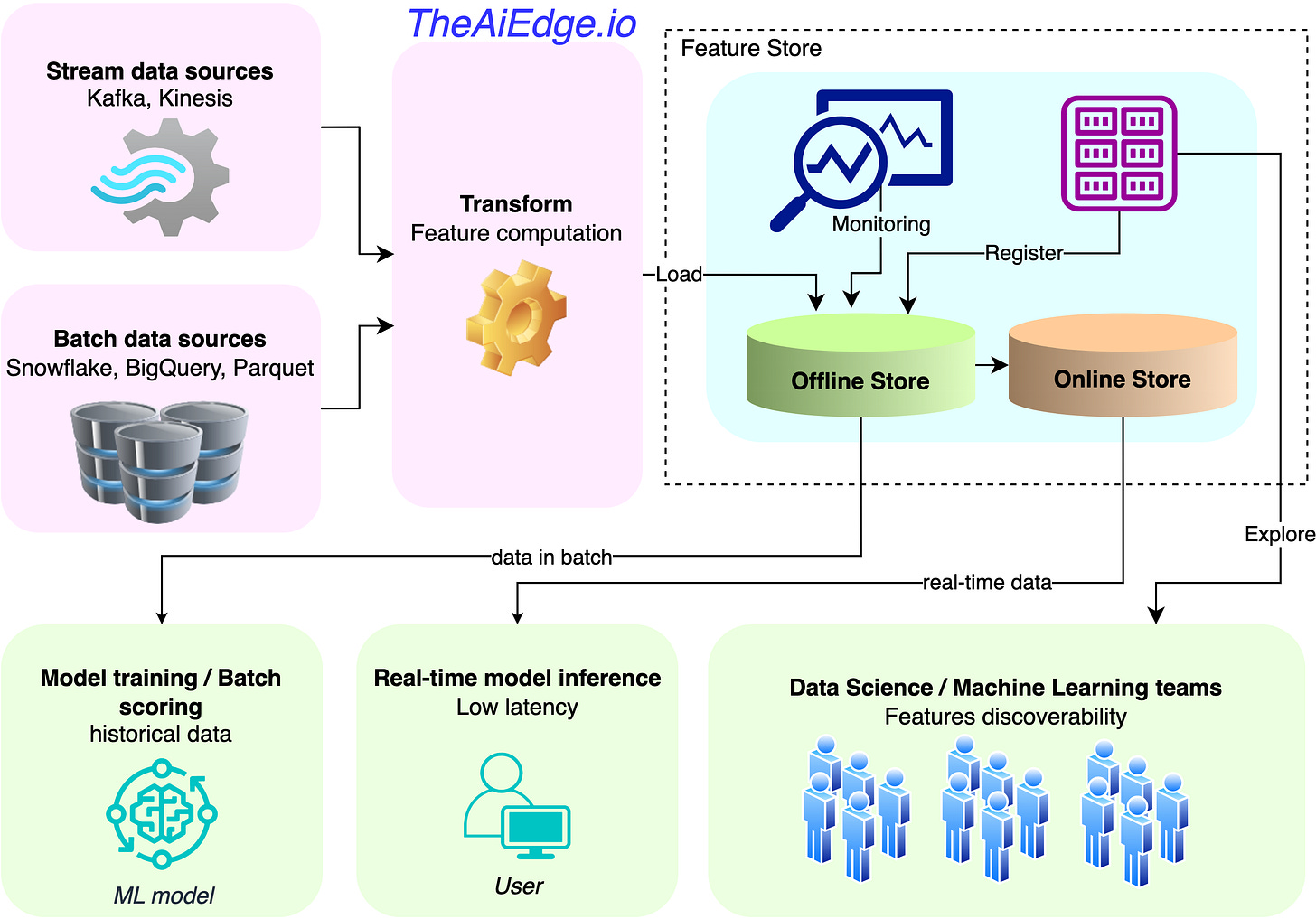
To understand the deep trade-offs involved in this process, let's explore a fantastic article that breaks down the engineering challenges.
Feature pipelines and feature stores — deep dive into system ...
The article 'Feature pipelines and feature stores' by Assaf Pinhasi is a masterclass in the practical trade-offs of feature engineering at scale. It connects high-level analytical needs to low-level system design choices.
Please read the following two sections carefully: 'Not all features can be fully pre-computed': Focus on the concept of 'Last mile' calculations. Understand why features depending on request-time data (like a user's current location) require a hybrid approach of pre-computation and real-time calculation. 'Pre-computation vs. feature accuracy' and 'Time-windows design tradeoffs': This is a crucial section for your goal of understanding time-based features. Absorb the different design patterns for time-window features (like tiles) and their implications for freshness, accuracy, and cost. This is the essence of justifying trade-offs.
The article makes it clear: there's no free lunch.
- Want ultra-fresh features for real-time fraud detection? You'll likely need a complex streaming pipeline and accept higher operational costs.
- Building a customer lifetime value model that runs weekly? You can rely on cheaper, simpler batch computations and pre-compute everything.
- Need to calculate
count of distinct users from this IP address? A precise calculation is expensive. An approximation algorithm like HyperLogLog might be a necessary trade-off between accuracy and scalability.
Your job as a designer is to choose the right point on this trade-off spectrum for each feature, always guided by the problem requirements from Step 1.
Case Study: Customer Churn Prediction
Let's make this concrete. Imagine you're tasked with designing the feature engineering strategy for a customer churn prediction model for a video streaming service. The goal is to identify users likely to cancel their subscription in the next 30 days.
1. Problem Framing
- Business Goal: Proactively reduce churn by offering incentives to at-risk users.
- ML Objective: Predict the probability of churn for each active user.
- Constraints: Predictions are needed daily for the marketing team. Interpretability is important so the team can understand why a user is at risk. A batch pipeline is sufficient; sub-second latency is not required.
2. Feature Brainstorming
- Static/User-level:
account_age_dayssubscription_tier(categorical)signup_device_type
- Dynamic/Behavioral (Time-Windows):
watch_time_hours_last_7d,_30d,_90dnum_sessions_last_7d,_30ddays_since_last_sessioncompletion_rate(ratio of finished vs. started shows)_last_30dnum_unique_titles_watched_last_30d
- Cyclical:
is_weekend(binary)- Spline features on
hour_of_dayto capture peak watching times.
- Advanced (for future iterations):
user_embedding: A dense vector representation of a user's taste, learned by an autoencoder on their watch history.LLM-generated features: Use an LLM to hypothesize new features based on descriptions of the existing ones, as shown in the diagram below. We might explore this "out-of-the-box" idea later in the course.

3. Prioritization & Justification
Here, we design a multi-phase strategy.
-
V1 (MVP):
- Features:
account_age_days,subscription_tier,days_since_last_session, andwatch_time_hours_last_30d. - Justification: This is a small set of highly predictive and interpretable features. They are computationally cheap to produce in a daily batch job (e.g., a simple SQL query or Spark job). This allows us to get a baseline model running quickly.
- Features:
-
V2 (Enhanced Model):
- Features: Add the 7-day and 90-day window features, the
completion_rate, and the cyclical spline features forhour_of_day. - Justification: The multi-window features capture both short-term engagement and long-term habit changes. The spline features allow a simple linear model to capture the non-linear effect of watching time. The cost increases, but it's manageable in a daily batch. We'd justify this by showing that the V1 model's performance has plateaued.
- Features: Add the 7-day and 90-day window features, the
-
V3 (High Complexity):
- Features: Introduce the
user_embedding. - Justification: This is a significant jump in complexity and a loss of direct interpretability. It requires a separate pipeline to train the autoencoder and generate the embeddings. This should only be pursued if the V2 model is still not meeting the business accuracy targets and the potential revenue saved from a further 2% improvement in churn prediction outweighs the engineering and maintenance cost.
- Features: Introduce the
This iterative approach, starting simple and adding complexity only when justified, is the hallmark of a mature feature engineering strategy.
Interview & Business Context Alert
Question: "You're leading the development of a real-time fraud detection system for credit card transactions. Outline your feature engineering strategy, focusing on the trade-offs you must make."
Your Analysis: "My strategy would be dictated by the key constraint: sub-100ms latency.
1. Feature Categories: I'd divide features into three groups:
- Request-time features: The transaction amount, merchant category, time of day. These are free, latency-wise.
- Pre-computed batch features: Historical data about the user, stored in a low-latency online feature store (like Redis or DynamoDB). Examples:
user_avg_transaction_value_last_90d,user_most_frequent_merchant_category_last_30d. These are calculated nightly via a Spark job.- Near real-time streaming features: Aggregates over very short windows. Examples:
user_transaction_count_last_1m,user_transaction_count_last_1h. These would be calculated using a streaming engine like Flink or Spark Streaming and constantly updated in the online store.2. Key Trade-offs:
- Staleness vs. Latency: I cannot calculate a 90-day average transaction value from raw database logs at inference time. It's too slow. I must use a pre-computed value. This introduces staleness—the value is up to 24 hours old.
- Mitigation: To mitigate this, I'd combine feature types. A powerful feature would be
(current_transaction_amount) / (user_avg_transaction_value_last_90d). This 'last-mile' calculation combines a fresh request-time feature with a slightly stale pre-computed feature, giving us powerful context with acceptable latency.- Accuracy vs. Cost: For a feature like
count_distinct_merchants_visited_last_hour, a precise calculation is hard in a distributed streaming system. I would use an approximation sketch like HyperLogLog. This trades a tiny amount of accuracy for huge gains in performance and scalability, which is a necessary and justified decision in a real-time fraud system."
Conclusion
This lesson marks a shift from a technician's mindset to an architect's. Designing a feature engineering strategy is a systematic process of balancing conflicting goals to solve a business problem.
Key Takeaways:
- A feature engineering strategy is a design process that starts with the business problem and its constraints (latency, cost, interpretability).
- The core of the work lies in justifying trade-offs between feature complexity, interpretability, and computational cost.
- In MLOps environments, feature stores and sophisticated data pipelines are essential for managing these trade-offs, especially for time-sensitive features.
- A phased approach (MVP -> V2 -> V3) is often the most practical way to manage complexity, starting simple and adding powerful but expensive features only when necessary and justified.
What's Next?
We've now completed our journey through the core principles of advanced feature engineering. You have a framework for designing a strategy. But how can you be confident that the features you've painstakingly designed and backfilled on historical data will actually perform well on future, live data? The real world is messy, and data distributions change.
In our next lesson, the first of Module 2, we will tackle this problem head-on. We'll learn how to apply adversarial validation to diagnose and quantify distribution drift between training, validation, and production datasets. This powerful technique will help you build models that are more robust to the inevitable shifts and changes of a production environment.