Recommended resources
The freely available resources this lesson will direct you to.
- Diffusion Models versus Generative Adversarial Networks (GANs) | AI Image Generation Modelswww.youtube.com
- DDPM - Diffusion Models Beat GANs on Image Synthesis (Machine Learning Research Paper Explained)www.youtube.com
- GANs vs. Diffusion Models: Putting AI to the test | Aurora Solaraurorasolar.com
- Synthetic Scientific Image Generation with VAE, GAN, and ...pmc.ncbi.nlm.nih.gov
Hello! Welcome back to our course on AI Engineering.
In our last lesson, you got hands-on experience using a pre-trained Stable Diffusion model to generate images from text. We saw how the Hugging Face diffusers library and its Pipeline abstraction make this complex process remarkably simple. You learned to guide the model's output using prompts and parameters like guidance_scale.
Today, we're zooming out to place diffusion models within the broader landscape of generative AI. For years, another type of model, the Generative Adversarial Network (GAN), dominated the field of image generation. This lesson directly addresses our learning outcome: to compare diffusion models with GANs in terms of image quality, diversity, and computational cost. We'll dissect their core differences, explore their unique strengths and weaknesses, and understand why diffusion models have recently emerged as a state-of-the-art alternative.
1. A Tale of Two Architectures
At their core, GANs and diffusion models approach the problem of image generation from fundamentally different perspectives.
-
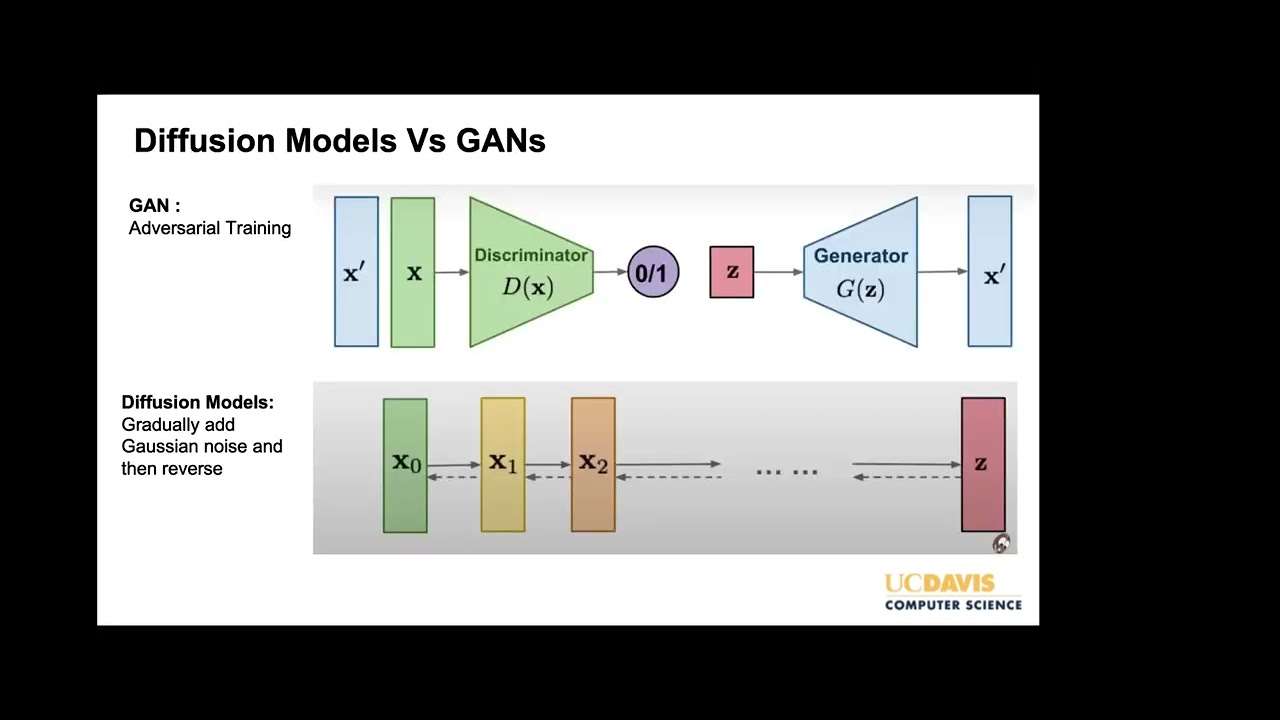
Generative Adversarial Networks (GANs): A GAN consists of two neural networks locked in a zero-sum game. The Generator tries to create realistic images from random noise, while the Discriminator tries to distinguish between real images (from the training set) and fake images (from the Generator). As they train together, the Generator gets better at making convincing fakes, and the Discriminator gets better at spotting them. The result, ideally, is a Generator that can produce highly realistic images.
-
Diffusion Models: As we've learned, these models work by first destroying information and then learning to restore it. The forward process gradually adds noise to an image over many steps until it becomes pure noise. The reverse process then learns to iteratively remove that noise, starting from a random noise image to generate a clean, new sample.
A key challenge with GANs is a failure mode called mode collapse. This happens when the generator finds a few outputs that can easily fool the discriminator and then produces only those limited variations, failing to capture the full diversity of the training data.
To see a quick overview of GANs, mode collapse, and how diffusion models offer an alternative, watch this short video.
Diffusion Models versus Generative Adversarial Networks (GANs) | AI Image Generation Models
This video from Quick Tutorials provides a concise introduction to GANs, the problem of mode collapse, and the alternative approach offered by diffusion models.
Watch the video from the beginning to 02:29. Pay attention to: The explanation of the GAN generator. The definition of 'mode collapse' and why it's a problem. The high-level description of the diffusion model's forward and reverse processes. The mention of the FID score as a metric for comparison.
2. The Head-to-Head Comparison
Now that we have a foundational understanding of both architectures, let's compare them across the key criteria.
Image Quality and Diversity
In 2021, a paper from OpenAI titled "Diffusion Models Beat GANs on Image Synthesis" marked a significant turning point. It demonstrated that with sufficient scale and a few architectural improvements, diffusion models could achieve better Fréchet Inception Distance (FID) scores than the leading GANs. FID is a standard metric used to evaluate the quality and diversity of generated images—a lower score indicates that the generated images are more similar to real images in terms of statistics and visual features.
The primary reason for this is that diffusion models are much less prone to mode collapse. The iterative refinement process and the stable training objective encourage the model to learn the entire data distribution, resulting in both high-fidelity and highly diverse outputs.
DDPM - Diffusion Models Beat GANs on Image Synthesis (Machine Learning Research Paper Explained)
The following video by Yannic Kilcher explains the paper that made this bold claim. We'll watch the introduction to understand the context and the results that backed it up.
Watch the following two clips: 00:00 - 01:10: This sets the stage, introducing the paper and its claim that diffusion models beat GANs, specifically on the FID metric. 53:23 - 54:14: This clip shows a visual comparison between images from a top-tier GAN (BigGAN) and the diffusion model from the paper (ADM), illustrating the quality difference.
Computational Cost: Training vs. Inference
This is where the trade-offs become very clear.
-
Training: GANs are notoriously difficult and unstable to train. The adversarial dynamic requires a careful balance; if the discriminator becomes too strong too quickly, the generator gets no useful gradient signal, and training stalls. Conversely, if the generator fools the discriminator too easily, it may not learn to produce diverse outputs. Diffusion models, with their straightforward loss function (predicting the added noise), are generally much more stable and reliable to train, although they can be computationally intensive due to their size.
-
Inference (Generation Speed): This is the biggest advantage for GANs. Once trained, a GAN's generator can produce an image in a single forward pass, which is extremely fast. Diffusion models, by contrast, are slow at inference because they must perform the iterative denoising loop, running a forward pass through the large U-Net model dozens or even hundreds of times for a single image.
This difference in inference speed is not trivial. Let's look at a practical comparison.
GANs vs. Diffusion Models: Putting AI to the test
This blog post from Aurora Solar provides an excellent, easy-to-understand comparison with concrete numbers on runtime differences.
Please read the sections titled "Runtime" and "How fast is a GAN compared to a diffusion model?" at the end of the article. Note the staggering 1000x speed difference mentioned.
It's important to note that this is an active area of research. Techniques exist to speed up diffusion sampling (like the DDIM mentioned in the Yannic Kilcher video), which can reduce the number of required steps from thousands to as few as 10-50, but a significant speed gap with GANs remains.
Controllability and Stability
-
Controllability: The iterative nature of diffusion models gives them a natural advantage in controllability. Techniques like classifier guidance (and the more modern classifier-free guidance) allow the generation process to be "steered" toward a desired concept (like a class label or text prompt) at each denoising step. This fine-grained control is more difficult to achieve with the single-shot generation process of a GAN.
-
Stability: As mentioned, GANs can be unstable during training. They are also sometimes less stable in their outputs. The Aurora Solar article you just read had a great GIF showing that small changes in the input to a GAN could cause large, unpredictable changes in the output image, whereas the diffusion model's output was much more consistent.
Let's consolidate these points by reading the clear pros and cons lists from the same article.
GANs vs. Diffusion Models: Putting AI to the test
The Aurora Solar article also contains concise lists of pros and cons for each model type, which nicely summarize our discussion.
Read the sections "Pros and cons of generative adversarial networks" and "Pros and cons of a diffusion model".
3. Summary of the Showdown
To bring everything together, here is a table that summarizes the key differences between these two powerful generative architectures.
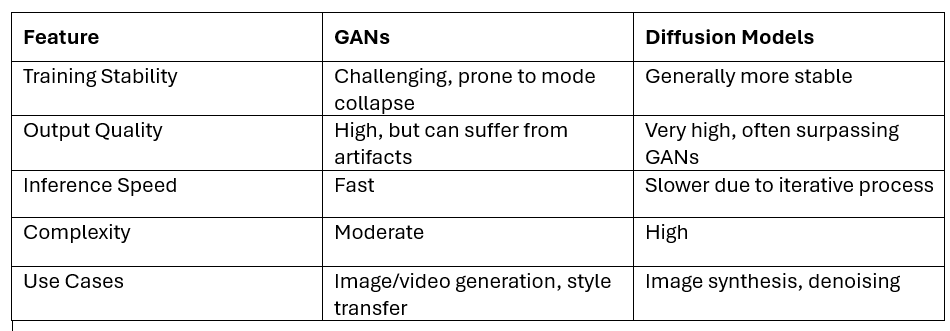
For a more academic perspective, the following research review also provides a similar comparison table.
Synthetic Scientific Image Generation with VAE, GAN, and Diffusion ...
This research paper review on generative models includes a table that summarizes the comparison from a more formal standpoint.
Please read the short paragraph just before Table 3 and review Table 3 itself. This table reinforces the points we've discussed on image quality, diversity, controllability, and training stability.
Conclusion
In this lesson, we compared the two titans of image generation: Generative Adversarial Networks and Diffusion Models. While GANs held the crown for a long time, diffusion models have emerged as a powerful competitor, often winning on image quality and diversity at the cost of slower generation times.
Key Takeaways:
- GANs operate on an adversarial principle (Generator vs. Discriminator), are very fast at inference, but can be unstable to train and may suffer from mode collapse, limiting output diversity.
- Diffusion Models use an iterative denoising process, produce state-of-the-art image quality and diversity, and are stable to train. Their main drawback is slow inference speed.
- The choice between them involves a trade-off: speed and efficiency (GANs) vs. quality and diversity (Diffusion Models).
- Research is constantly evolving to mitigate the weaknesses of both architectures, with efforts to speed up diffusion sampling and improve GAN stability and quality (e.g., GigaGAN).
Preview of the Next Lesson
Both GANs and diffusion models are powered by massive neural networks. Training these models effectively is a monumental task that depends heavily on the choice of optimizer. In our next lesson, we will kick off a new module on advanced training techniques by diving into the most important optimization algorithms used in deep learning: SGD, Momentum, RMSProp, and Adam. Understanding these will be crucial as we move toward training our own deep neural networks.