Recommended resources
The freely available resources this lesson will direct you to.
Welcome back. Last lesson turned the 100 MW solar plant’s study questions into a data-request checklist. Some responses may arrive as preliminary designs, some will need clarification, and the grid-side cases may come from a different organization altogether. This lesson addresses what happens next: how to state what the study assumes, and how to decide whether its results are acceptable.
We will keep Bus B as the point of interconnection (POI) and Terminal T as the ownership boundary. The reactive-capability measurement point is still provisional. By the end, you will have a compact, reviewable set of assumptions and criteria for the four study questions carried forward from the previous lessons. Allow about 40–45 minutes, including the focused readings.
Separate the conditions of a study from its pass–fail rules
A study assumption states a condition under which a result was produced: the plant’s dispatch, the network configuration, an equipment parameter, or how a control operates. An acceptance criterion states how the result will be judged. Both must be specific enough that another analyst could repeat the test and reach the same classification.
Compare these two statements:
“Study the plant at full output and check for overloads.”
“In the approved summer-peak grid case, dispatch the plant to 100 MW net injection at Bus B. With the system intact, compare each monitored branch’s maximum terminal loading with its applicable normal rating. Repeat for the agreed single-element outages using the applicable emergency ratings.”
The second statement identifies an operating point, measurement location, case, events, monitored quantity, and rating basis. It still needs the case revision, monitored-branch list, outage list, and approved ratings before it can govern a live study. Specific wording makes those remaining gaps visible.
NERC’s TPL-001-5.1 — Transmission System Planning Performance Requirements illustrates why documenting assumptions matters in a transmission planning assessment. Read it for the discipline of declaring cases and testing credible changes—not as a declaration that this hypothetical interconnection is itself a TPL Planning Assessment.
TPL-001-5.1 — Transmission System Planning ...
Read NERC’s requirements for documented planning assumptions and sensitivity cases. They provide a useful model for making the solar study’s operating conditions explicit.
On pp. 2–3, find Requirement R2, beginning with the annual Planning Assessment, then Part 2.1.3 on sensitivity cases. Read R2 and sensitivity cases. Focus on the difference between a documented base condition and a credible variation that produces a measurable system response.
For our solar plant, 100 MW net at Bus B is a proposed base-case assumption, not yet an established equipment capability. D-02 must confirm what “100 MW” denotes and whether losses and auxiliary demand have been accounted for. A useful sensitivity might change the plant dispatch or a credible grid condition; it should have a stated purpose rather than exist simply because the software can run it.
Freeze a reproducible scenario before judging results
An assumption is most useful when it answers which version, which value, and whose evidence? Consider the following illustrative study scenario. Its numerical values are teaching examples, not requirements drawn from the readings or approved limits for an actual project.
| Assumption ID | Illustrative assumption to record | Evidence or status to resolve |
|---|---|---|
| A-01: plant output | Model 100 MW net injection at Bus B in the full-output case; record gross inverter output, auxiliaries, and modeled losses separately. | Confirm against D-02. Mark provisional until the rating and measurement point are verified. |
| A-02: grid conditions | Use identified peak and off-peak grid-case revisions. Include the facilities specified as in service in each revision; compare cases with and without the proposed plant when assessing its impact. | Obtain approved cases and inclusion rules through D-10. Record exact file names or version identifiers in the study record. |
| A-03: outages and ratings | Study the agreed system-intact case and identified single-element outages. For each monitored branch, use the approved normal rating when intact and the approved emergency rating after an outage, subject to that rating’s duration and operating conditions. | Obtain the outage list, monitored-element list, ratings, and their applicability from the study coordinator. |
| A-04: plant controls | State the plant’s control mode, controlled bus, setpoint, reactive limits, and whether taps and switched shunts operate in each case. | Confirm against D-03, D-06, D-09, and the grid-case instructions. |
| A-05: faults and protection | Identify the fault locations, clearing actions and times, and the grid and plant models used. | Confirm grid-side information through D-10 and plant settings through D-09. Do not replace missing settings with unexplained defaults. |
The point is not to fill every cell with a plausible number. It is to distinguish confirmed, provisional, and unavailable inputs. If the transformer impedance arrives without its MVA base, for example, the study should record both the temporary value used for a screening run and the unresolved D-04 request. A screening result based on it is not a verified final result.
A published interconnection report shows how this looks in practice. In the historical MISO DPP 2018 April Central Area Study Phase II Report, bench and study cases are distinguished, and monitored elements, contingencies, and solution controls are specified. Its case names and settings belong to that study, not automatically to ours.
MISO DPP 2018 April Central Area Study Phase II Report
Use this historical MISO report as an example of reproducible case documentation: it says what differs between the reference and project cases and how the contingency analysis is solved.
On pp. 15–16, read Section 3, “Model Development and Study Assumptions,” from Section 3.1, “Base Case Models,” through the comparison in Section 3.4, “Study Methodology”: case assumptions. Notice the named case sets, normal versus emergency monitoring, contingency categories, and treatment of taps and shunts.
A case that solves successfully is not necessarily the case you intended. If the study case contains the plant but also an unrecorded network upgrade absent from the reference case, a before-and-after difference cannot be attributed confidently to the plant. Record case differences before interpreting result differences.
Write criteria with a measurement point and an authority
The criterion should identify not just a threshold, but where, when, and under which event it applies. It should also say where the threshold came from. An interconnection agreement, current provider procedure, transmission-owner criterion, equipment rating, and study-team screening objective may serve different purposes. An attractive number from another region’s report is not a substitute for the applicable criterion.
NERC TPL-001-5.1 makes this distinction explicit for transmission planning: it calls for documented voltage and instability criteria, while its planning-event table refers to applicable facility ratings and limits established by the relevant planners. It does not supply a universal POI voltage band that we can copy into this solar study.
TPL-001-5.1 — Transmission System Planning ...
Return to the NERC document to distinguish a required kind of criterion from a numerical limit that must be established for a particular system.
On p. 10, read Requirements R5–R6, beginning with voltage and instability criteria. Then on p. 22, read the “Steady State Only” and “Stability Only” entries in Table 1, from planning-event criteria. Note who establishes voltage limits, and why a rating must be identified before it can be checked.
The MISO report provides a different kind of example: numerical rules for deciding when an overloaded facility or out-of-limit bus becomes an interconnection constraint attributable to studied generators. Those screening and attribution rules are not identical to the underlying question, “Is this result within an applicable operating limit?”
MISO DPP 2018 April Central Area Study Phase II Report
Read this report’s criteria as an example of how an operator defines project impact, not as universal thresholds for the hypothetical plant.
On p. 16, find Section 3.5, “Performance Criteria.” Read thermal and voltage criteria. Separate the tests for a facility already being overloaded from the additional tests used to decide whether a study generator is responsible for mitigating that constraint.
The distinction is professionally important. Suppose a branch exceeds its rating in both the reference case and the case with the solar plant. You must report the exceedance. Whether the project caused or materially worsened it requires a separate comparison under the applicable attribution methodology. Conversely, a small project impact does not turn an overloaded branch into a healthy one.
Apply the pattern to the four solar study questions
The following is a draft study specification for illustration. Numbers introduced here are hypothetical screening values. Before use on a real project, replace them with confirmed equipment data and current, applicable, approved criteria; otherwise label the associated result screening only or indeterminate.
| Study question | Measurable assumption or test condition | Acceptance criterion and evidence needed |
|---|---|---|
| R-01: steady-state grid impact | Run A-01 through A-04 for each approved grid case and outage. Record voltage at Bus B and each agreed monitored bus; record maximum loading at both ends of each monitored branch. | For the intact case, loading must not exceed that branch’s applicable normal rating; after each specified outage, it must not exceed the applicable emergency rating under its stated duration and operating conditions. Voltages must meet the separately supplied normal and post-outage bus limits. Record the rating and voltage-criterion source beside each result. |
| R-02: reactive capability | At 100 MW net at Bus B, test the agreed voltage conditions and both reactive-power directions. As an illustrative project target, consider MVAr injection and MVAr absorption measured at Bus B. State the sign convention and the control/measurement point. | The modeled facility must attain each approved POI reactive target without exceeding documented inverter, transformer, or plant-control limits. Until D-03 confirms capability and the target and measurement point are approved, report the numerical result without a final pass–fail claim. |
| R-03: dynamic performance | Specify a particular faulted element, fault type and location, pre-fault dispatch, clearing actions and times, and simulation duration. For example, a screening event could be initiated at 1.00 s, cleared at 1.10 s, and simulated to 11.10 s. Monitor Bus B voltage and plant active/reactive response. | Check connection status and stability against the applicable ride-through and system-performance requirements. If the agreed screening rule were “Bus B voltage reaches at least per unit within 2 s after clearing and remains at or above that value for the rest of this run,” record exactly how the trace meets it. Do not present this illustrative rule as an applicable ride-through requirement. Confirm protection settings and event details before a final determination. |
| R-04: Bus B breaker duty | Calculate fault duty for the specified fault types and system configurations using documented sequence, grounding, and inverter fault-response inputs. Identify the actual Bus B breaker and the basis of its rating. | Compare each calculated duty with the breaker’s corresponding applicable interrupting capability, including the required voltage, current basis, X/R or asymmetry treatment, and contact-parting or clearing-time considerations. A numerical comparison without a matched rating basis is incomplete. |
Notice how R-02 distinguishes a plant performance target from an input assumption. Writing “assume the plant provides MVAr” would conceal the very capability the study is meant to test. Likewise, R-04 does not declare a breaker adequate merely because one calculated symmetrical-current number is smaller than a nameplate number; the quantities must be comparable on the required duty basis.
For a concise results record, pair each criterion with a result, classification, and evidence reference. A classification vocabulary might be meets criterion, does not meet criterion, screening only, or indeterminate—required input or criterion pending. This prevents a blank criterion cell from being mistaken for a pass.
Keep study-area screens separate from acceptance
A network study cannot monitor every conceivable element at equal depth. It may use electrical-impact factors to identify a study area, then apply ratings and voltage criteria within the agreed scope. The supplied network sketch depicts an orange “5% DFAX Circle”, an overload symbol, and facilities at different development stages.
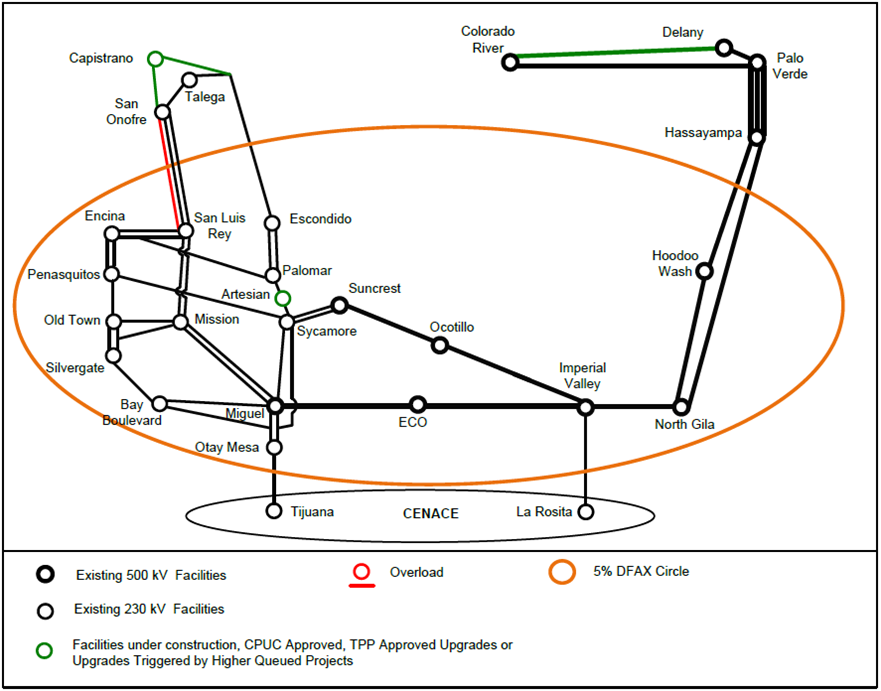
This is not our Bus B network. In particular, the orange boundary cannot tell us whether a Bus B result passes, whether a particular project caused an overload, or whether 5% is the applicable screen in another jurisdiction. A study-area rule answers what to examine; a performance criterion answers how to judge a measured result; an attribution rule answers what impact belongs to the project. Keep all three in separate fields of the study record.
A final quality check is to read each draft sentence as if you had to reproduce the study six months later. “Use normal clearing” needs a defined fault, clearing action, and time. “Voltage is acceptable” needs a bus, event, observation window, limit, and source. “Plant meets requirements” needs the tested operating point and the specific applicable requirement. Where any of those are pending, say so rather than quietly supplying a default.
Key takeaways
A reviewable study package makes its operating assumptions reproducible and its acceptance criteria traceable. State values with units and measurement points; identify cases, contingencies, controls, ratings, and revisions; distinguish provisional inputs from confirmed ones. Judge performance against applicable criteria, and assess project attribution separately from the existence of a violation.
This completes the study-scoping module: you have moved from identifying the study decision to defining its governing requirements, boundaries, data needs, assumptions, and tests. The next module supplies the network and inverter fundamentals needed to understand what the models actually calculate.