Recommended resources
The freely available resources this lesson will direct you to.
Welcome to the final lesson of our course. You've come an incredible distance, moving from the fundamentals of algorithmic thinking to mastering a wide array of patterns for solving complex problems. In our last session, we simulated a full technical interview, applying a structured framework to solve a Medium-level problem under pressure. That exercise solidified the process—clarify, plan, code, test, and analyze—that transforms interview anxiety into a confident demonstration of your engineering skills.
Today, we take the final step. We're going to demystify LeetCode Hard problems. These problems often feel like the final boss of interview preparation, but the reality is more encouraging. A "Hard" problem is rarely about some esoteric, never-before-seen algorithm. Instead, it's typically a composite problem that weaves together two or more of the patterns you already know.
This lesson's goal is to equip you with the mindset and methodology to decompose a selected LeetCode Hard problem into its component patterns before you even start implementation. Think of it like breaking down a complex UI feature into smaller, well-defined components. The same engineering discipline applies here. By learning to see the patterns within the puzzle, you'll find that even the most intimidating problems become manageable. Let's begin.
What Makes a Problem "Hard"?
Before we can solve Hard problems, it's crucial to understand why they are labeled as such. It's not about being a "genius"; it's about navigating increased complexity. The jump from Medium to Hard typically involves one or more of the following:
- Multiple, Combined Patterns: The problem requires you to use two or more patterns in sequence. For example, using Breadth-First Search (BFS) to find a shortest path length, and then using Backtracking (DFS) to reconstruct all the paths of that length.
- Non-obvious Problem Modeling: You might need to recognize that a problem described in terms of words or grids is actually a graph problem in disguise.
- Specialized Data Structures: A standard approach might be too slow, requiring a more advanced data structure like a monotonic deque or a trie for an optimal solution.
- Complex State Representation: For Dynamic Programming or Backtracking problems, defining the state you need to track can be much more intricate than in Medium problems.
The key to overcoming this is to avoid common mistakes, especially the temptation to jump straight into coding.
Struggling with LeetCode Hard? A Step-by-Step Guide with Real Examples - Lodely
This article from Lodely does an excellent job of outlining the common pitfalls when approaching Hard problems. Please read the section on "Common Mistakes When Solving Hard Problems".
Focus on the list of mistakes. Notice how many of them are about a lack of a systematic process, such as jumping to code or memorizing solutions, rather than a lack of raw coding ability. This reinforces why our pattern-based approach is so vital.
A Four-Step Framework for Decomposition
Hard problems require a more rigorous and explicit planning phase. Here is a systematic framework to break down any complex problem.
- Analyze the Anatomy of the Problem: Before anything else, become a detective and scrutinize the problem statement for clues. The constraints, input/output formats, and keywords are powerful signals.
- Formulate a Brute-Force Solution: Articulate a simple, even if inefficient, solution. This confirms your understanding and exposes the core computational task. The inefficiency of this approach is the "bottleneck" you need to optimize.
- Identify the Core Pattern(s): Based on the clues from Step 1 and the bottleneck from Step 2, form a hypothesis about the underlying patterns.
- Plan the Implementation: Sketch out how the identified patterns will work together to form the final algorithm.
Let's explore Step 1 in more detail, as it's the most powerful filtering tool you have.
Step 1: Analyze the Anatomy of the Problem
The clues to a problem's solution are often hidden in plain sight. Mastering pattern recognition starts with knowing where to look. The following video and reference table provide an excellent guide to connecting problem characteristics with algorithmic patterns.
How to Instantly Recognize Leetcode Patterns (500 problems later)
The video "How to Instantly Recognize Leetcode Patterns" by Bitflip provides a fantastic, systematic checklist. Pay close attention to how he uses different parts of the problem statement to narrow down the possibilities.
Watch these key segments: Checking Constraints: This is a crucial, often overlooked first step. The size of n tells you the required time complexity. Input Format: Whether you're given a sorted array, a tree, or a graph is a massive hint. Output Format: What you need to return (e.g., a single number, all combinations) points to specific patterns. Question Keywords: This section highlights explicit phrases that are strong signals for certain algorithms.
The leetcode-patterns resource provides a similar set of heuristics in a handy table format. It’s a great cheat sheet to have open when you're practicing.
This resource by Sean Prashad is a concise table mapping problem conditions to likely algorithmic approaches.
Review the entire table. This is the kind of mental model you want to build. When you see "If input array is sorted," your mind should immediately jump to "Binary search, Two pointers."
Now, let's apply this framework to a couple of classic LeetCode Hard problems.
Worked Example 1: Trapping Rain Water (LeetCode 42)
Problem: Given n non-negative integers height representing an elevation map where the width of each bar is 1, compute how much water it can trap after raining.
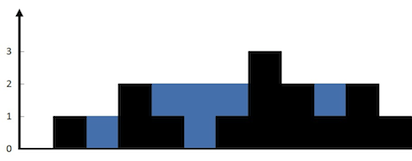
Decomposition
-
Analyze:
- Input: An array of integers (
height). Not sorted.
- Output: A single integer (total water).
- Keywords: "trap water". This suggests we're interested in being "bounded" on both sides.
- Constraints:
ncan be up to2 * 10^4. This means an O(n²) solution might be too slow, and we should aim for O(n) or O(n log n).
- Input: An array of integers (
-
Brute-Force:
For each bari, the water it can hold is determined by the walls to its left and right. The water level will rise to the height of the shorter of the two tallest walls surrounding it.
So, for eachi, we can:- Find
left_max= the maximum height of all bars from0toi. - Find
right_max= the maximum height of all bars fromiton-1. - The water trapped at
iismin(left_max, right_max) - height[i]. We only add this if it's positive. - Sum this up for all
i.
This involves a nested loop structure (iterating for eachi, then scanning left and right). Complexity: O(n²). As predicted, this is likely too slow.
- Find
-
Identify Core Pattern(s):
The bottleneck is re-calculatingleft_maxandright_maxfor every single bar. This is repeated work.- Pattern 1: Precomputation / Dynamic Programming. Can we pre-calculate these values? Yes. We can create an array
left_maxeswhereleft_maxes[i]is the max height up toi. We can do this in one pass from left to right. Symmetrically, we can create aright_maxesarray in one pass from right to left. Then, in a third pass, we can calculate the trapped water at eachiusingmin(left_maxes[i], right_maxes[i]) - height[i]. This approach takes O(n) time and O(n) space. This is a great optimized solution. - Pattern 2: Two Pointers. Can we do even better and use O(1) space? Let's reconsider the formula
min(left_max, right_max). Imagine two pointers,leftat the start andrightat the end. We also trackleft_max_so_farandright_max_so_far.- If
height[left] < height[right], the amount of water at theleftpointer's position is determined byleft_max_so_far, because we know there's a taller wall (height[right]) somewhere to the right. Theright_maxis not the limiting factor here. We can calculate water atleft, and moveleftinward. - Symmetrically, if
height[right] <= height[left], the water at therightpointer is determined byright_max_so_far. We calculate water and moverightinward.
This elegant approach also achieves O(n) time but with O(1) space.
- If
- Pattern 1: Precomputation / Dynamic Programming. Can we pre-calculate these values? Yes. We can create an array
This problem demonstrates how decomposing the brute-force logic reveals opportunities for optimization, leading to two distinct patterns: a DP-like precomputation and a clever two-pointer solution.
Worked Example 2: Sliding Window Maximum (LeetCode 239)
Problem: You are given an array of integers nums and an integer k. There is a sliding window of size k which is moving from the very left of the array to the very right. You can only see the k numbers in the window. Return the maximum value in each sliding window.
Decomposition
-
Analyze:
- Input: An array
nums, an integerk.
- Output: An array of numbers (the max of each window).
- Keywords: "sliding window", "maximum". This is a very strong signal.
- Constraints:
nup to10^5. An O(n*k) solution will be too slow. We need something closer to O(n).
- Input: An array
-
Brute-Force:
Iterate through all possible starting positions of the window (from0ton-k). For each window, iterate through itskelements to find the maximum. Complexity: O(n*k). As expected, this won't pass. -
Identify Core Pattern(s):
The keywords and our pattern-recognition resources point us in a clear direction.- The
leetcode-patternstable: "If asked for sliding window max/min" -> Monotonic queue. - The
Struggling with LeetCode Hard?article explicitly uses this problem as an example for the Deque / Monotonic Queue pattern.
The pattern is clear: this problem is designed to be solved with a specialized data structure. A monotonic deque (a double-ended queue) is perfect for this.
- The
-
Plan the Implementation:
We will use a deque to store indices of elements fromnums. The deque will be kept "monotonic decreasing" based on the values at those indices.
For each elementnums[i]as we iterate through the array:- Clean the front: Remove indices from the front of the deque that are no longer in the current window (i.e., their index is
<= i - k). - Maintain monotonicity: While the deque is not empty and the value at the index at the back of the deque is less than
nums[i], pop from the back. This ensures that we only keep potentially maximal elements. - Add the new element: Push the current index
ito the back of the deque. - Record the max: Once the window is full (
i >= k - 1), the maximum element for the current window isnums[deque.front()]. Add this to our result.
- Clean the front: Remove indices from the front of the deque that are no longer in the current window (i.e., their index is
By decomposing the problem, we went from a slow O(n*k) approach to identifying a very specific pattern (monotonic deque) that gives us an optimal O(n) time solution, as each element is pushed and popped from the deque at most once.
Conclusion and Course Wrap-Up
Throughout this course, we've journeyed from foundational concepts to the most challenging interview patterns. Today, we've seen that LeetCode Hard problems are not an insurmountable wall but intricate puzzles built from familiar pieces. The key is not to have a flash of genius, but to apply a systematic process of decomposition—analyzing the problem's anatomy, identifying bottlenecks, and mapping them to the patterns you have diligently learned.
Key Takeaways:
- Hard problems are composite problems. They test your ability to connect and combine patterns you already know.
- Decomposition is a repeatable skill. By methodically analyzing constraints, inputs, outputs, and keywords, you can turn an intimidating problem statement into a concrete plan.
- Pattern recognition is your superpower. Your investment in learning patterns like two-pointers, sliding windows, BFS, and DP is what allows you to see the structure within the complexity.
You began this journey with a goal to finally master algorithms and overcome "algo phobia." You are now equipped with not just a toolbox of algorithms, but a robust framework for thinking like a problem-solver. Your extensive engineering background, combined with this new structured approach to algorithms, is a powerful combination.
This is the end of the formal lessons, but it's the start of your confident practice. Continue to apply this decomposition framework. Treat every problem, no matter how hard, as an opportunity to hone your analytical process. You have the tools, you have the method, and you have the experience. Congratulations on completing this journey and investing in your professional growth. You are ready.