Recommended resources
The freely available resources this lesson will direct you to.
Welcome to the final lesson of our course. Over the past several weeks, you've built a formidable toolkit of algorithmic knowledge, progressing from the fundamentals of complexity analysis to advanced patterns like dynamic programming. Most recently, we focused on the crucial skill of systematically debugging flawed solutions, turning errors from a source of anxiety into an opportunity to showcase your analytical rigor.
Today, we bring everything together. This lesson is your dress rehearsal for the main event: a technical interview. Our goal is to simulate the entire process of solving a Medium-level problem under a time constraint. You will learn to apply a structured, five-step framework to clarify the problem, devise a solution, implement it cleanly, test it thoroughly, and explain your reasoning—all within the typical 45-minute window. This structured approach is the key to managing interview pressure and demonstrating the full scope of your abilities.
This is the culmination of your journey to overcome "algo phobia" and master technical interviews. Let's begin.
The Anatomy of a Coding Interview
A technical interview is more than a test of your coding ability; it's an assessment of your problem-solving process, communication skills, and engineering maturity. Interviewers want to see how you think. Having a reliable framework allows you to focus your mental energy on the problem itself, rather than on what you're "supposed" to be doing.
The image below presents an excellent five-step process that we will use as our guide. It breaks down a 45-60 minute interview into manageable phases, from understanding the problem to verifying the solution.
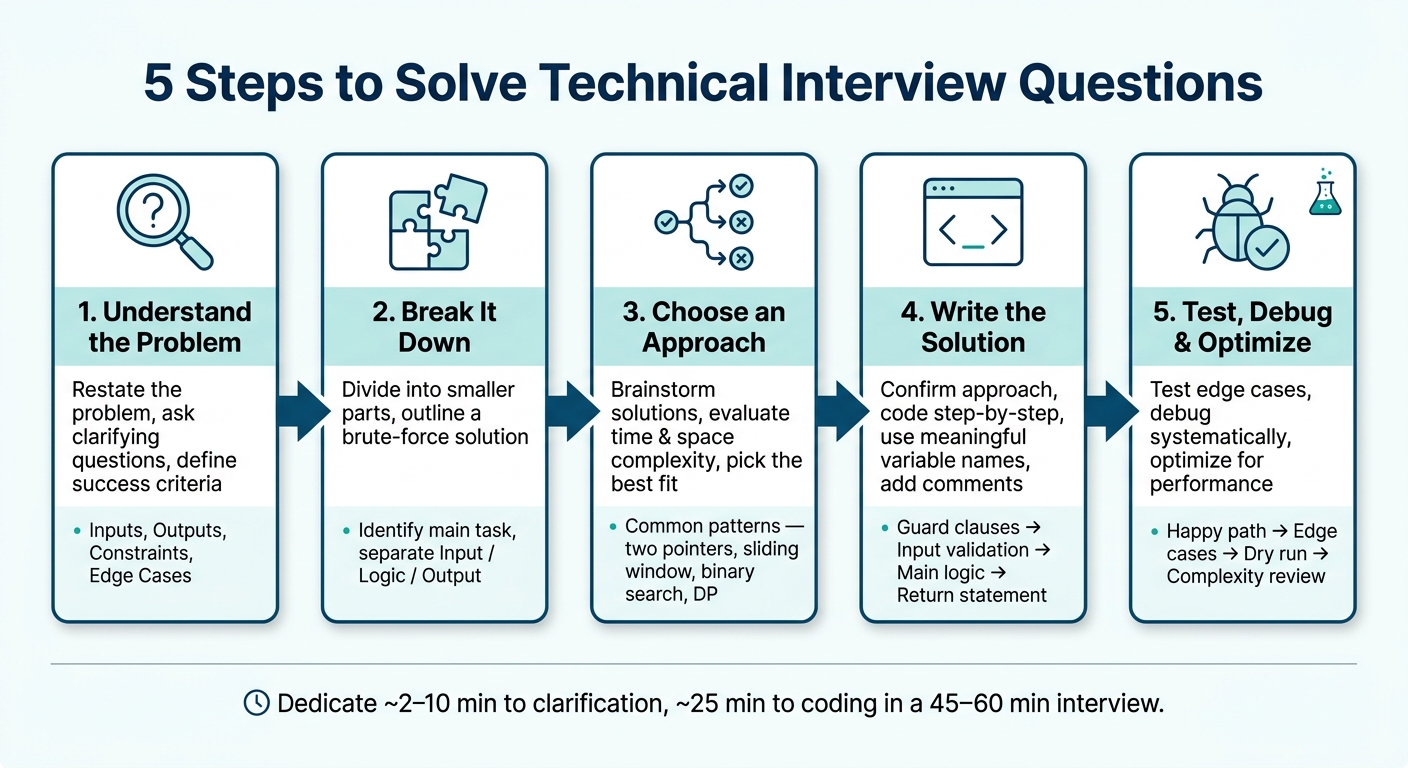
We will explore each of these steps in detail, using insights from our curated resources to understand what is expected in each phase.
Step 1: Understand the Problem (2-10 minutes)
As a senior developer, you know that rushing into a solution without fully understanding the requirements is a recipe for disaster. The same is true in an interview. The first few minutes are your chance to de-risk the entire session.
The 30-minute guide to rocking your next coding interview
This guide by Yangshun Tay provides a fantastic, real-world overview of the interview process. Focus on the section "What to do when you get the question."
Read from the beginning of the section. Pay close attention to the list of clarifying questions provided. These are your primary tools for scoping the problem.
The key actions in this phase are:
- Restate the problem: Repeat the question in your own words to confirm you've understood it correctly.
- Ask clarifying questions: Use the list from the article as a starting point. Your goal is to uncover all implicit assumptions about the inputs, outputs, and constraints. This directly uses the skills we built in the very first module.
- Input size and value range? (e.g.,
n <= 10^5) - Data types? (e.g., integers, floats, ASCII strings, Unicode?)
- Are inputs sorted? Can they contain duplicates?
- What are the edge cases? (e.g., empty arrays, null inputs)
- Input size and value range? (e.g.,
- Define success criteria: Manually work through one or two small examples to ensure you and the interviewer agree on the expected output.
This initial dialogue demonstrates thoughtfulness and attention to detail, traits of a senior engineer. It also buys you time to let the problem sink in.
Steps 2 & 3: Break It Down and Choose an Approach (5-10 minutes)
Once the problem is clear, the next step is to devise a plan. It's crucial to communicate your thought process here. Don't solve the problem in silence.
- Start with a Brute-Force Solution: As the "30-minute guide" suggests, you should
always start with a simple, straightforward solution, even if you know it's inefficient. This achieves two things: it proves you can solve the problem, and it provides a baseline for optimization. - Analyze Complexity: State the time and space complexity of your brute-force approach. For example: "This approach involves a nested loop, so it would be O(n²). Given the constraint that n can be up to 10^5, this will likely be too slow. We need to find a more optimal solution."
- Identify Bottlenecks and Patterns: This is where you connect the problem to the patterns you've learned throughout this course. Ask yourself: What is the repeated work in the brute-force solution? Can I use a hash map to avoid re-computation? Is the data sorted, suggesting binary search or two pointers? Am I looking for a contiguous subarray, suggesting a sliding window?
- Propose the Optimal Approach: Explain your optimized strategy and its new time and space complexity. For example: "By using a hash map to store pre-computed values, we can eliminate the inner loop and reduce the time complexity to O(n)." Get the interviewer's buy-in before you start coding.
Step 4: Write the Solution (20-25 minutes)
With an agreed-upon plan, you can begin implementation. Your extensive experience as a front-end lead is a huge asset here. You naturally write clean, readable code.
The 30-minute guide to rocking your next coding interview
Review the sections on the coding and post-coding phases.
Focus on the advice in Starting to code and the review process described in After coding.
Key points for this phase:
- Think Out Loud: Explain what you are implementing at a high level. For instance, "First, I'll initialize my hash map. Now, I'll iterate through the input array to populate the map." This keeps the interviewer engaged.
- Use Clear Naming: Your code should be largely self-documenting. Use meaningful variable names (
charFrequencyinstead ofmap). - Write Modular Code: If you find yourself writing a complex block of logic, consider extracting it into a helper function. This is a strong signal of good software engineering practice.
Step 5: Test, Debug & Optimize (5-10 minutes)
Do not announce "I'm done" the moment you finish typing. Your code likely has small bugs. The final phase is your chance to demonstrate a commitment to quality.
As we covered in the previous lesson, debugging is a structured process.
- Review Your Code: Read through your code one last time, looking for off-by-one errors, incorrect variable names, or other common mistakes.
- Develop Test Cases: Proactively suggest test cases. Start with the "happy path" example you used earlier. Then, add edge cases: empty input, input with all unique values, input with all identical values, etc.
- Perform a Dry Run: Walk through your code with one of the test cases, line by line, verbalizing the state of your variables. This is the single most effective way to catch logic errors, as we saw in the
Medium Google Coding Interviewvideo with Ben Awad. - State Final Complexity: Conclude by restating the time and space complexity of your final solution and explaining any trade-offs you made.
The Mock Interview Walkthrough
Let's put this framework into practice. I will be your interviewer. Your problem is Group Anagrams.
Problem: Given an array of strings strs, group the anagrams together. You can return the answer in any order. An Anagram is a word or phrase formed by rearranging the letters of a different word or phrase, typically using all the original letters exactly once.
Example:
Input: strs = ["eat","tea","tan","ate","nat","bat"]
Output: [["bat"],["nat","tan"],["eat","tea","ate"]]
Phase 1: Clarification (You and I)
- You: "Okay, the task is to group words that are anagrams of each other. First, some clarifying questions. Are the strings all lowercase English letters? What are the constraints on the number of strings and their length? What should I do if the input array is empty?"
- Me (Interviewer): "Great questions. Yes, all strings consist of lowercase English letters. The input array
strswill have between 0 and 10,000 strings. Each string's length is between 0 and 100. If the input is empty, you should return an empty array."
Phase 2 & 3: Planning (You)
- You (Brute-Force): "A simple brute-force way to do this would be to take each string and compare it to every other string to see if they are anagrams. To check if two strings are anagrams, I could sort their characters and see if the sorted versions are identical. This would involve a nested loop, making the complexity O(N² * K log K), where N is the number of strings and K is the maximum length of a string (for sorting). This is too slow for N=10,000."
- You (Optimization): "The bottleneck is the repeated anagram check. We can do better. The sorted version of a string can serve as a canonical key for a group of anagrams. For example, 'eat', 'tea', and 'ate' all become 'aet' when sorted. I can use a hash map where the key is the sorted string and the value is a list of all its corresponding anagrams. I would iterate through the input strings once. For each string, I'd sort it to create a key, and then add the original string to the list associated with that key in the map. Finally, I would return the values of the map. This approach would have a time complexity of O(N * K log K) and space complexity of O(N * K)."
- Me (Interviewer): "That sounds like an excellent approach. Please go ahead and code it."
Phase 4 & 5: Implementation & Verification (You)
Here is a clean implementation based on your proposed plan.
function groupAnagrams(strs: string[]): string[][] {
    if (strs.length === 0) {
        return [];
    }

    const anagramMap = new Map<string, string[]>();

    for (const str of strs) {
        // Create the canonical key by sorting the string's characters
        const key = str.split('').sort().join('');

        // If the key isn't in the map, initialize it with an empty array
        if (!anagramMap.has(key)) {
            anagramMap.set(key, []);
        }

        // Add the original string to the list for this key
        anagramMap.get(key)!.push(str);
    }

    // The values of the map are the grouped anagrams
    return Array.from(anagramMap.values());
}
- You (Testing): "Now, let's test this. For
strs = ["eat", "tea", "tan"]:str = "eat". Key becomes "aet". Map is{"aet": ["eat"]}.str = "tea". Key becomes "aet". Map becomes{"aet": ["eat", "tea"]}.str = "tan". Key becomes "ant". Map becomes{"aet": ["eat", "tea"], "ant": ["tan"]}.
The final output would be[["eat", "tea"], ["tan"]]. This looks correct."
- You (Edge Cases): "For an empty input
[], the initial check returns[]. Correct. For["a"], the map would be{"a": ["a"]}and the output[["a"]]. Correct. For["", ""], the key would be""and the output[["", ""]]. Correct."
This completes the interview process for this problem, well within the time limit and demonstrating competence at every step.
Learning from Real Interviews
Watching others navigate the pressures of an interview is incredibly instructive. The following videos show senior engineers solving problems, making mistakes, and communicating their thought process.
Senior Software Engineer Mock Technical Interview (Coding/Algorithms in JavaScript)
In "Senior Software Engineer Mock Technical Interview", watch how Dan, a senior developer like yourself, tackles a problem that evolves in complexity. This video is valuable because it shows a realistic, iterative problem-solving session.
Clarification and Initial Idea: Watch from the problem statement at the beginning to see how Dan clarifies the problem and quickly implements a simple solution using a Set. Handling a Twist: The interviewer adds a wildcard feature. Observe how Dan adapts, first proposing a regex-based solution from this point. Getting Stuck and Receiving Hints: This is a critical part of any interview. From this timestamp, watch how the interviewer guides Dan toward a more optimal solution involving pre-computation. Notice Dan's initial confusion and how he works through it collaboratively. This is a perfect example of handling a "trough" gracefully. The Debrief: The feedback from the interviewer, Sophie, is gold. Listen from the debrief section to understand what she valued (fluency, speed) and where Dan could improve (clarifying more upfront, framing things positively).
This next video shows a different style, but is just as insightful, particularly for its clear demonstration of debugging a subtle algorithmic bug.
Medium Google Coding Interview With Ben Awad
In "Medium Google Coding Interview With Ben Awad", Clément Mihailescu interviews Ben on a graph-style matrix problem. This is a masterclass in thinking out loud and debugging under pressure.
Exploring and Discarding Ideas: From this point, Ben explores several initial ideas, including a "jank" one involving rings, and correctly identifies that it won't work. This shows self-correction. Finding the Core Idea: He quickly pivots to a Depth-First Search (DFS) approach starting from this segment, realizing the matrix itself is an implicit graph. The Bug: After implementing the DFS, his code fails some test cases. The debugging process, from identifying the failure to finding the bug, is a must-watch. He realizes he's checking for visited nodes in the wrong place in his recursion, causing an infinite loop. This is a very common DFS bug. Complexity Analysis: Finally, watch the discussion on time and space complexity. This reinforces the importance of being able to justify your algorithm's performance.
Conclusion
You have reached the end of this course, but it is just the beginning of a new phase in your professional growth. You began this journey with a goal to finally conquer algorithms and a self-professed "algo phobia." Today, you are equipped not only with knowledge of specific data structures and algorithms but, more importantly, with a robust, repeatable process for solving unfamiliar problems under pressure.
Key Takeaways:
- The Five-Step Framework is Your Anchor: In the heat of an interview, rely on the process: Clarify -> Plan -> Code -> Test -> Analyze. It provides structure and ensures you hit all the points an interviewer is looking for.
- Communication is Non-Negotiable: Think out loud. Explain your brute-force approach, the bottleneck, and your proposed optimization. Walk through your code and test cases.
- Mistakes are Part of the Process: As the mock interviews show, even strong engineers get stuck and make bugs. How you recover—by staying calm, thinking systematically, and collaborating with your interviewer—is what truly defines your seniority.
You have invested the time and effort to build a deep, foundational understanding of algorithmic problem-solving. Your years of software engineering experience provide a massive advantage in writing clean, high-quality code. By combining that experience with the structured thinking you've honed in this course, you are fully prepared to excel in any technical interview. Congratulations on this significant achievement.