Recommended resources
The freely available resources this lesson will direct you to.
Hello! Welcome back to our course on architecting security products.
In our previous lesson, we designed the communication channels for our Runtime Application Self-Protection (RASP) agent, focusing on how it exports rich, contextual event data to SIEMs and how it can create a powerful feedback loop to a Web Application Firewall (WAF). This naturally leads to a crucial architectural question: if these tools can work together, how are they fundamentally different?
This lesson directly addresses that question. Our learning outcome is to compare RASP vs. WAF architectures, evaluating the trade-offs between inline app-level vs. network-level protection.
We will move beyond seeing them as just two boxes in a diagram and dive into the core design principles that make them distinct. As someone keen on building security products, understanding these first-principles differences in architecture, detection mechanisms, and operational trade-offs is essential for making informed design decisions.
1. The Fundamental Architectural Distinction: Placement and Perspective
The single most important difference between a WAF and a RASP lies in where they are deployed and the perspective that deployment gives them. Everything else—their detection capabilities, their weaknesses, and their performance characteristics—stems from this core distinction.
-
WAF: The Perimeter Guard (Network-Level)
A WAF operates outside and in front of the application. It's almost always implemented as a reverse proxy that inspects all incoming HTTP/S requests before they reach your application server. Its perspective is that of a gatekeeper looking at traffic passing by. -
RASP: The Internal Agent (Application-Level)
A RASP operates inside the application's own process. It instruments the application runtime (e.g., the JVM, the Node.js event loop) to gain deep visibility into what the code is actually doing. Its perspective is that of an insider observing the application's behavior from within.
This architectural drawing visually contrasts the two approaches perfectly.
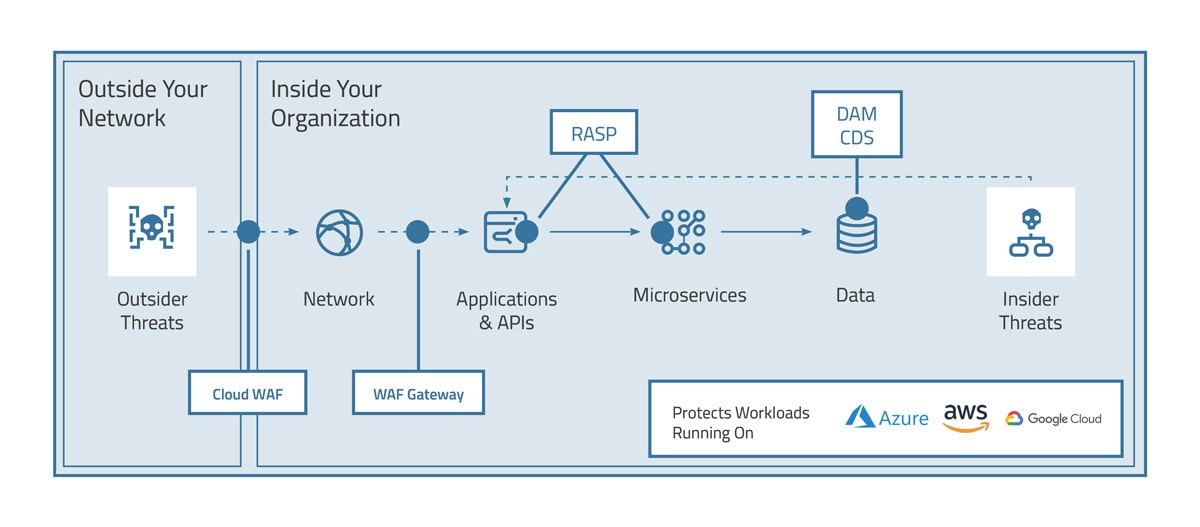
Because of their different locations, they answer fundamentally different questions:
- A WAF asks: "Does this request look malicious based on its structure and content?"
- A RASP asks: "Is this request causing the application to behave in a malicious way?"
To build on this, let's explore how each technology works in more detail.
RASP vs WAF for API Security Guide (2026)
The following resource provides a clear and concise explanation of both RASP and WAF, focusing on their operational mechanics and core architecture. It will help solidify our understanding of their distinct roles.
Please read the following sections from the Levo.ai article: 'What is Runtime Application Self Protection (RASP)?' and 'How does RASP Security work?' to understand its internal, execution-centric model. 'Architecture Of RASP' to see its typical components like instrumentation and sink monitoring. 'What is Web Application Firewall (WAF)?' and 'How does WAF Security work?' to grasp its external, request-centric model. 'Architecture of WAF' to see its components like the traffic interception layer and rule engine. \nFocus on the contrast between RASP's 'execution-centric' model and WAF's 'request-centric' model.
2. Deep Dive: Detection Mechanisms
The difference in perspective dictates the detection mechanisms each technology can employ. This is where the trade-offs in accuracy and coverage become apparent.
WAF: Pattern Matching at the Perimeter
A WAF's analysis is confined to the data it can see in an HTTP request. Its primary detection method is pattern matching.
- Signature-Based Detection: The WAF's rule engine compares request payloads against a large database of regular expressions (RegEx) that represent known attack patterns (e.g.,
_OR_ '1'='1'--). This is fast but brittle. - Heuristics: The WAF might use heuristics to score a request's riskiness. For example, a request containing both
<script>andeval()might get a higher score. - Protocol Compliance: The WAF can block requests that don't conform to HTTP standards, which can stop some scanners and malformed attacks.
The core weakness here is the lack of context. A WAF doesn't know if a payload like ' OR '1'='1 will actually be executed by a vulnerable SQL query or if it's just harmless text being saved to a database field. This ambiguity is a primary source of false positives.
RASP: Behavioral Analysis at Runtime
RASP's internal vantage point allows for far more sophisticated, context-aware detection. The following article explains why this is a significant architectural advantage over traditional methods.
This article from Waratek, a RASP vendor, makes a strong case for why context-aware detection is superior to traditional pattern matching. It explains the mechanics and limitations of each approach.
Please read the sections titled: 'The Pitfalls of Traditional RASPs': This section explains the problem with heuristic methods that lack context, which is highly relevant to WAFs as well. 'Waratek’s Innovative Approach': Focus on the descriptions of Data Tainting and Syntax Analysis. Understand how these non-heuristic techniques work. 'Limitations of RegEx-based Rules': This part gives concrete examples of how simple pattern matching fails for CSRF and Insecure Deserialization, highlighting the need for deeper context. \nThis will give you a first-principles understanding of why RASP can be more precise.
As the article details, modern RASP agents use two powerful techniques that are impossible for a WAF to replicate:
-
Taint Analysis: The agent marks all user-supplied input (from HTTP parameters, headers, etc.) as "tainted." It then tracks this tainted data as it flows through the application's code. If the tainted data reaches a sensitive "sink" function (like
exec, a SQL query executor, or a deserialization method) without first passing through a sanitization function, the RASP agent knows an attack is happening and can block it. It's not guessing based on patterns; it's observing unsafe data flow in real time. -
Syntax Analysis: For attacks like SQL injection, a RASP agent can intercept the final SQL query just before it's sent to the database. It can then parse this query and check its syntactic structure. If the structure was illegally modified by user input (e.g., turning a single
SELECTstatement into two separate statements), the attack is detected. The RASP understands the grammar of SQL, whereas the WAF only understands a few suspicious strings.
3. A Head-to-Head Architectural Comparison
Let's synthesize these points into a direct comparison of the architectural trade-offs. The decision to use a WAF, a RASP, or both depends on balancing these factors for a specific application and threat model.
This summary image provides a quick overview of the key differences.

For a more detailed breakdown, the comparison table in the Levo.ai article is an excellent resource.
RASP vs WAF for API Security Guide (2026)
This table provides a comprehensive, side-by-side comparison of WAF and RASP across several critical parameters.
Please study the table in the 'RASP vs WAF' section. Pay close attention to the trade-offs implied by each row, especially: Security perspective: 'Execution and behavior based' vs. 'Traffic and pattern based'. Visibility into business logic: Note that neither technology is designed to understand business logic abuse. Vulnerabilities best detected: See how their coverage is complementary. Operational overhead: 'Runtime instrumentation' vs. 'Rule tuning and maintenance'.
Here is a summary of the most critical trade-offs for a system architect:
| Attribute | Web Application Firewall (WAF) | Runtime Application Self-Protection (RASP) |
|---|---|---|
| Protection Point | Network Level (Reverse Proxy) | Application Level (Runtime Instrumentation) |
| Primary Strength | Breadth of coverage against known, pattern-based attacks at scale. Filters high-volume "noise." | Depth and accuracy for complex, context-dependent attacks (e.g., injection, deserialization). |
| False Positives | Higher. Lack of context means it may block legitimate requests that look suspicious ("WAF tuning" is a major pain point). | Lower (for the vulnerabilities it covers). Detections are based on actual application behavior, not just patterns. |
| Performance Impact | Adds network latency to every request. Offloads CPU/memory usage from the application server to the proxy itself. | Adds CPU/memory overhead directly to the application process. Can impact application start-time and throughput if not carefully designed. |
| Deployment & Ops | Deployed once at the network edge to protect many apps. Requires constant rule updates and tuning to balance security and availability. | Deployed per-application. Requires language-specific agents and integration into the SDLC. Can be complex in polyglot microservice environments. |
| "Zero-Day" Defense | Poor. Relies on signatures for known vulnerabilities. A new attack pattern requires a new rule. | Better. By focusing on unsafe behaviors (like tainted data reaching a sink), it can often block novel exploits of existing vulnerability classes (e.g., a new SQLi bypass). |
Conclusion
Today we've conducted a deep architectural analysis of WAF and RASP technologies. It's clear they are not interchangeable; they are architecturally distinct solutions that solve different parts of the application security problem. A WAF provides a broad, coarse-grained filter at the perimeter, while a RASP offers a precise, fine-grained defense from within the application itself.
Key Takeaways:
- Architectural Placement is Key: WAF is an external, network-level control that inspects traffic. RASP is an internal, application-level control that observes execution.
- Detection Mechanisms Differ Fundamentally: WAFs rely on pattern-matching on network data, which is fast but lacks context. RASP uses techniques like taint analysis on live application behavior, which is more accurate but adds overhead.
- Trade-offs are Significant: The choice between them (or the decision to use both) involves balancing accuracy, performance overhead, operational complexity, and the specific threats you need to mitigate.
- They are Complementary: A common "defense-in-depth" strategy uses a WAF to block high-volume, low-sophistication attacks at the edge, reducing the load on the RASP agent, which then focuses on detecting complex attacks that bypass the WAF.
Preview of the Next Lesson
We've highlighted that a major operational challenge for RASP is its per-application deployment model. How do you manage policies, configurations, and updates for hundreds or thousands of agents running across a distributed environment?
In our final lesson of this module, we will architect the solution to this problem: "Design a centralized management console for configuring RASP policies and deploying them to a fleet of agents." This will complete our end-to-end design of a modern RASP system.