Recommended resources
The freely available resources this lesson will direct you to.
Hello! Welcome to the seventh lesson in our module on the fundamentals of Transformer models.
In our last few lessons, we've assembled the essential building blocks: token embeddings, positional encodings, and the powerful multi-head attention mechanism. We saw how multi-head attention allows a model to build a rich, contextual understanding of an input sentence.
Now, it's time to put these pieces together to see how a model like GPT actually generates text. We will focus on a specific and highly influential architecture: the decoder-only Transformer.
Today's learning outcome is to: Explain how decoder-only models (like GPT) generate text autoregressively.
By the end of this lesson, you'll understand the step-by-step, token-by-token process that allows these models to write everything from a single word to a complete essay.
1. The Decoder-Only Architecture
The original Transformer model, designed for translation, had two main parts: an encoder to process the input sentence and a decoder to generate the translated output. However, many of the most famous Large Language Models, including the GPT family, use only the decoder part of this architecture.
Let's start by reading a brief overview of the different Transformer architectures. This will clarify what a 'decoder-only' model is and what it's best suited for.
From the Hugging Face LLM Course, please read the section titled 'Decoder models'. Focus on the definition of auto-regressive models and their primary use case: text generation.
As the article notes, decoder models are also called auto-regressive models. This is the key concept for this lesson. Auto-regressive simply means that the model's prediction for the next step depends on its own outputs from previous steps.
Let's look at a diagram of this architecture.

Notice a crucial component in the diagram: Masked Self-Attention. This is a slight variation of the multi-head attention we studied previously.
2. Masked Self-Attention: Seeing Only the Past
In a decoder, when the model is predicting the token for position i, it should only be allowed to use information from tokens at positions 0 to i-1. It cannot "see into the future." Masking enforces this rule by hiding or "masking" any attention scores for subsequent tokens.
This video from HuggingFace provides a concise explanation of masked self-attention and its role in text generation.
This short video clearly illustrates the concept of masking and connects it directly to the process of text generation.
Watch the segment from the beginning until 02:18. Pay close attention to the explanation of how the right context (future words) is masked out and how this makes the architecture suitable for generation.
This "causal" nature (where the output depends only on past information) is what makes the decoder architecture perfect for generating text sequentially.
3. The Autoregressive Generation Loop
Now we get to the core of the process. How does a decoder-only model use masked attention to generate a sentence? It does so in a loop, one token at a time.
From your software engineering perspective, you can think of this as a while loop that runs until a stop condition is met:
- Start with an initial input (the prompt).
- Process the input through the decoder blocks to predict the single most likely next token.
- Append this newly generated token to the input sequence.
- Repeat from step 2, using the new, longer sequence as the input.
- Stop when the model generates a special end-of-sequence token or reaches a maximum length.
This diagram perfectly illustrates the feedback loop inherent in this process.
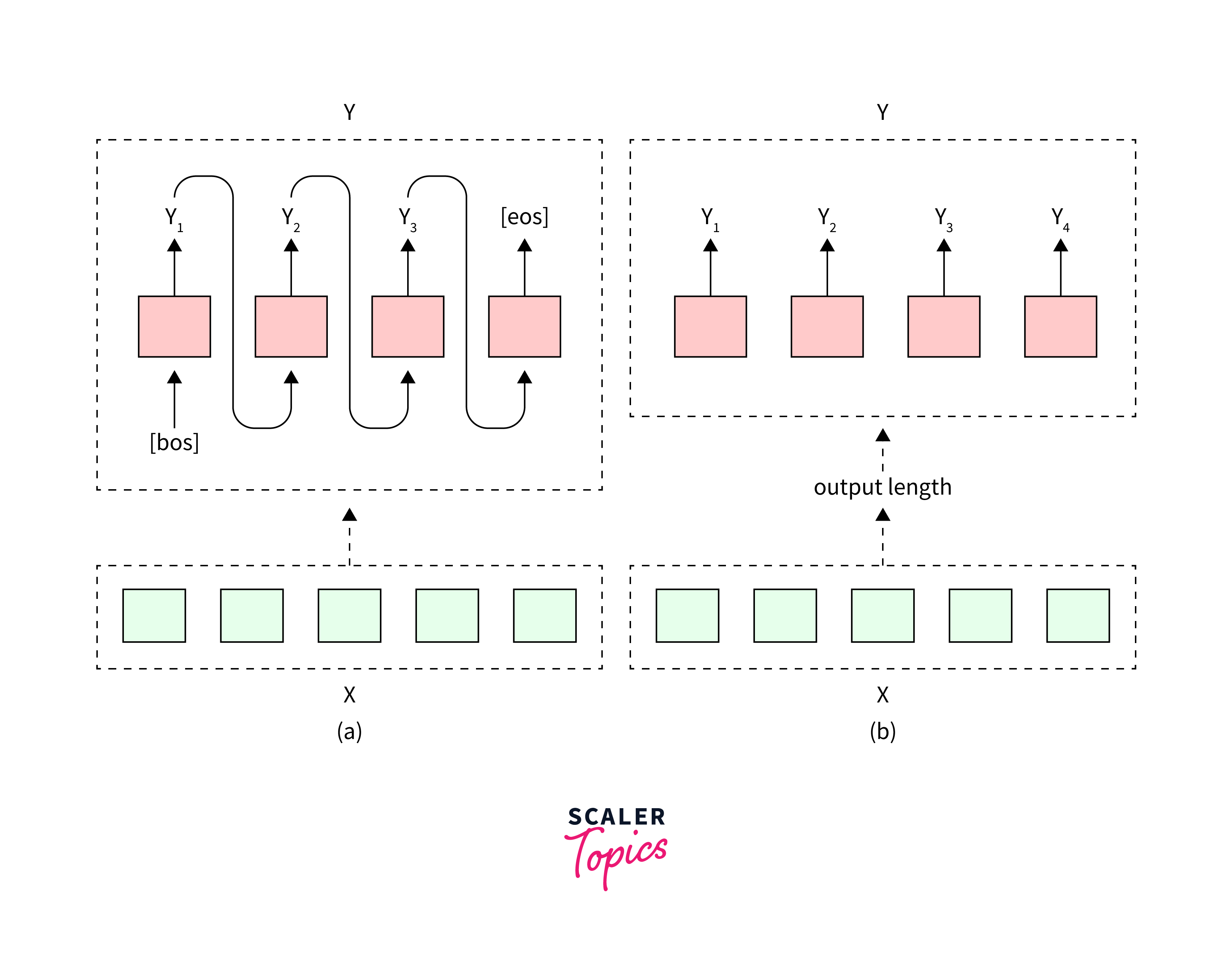
The following video from StatQuest provides a wonderfully detailed, step-by-step walkthrough of this entire process. It's the most comprehensive resource for this topic, and we'll focus on the key parts that demonstrate the generation loop.
Decoder-Only Transformers, ChatGPTs specific Transformer, Clearly Explained!!!
This video breaks down the complete mechanics of a decoder-only Transformer. We'll watch the sections that show how the model goes from processing a prompt to generating a full response.
Please watch the following two segments: Predicting the First Word (22:58 - 26:19): This part shows how, after processing the entire prompt ('what is statquest'), the model uses the final token's representation to predict the very first word of the response. Generating the Full Response (26:19 - 32:06): This is the most crucial part. It walks through the complete autoregressive loop. You'll see the model generate the word 'awesome', append it to the input, and feed the entire sequence back in to generate the final 'end of sentence' token, which stops the generation. Focus on how the input sequence grows with each step of the loop.
This iterative process is fundamental to how models like ChatGPT work. When you type a prompt and see the response being "typed out" word by word, you're essentially watching a real-time execution of this autoregressive loop.
4. Consolidating Your Understanding
The StatQuest video is dense, but it connects all the concepts we've learned so far: embeddings, positional encodings, attention (in its masked form), and the final prediction layer. The entire video is a fantastic resource if you wish to see every calculation in detail.
To further solidify the concepts, especially the distinction between different Transformer architectures, this article by Sebastian Raschka is highly recommended.
Understanding Encoder And Decoder LLMs
This article provides a clear, technical comparison of encoder-only, decoder-only, and encoder-decoder models. It's a great read to cement your understanding of where decoder-only models fit in the broader landscape.
Read the sections titled 'Decoders' and 'Terminology and jargon'. The 'Decoders' section reinforces the role of masked attention and the autoregressive property. The 'Terminology' section provides a nuanced clarification of what 'autoregressive decoding' means in practice.
Conclusion
In this lesson, we've unveiled the core mechanism behind text generation in modern LLMs. We moved from the static building blocks of the Transformer to the dynamic, iterative process of autoregressive generation.
Key Takeaways:
- Decoder-Only Architecture: Models like GPT are based solely on the decoder part of the original Transformer, making them specialized for generation.
- Autoregressive Generation: Text is generated one token at a time. The model's output at one step becomes part of its input for the next step.
- Masked Self-Attention: This is the key that enables causal generation. By preventing the model from attending to "future" tokens, it ensures the model learns to predict the next word based only on the preceding context.
- The Generation Loop: The process is a loop of predict, append, repeat until a termination condition is met.
We've now established a solid understanding of the architecture behind a model like GPT. In the next lesson, we'll zoom out and compare the major families of LLMs that you'll encounter in the wild, such as GPT, LLaMA, and Claude, discussing their high-level differences and characteristics.