Recommended resources
The freely available resources this lesson will direct you to.
Hello! Welcome to the final lesson of our first module, where we've journeyed from individual neurons to the complete Transformer architecture.
In our last lesson, we saw exactly how decoder-only models like GPT generate text through an iterative, token-by-token process called autoregressive generation. This mechanism is the engine behind most of the models you hear about today.
Now that we understand the fundamental architecture, it's time to zoom out and survey the landscape of the major Large Language Models. This lesson addresses the learning outcome: Compare key LLM families (e.g., GPT, LLaMA, Claude) at a high level.
We'll move from the how (the architecture) to the who (the creators and their models), equipping you with a mental map of the current LLM ecosystem. Understanding the key players and their philosophies is crucial for making informed decisions when building AI-powered applications.
1. A Framework for Comparison: Proprietary vs. Open Models
Before we dive into specific names like GPT or LLaMA, it's essential to understand the most significant dividing line in the LLM world: the difference between proprietary and open models. This distinction has major implications for cost, customization, privacy, and deployment—all critical factors from a software engineering perspective.
The following video from IBM Technology provides an excellent introduction to this concept.
Should You Use Open Source Large Language Models?
This video clearly explains the fundamental difference between proprietary and open-source Large Language Models, which is the first and most important way to categorize them.
Please watch the video from 00:33 to 05:27. As you watch, focus on: The definition of proprietary vs. open-source. The advantages of open-source models, such as transparency and fine-tuning. The introduction of specific open-source families like Llama 2.
To build on the video's explanation, let's read a more detailed breakdown.
The best large language models (LLMs) in 2024
This article from Zapier provides a clear, practical distinction between proprietary, open, and true open-source models, which is a nuance particularly relevant for development.
Please read the section titled 'What is an open source LLM?'. Pay attention to the subtle but important difference between an 'open' license (like Meta's Llama) and a permissive 'open source' license.
So, to summarize this crucial distinction:
- Proprietary Models:
- Examples: OpenAI's GPT series, Anthropic's Claude series, Google's Gemini Pro.
- Access: Typically through a paid API. The model's architecture and weights are a trade secret.
- Analogy: Using a third-party SaaS product. You get high performance and ease of use, but you depend on the provider and have limited control.
- Open Models:
- Examples: Meta's Llama family, Mistral's models, Google's Gemma.
- Access: The model weights are publicly available. You can download and run them on your own hardware (or use them via third-party hosting providers).
- Analogy: Using an open-source library like PostgreSQL. You have full control, can customize it, ensure data privacy, and potentially lower operational costs, but it requires more setup and expertise.
With this framework in mind, let's meet the key model families.
2. The Major LLM Families
The LLM landscape is fast-moving, but a few key "families" consistently dominate headlines and benchmarks. We'll use a set of comparison tables from a comprehensive guide to get a structured overview.
The Complete LLM Model Comparison Guide
This guide from Helicone.ai provides excellent, up-to-date tables comparing the top models on key metrics. This is a great way to get a high-level, data-driven view of the landscape.
Please study the first three sections of this article, focusing on the tables: Main Comparison Table: Look at the first table under the article's title. It compares model families like OpenAI, Anthropic, Google, and Meta on high-level features like context window and multimodality. Performance Benchmarks Table: In the 'Top LLM Performance Benchmarks Comparison' section, review the table that shows how specific models perform on tasks like reasoning (GPQA) and coding (SWE-bench), and compare their speed and cost. Proprietary vs. Open Source Table: The table in the 'Proprietary vs. Open Source Models' section provides a concise summary of the trade-offs we just discussed.
Now, let's add some narrative context to those numbers and introduce the "personalities" of the major players.
OpenAI (GPT Family)
- Category: Proprietary
- Models: GPT-3.5, GPT-4, GPT-4o ("o" for omni)
- Key Traits: The pioneers that brought LLMs into the mainstream with ChatGPT. Their models, especially the GPT-4 series, are often considered the all-around state-of-the-art for complex reasoning, instruction following, and coding. They are the benchmark against which others are frequently measured.
Anthropic (Claude Family)
- Category: Proprietary
- Models: Claude 3 family (Haiku, Sonnet, Opus)
- Key Traits: Founded by former OpenAI researchers with a heavy emphasis on AI safety. Their "Constitutional AI" approach aims to build more predictable and less harmful models. Claudes are known for their very large context windows, strong performance in creative and professional writing, and are highly competitive with GPT-4, especially in coding tasks.
To see a direct comparison in action, the following video provides a hands-on test of Claude 3 against its competitors.
The New, Smartest AI: Claude 3 – Tested vs Gemini 1.5 + GPT-4
This video from the 'AI Explained' channel does an excellent job of testing the capabilities of Claude 3 against GPT-4 and Google's Gemini, giving you a practical sense of their relative strengths and weaknesses.
Watch the following segments to see how these models compare on different axes: Vision & Reasoning (00:55 - 02:22): A test of multimodal (image) understanding. Creativity & Refusals (04:20 - 05:19): Shows differences in how 'safe' or 'creative' models are willing to be. Benchmark Comparison (07:30 - 11:30): A detailed look at how Claude 3 stacks up against GPT-4 and Gemini on official benchmarks like math, coding, and graduate-level questions. This part is dense but gives a great overview of performance metrics.
Meta (Llama Family)
- Category: Open
- Models: Llama 2, Llama 3
- Key Traits: The most influential family of open models. While not always matching the absolute peak performance of the best proprietary models, Llama 3 is exceptionally capable and has fueled a massive ecosystem of fine-tuned versions. Its open nature makes it the go-to choice for applications requiring on-premise deployment, data privacy, and deep customization.
Google (Gemini and Gemma Families)
- Category: Gemini (Proprietary), Gemma (Open)
- Models: Gemini 1.5 Pro, Gemma series
- Key Traits: Google's flagship models are natively multimodal, designed from the ground up to handle text, images, and audio seamlessly. Gemini 1.5 Pro is famous for its massive 1 million token context window, enabling analysis of huge documents or entire codebases in a single prompt. The Gemma models are their open counterparts, derived from the same research.
3. Visualizing the LLM Landscape
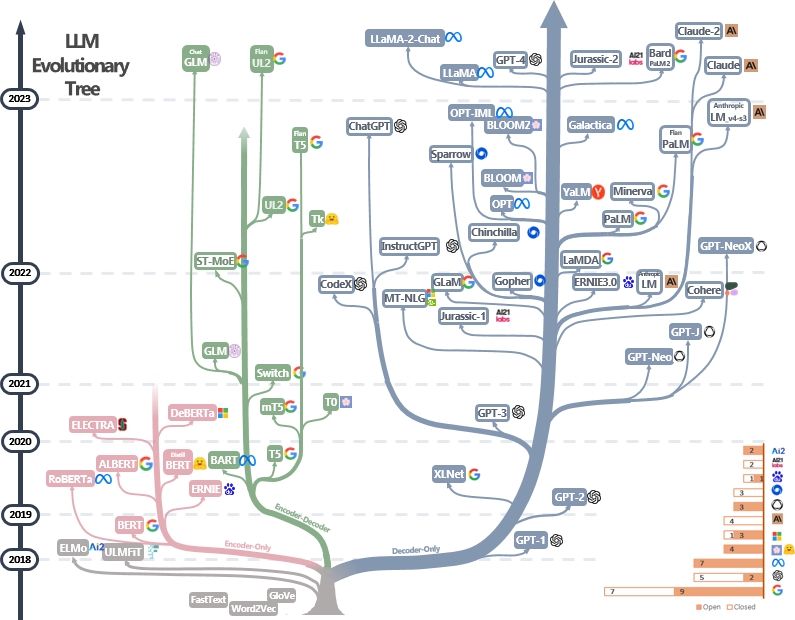
To tie everything together, let's look at two images that summarize this information visually.
First, a direct, feature-by-feature comparison of the latest models from the three main families we've discussed.

Second, a historical view shows how these different families evolved from the core Transformer architectures we studied in this module.
Conclusion
In this lesson, we mapped out the dynamic and competitive landscape of Large Language Models. You now have a framework for evaluating and comparing different models as you begin to think about building applications with them.
Key Takeaways:
- Proprietary vs. Open is the Key Divide: Proprietary models (GPT, Claude) offer peak performance and ease-of-use via APIs, while open models (Llama) offer control, customization, and cost-efficiency.
- There is No Single "Best" Model: The choice depends on the task. GPT-4o is a powerful generalist, Claude 3 excels in writing and coding with large contexts, and Llama 3 is the king of the open ecosystem.
- Key Comparison Points: When evaluating a model, consider its access model (proprietary/open), context window size, performance on relevant benchmarks (e.g., coding, reasoning), multimodality, and cost.
- A Rapidly Evolving Field: The leader in performance today might be overtaken tomorrow. The constant competition between these families is a primary driver of the rapid progress in AI.
This lesson concludes our first module! We have built a solid foundation, starting from the basic neuron and ending with a high-level overview of the most powerful LLMs in the world.
In our next module, LLM Training and Alignment Concepts, we will delve into the fascinating process of how these massive models are created. Our first lesson will explore the monumental effort of pre-training, looking at the data, objectives, and immense computational power required to bring an LLM to life.