Recommended resources
The freely available resources this lesson will direct you to.
Hello! Welcome back to our final lesson on the path integral formulation of quantum mechanics.
In our previous lesson, we explored the powerful technique of Wick rotation, where we moved from real to imaginary time (). This transformed the oscillatory path integral into one with real, decaying weights, forging a deep connection between quantum mechanics and statistical mechanics. We saw that the partition function can be expressed as a path integral over all paths that are periodic in imaginary time.
Today, we will apply this imaginary-time formalism to a quintessentially quantum problem: tunneling. Specifically, we will analyze a particle in a double-well potential. While in real time there are no classical paths that cross the potential barrier, we will discover that in imaginary time, such paths—called instantons—not only exist but are the key to understanding tunneling.
Our learning outcome for this lesson is to calculate the instanton contribution to tunneling amplitudes in a double-well potential. This will provide a beautiful semi-classical picture of tunneling and reveal the energy splitting between the ground states of the coupled wells, a phenomenon missed by standard perturbation theory.
The Double-Well Potential and the Power of Imaginary Time
Let's consider a particle in a symmetric double-well potential, with two minima at positions . A common example is the quartic potential .

Classically, if a particle's energy is less than the barrier height, it is trapped in one of the wells. Quantum mechanically, it can tunnel through the barrier. How can we describe this with the path integral, which is built around the classical action?
As we saw last time, the Euclidean propagator (in imaginary time ) is:
where the Euclidean action is . The stationary phase approximation requires finding paths that extremize . The Euler-Lagrange equation gives:
This is the equation of motion for a classical particle in the inverted potential . As the image above shows, in this inverted potential, the original minima at become maxima. Crucially, there now exists a classical solution that starts at (at ), rolls down the hill, and comes to rest at (at ). This non-trivial solution in imaginary time is the instanton.
The following reading provides a detailed derivation of the instanton solution and its role in calculating the tunneling amplitude.
Chapter 3 Feynman Path Integral
The key to applying path integrals to tunneling is to work in imaginary time. The following reading explains how this transforms the problem into finding classical paths in an inverted potential and introduces the 'instanton' solutions that mediate tunneling.
Please read Section 3.3.2, 'Double Well Potential: Tunneling and Instantons', starting from page 84. Focus on the first part, up to the subsection 'The Instanton Gas' on page 85. Understand why the Wick rotation is performed, what the resulting equation of motion looks like, and what an instanton solution represents.
The Instanton Solution and its Action
As you've just read, the instanton is the classical path in imaginary time connecting the two degenerate potential minima. Its name, coined by Gerard 't Hooft, reflects that it's a configuration localized in Euclidean time, analogous to a soliton which is localized in space.
The action of this single-instanton path, , can be calculated without explicitly solving for the path . Using the conservation of energy in the inverted potential (), we find:
This expression is identical to the exponent in the WKB approximation for tunneling, which is no coincidence. The path integral provides a more rigorous foundation for this semi-classical result.
For a specific potential like , where is the oscillation frequency at the bottom of the wells, the instanton path can be solved explicitly. As shown in the resource LINK, the solution is , where is the center of the instanton.
The Dilute Instanton Gas
To find the full propagator, for example from to , we must sum over all possible paths. In the semi-classical approximation, this means summing over all classical solutions. These include not just a single instanton, but also paths that tunnel back and forth multiple times—a sequence of instantons and anti-instantons (which travel from to ).
For large barrier heights, the instanton action is large, making the tunneling probability low. This means the instantons are typically well-separated in imaginary time, forming a "dilute gas".
Chapter 3 Feynman Path Integral
A single instanton describes one tunneling event. To calculate the full transition amplitude, we must consider all possible sequences of tunneling back and forth. This leads to the concept of a 'dilute instanton gas'.
Continue reading Section 3.3.2, from the subsection 'The Instanton Gas' on page 85 to the end of the section on page 90. Pay close attention to how the sum over multi-instanton configurations is constructed (Eq. 3.37), how the classical and quantum fluctuation parts are combined (Eqs. 3.38-3.39), and how the final sum leads to the hyperbolic sine/cosine forms for the transition amplitude (Eq. 3.41).
The Tunneling Amplitude and Energy Splitting
The reading details how summing over these multi-instanton paths works. The key idea is that the total path integral can be approximated by a sum over configurations with instantons.
- A path from to must have an even number of tunneling events.
- A path from to must have an odd number of tunneling events.
The sum over these paths can be organized into a power series. For a total imaginary time evolution , the result for the Euclidean propagators is:
Here, is the contribution from quantum fluctuations around the minima (the zero-point energy of the harmonic approximation in each well), and is the crucial term that arises from the sum over the instanton gas:
The factor is a prefactor that comes from computing the quantum fluctuations (functional determinant) around the instanton path. Its calculation is more involved as it requires careful treatment of a "zero mode" related to the time-translation symmetry of the instanton, a topic explored in the "Info" box in resource LINK (sections 2,3) if you're curious.
Now, let's interpret this result. We know that tunneling lifts the degeneracy of the two ground states localized in each well, creating a symmetric ground state and an anti-symmetric first excited state . Their energies are split by a small amount, , where is the single-well ground state energy.
If we compute the propagators using these eigenstates, we get:
Using the symmetries of the states (, ), these expressions reduce to the same and forms.
By comparing the two results, we identify as the energy shift due to tunneling. The instanton calculation has given us a direct, non-perturbative formula for the energy splitting between the symmetric and anti-symmetric states: . This exponential dependence on is a signature of a non-perturbative effect that cannot be captured by a standard Taylor series expansion in .
Test your understanding!
The instanton action is given by . Consider a symmetric double-well potential. How would you expect the tunnel splitting to change if you:
- Increase the mass of the particle?
- Increase the height of the potential barrier between the wells?
- Increase the distance between the wells?
Justify your answers based on the formula .
Show answer
The tunnel splitting is . A larger leads to an exponentially smaller splitting.
- Increasing mass : is proportional to . Increasing the mass increases , which makes the exponent more negative. Therefore, the tunnel splitting will decrease exponentially. Heavier particles tunnel less.
- Increasing the barrier height: Increasing the height of in the barrier region directly increases the value of the integrand . This increases the overall action , causing to decrease exponentially. Higher barriers are harder to tunnel through.
- Increasing the distance between wells: This increases the integration range from to, for example, . Since the integrand is positive, a wider integration range increases the value of . This, in turn, causes to decrease exponentially. Wider barriers are also harder to tunnel through.
Connection to Condensed Matter Systems
The double-well potential is not just a toy model. It's a fundamental paradigm in condensed matter physics. For example, a nitrogen atom in an ammonia molecule (NH) can be on either side of the plane of hydrogen atoms, giving a double-well potential. The tunnel splitting is what gives rise to the famous 24 GHz microwave absorption line used in masers.
In your field, a direct application is the double quantum well, often realized in semiconductor heterostructures.
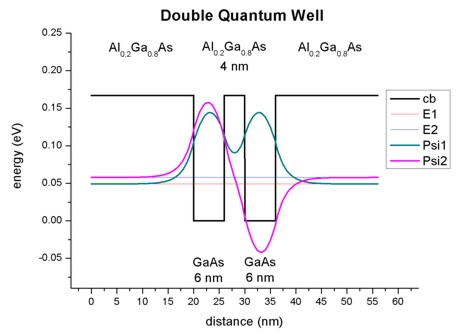
This image shows exactly the physics we have described. The two lowest energy states are the symmetric and anti-symmetric combinations of the single-well ground states, and their energy separation is a direct consequence of tunneling through the central AlGaAs barrier. This splitting is crucial for designing coupled quantum systems, including certain types of quantum bits (qubits).
Conclusion
This lesson concludes our exploration of the path integral formulation. We've seen how this powerful framework provides not only an alternative way to formulate quantum mechanics but also a physically intuitive tool for understanding complex quantum phenomena.
Key Takeaways:
- Quantum tunneling in a double-well potential can be described by classical paths in imaginary time within an inverted potential.
- The classical solution that "rolls" from one potential maximum to the other in imaginary time is called an instanton.
- The path integral is approximated by a sum over a dilute gas of instantons and anti-instantons, representing sequences of tunneling events.
- This summation naturally leads to an expression for the energy splitting () between the symmetric and anti-symmetric ground states.
- The splitting is found to be proportional to , demonstrating the non-perturbative nature of tunneling.
Preview of the Next Module:
We have spent this module developing an advanced single-particle formalism. However, most of the fascinating phenomena in condensed matter physics—from magnetism and superconductivity to the quantum Hall effect—arise from the collective behavior of many interacting particles.
Our next module, "Identical Particles and Second Quantization," will equip us with the essential tools to tackle these many-body problems. We will move beyond the single-particle wavefunction and learn the language of creation and annihilation operators, a powerful formalism that is the bedrock of modern many-body theory. This will be a crucial step towards your goal of understanding advanced condensed matter physics.