Recommended resources
The freely available resources this lesson will direct you to.
Hello! Welcome to the final lesson of our module on the path integral formulation. So far, we've established the path integral as a powerful alternative to the operator-based approach to quantum mechanics. Most recently, we used the imaginary-time path integral to understand the non-perturbative phenomenon of quantum tunneling via instantons.
Today, we'll return to real-time dynamics and apply the path integral to another profound and quintessentially quantum mechanical phenomenon: the Aharonov-Bohm effect. This effect demonstrates that in quantum mechanics, the electromagnetic potentials () are more fundamental than the fields () themselves. It's a striking example of a non-local, topological effect that has deep implications for our understanding of gauge theories and has direct relevance to condensed matter systems like superconductors and the quantum Hall effect.
Our learning outcome is to apply the path integral formulation to a charged particle in an electromagnetic field to analyze the Aharonov-Bohm effect. We will see how the "sum over histories" perspective provides a remarkably intuitive explanation for this otherwise puzzling effect.
Classical vs. Quantum View of Gauge Invariance
In classical electromagnetism, the vector potential and scalar potential are considered mathematical conveniences. The physical reality is attributed to the electric and magnetic fields, and . This is because the laws of motion (like the Lorentz force law) only depend on and , which remain unchanged under a gauge transformation:
While the Lagrangian for a charged particle, , does change, the action only changes by a boundary term. This leaves the classical equations of motion invariant.
In quantum mechanics, the story is different. The propagator involves the factor , and a change in the action, even by a boundary term, introduces a phase factor. As you'll see in the following video, this phase factor, while invisible in some contexts, can produce observable interference effects.
Quantum Theory, Lecture 6: Path Integrals. Propagators. Aharonov-Bohm Effect.
To begin, let's watch a segment from a lecture by Prof. Alexander Maloney. It provides an excellent explanation of how gauge transformations, which are unobservable classically, can produce physical effects in quantum mechanics by altering the phase of the wave function.
Please watch the segment from 43:23 to 59:46. Focus on understanding how a shift in the Lagrangian by a total derivative leads to a phase shift in the quantum propagator and the wavefunction.
As the video explained, under a gauge transformation, the action changes as , and the propagator transforms as:
This implies that the wavefunction itself transforms locally as . While a global phase change is unphysical, a relative phase between two interfering paths is measurable, and this is the heart of the Aharonov-Bohm effect.
The Aharonov-Bohm Experimental Setup
Let's consider the canonical Aharonov-Bohm experiment.
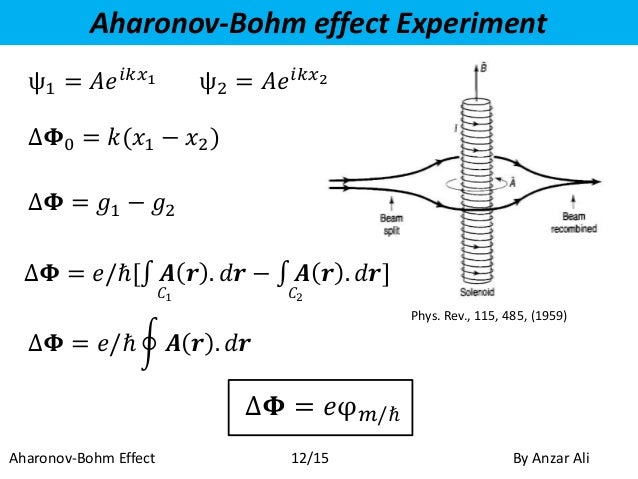
- We have an infinitely long, thin solenoid. A current runs through it, producing a magnetic field confined entirely inside the solenoid.
- Outside the solenoid, the magnetic field is zero.
- However, the vector potential outside the solenoid is not zero. By Stokes's theorem, the line integral of around any loop enclosing the solenoid must equal the magnetic flux passing through it: .
- An electron beam is split and sent along two paths, one on each side of the solenoid. The paths are then recombined to produce an interference pattern on a detector screen.
Crucially, the electrons travel only in the region where and thus experience no classical force.
Path Integral Analysis
The path integral formalism provides a beautifully clear explanation for this effect. The action for a charged particle includes the term . For a static magnetic field, the phase acquired by a particle traveling along a path due to the vector potential is:
The total propagator is a sum over all possible paths from the source to the detector. We can group these paths into two main classes: paths like that go above the solenoid, and paths like that go below.
The following reading explains how the total phase difference between these two classes of paths is calculated.
The Path Integral approach to Quantum Mechanics
This reading from Lin Lin's lecture notes, 'The Path Integral approach to Quantum Mechanics', clearly explains the Aharonov-Bohm effect using the path integral formalism. It demonstrates how the phase difference between topologically distinct paths leads to an observable shift in the interference pattern.
Please read Section 5.3, 'The Aharonov-Bohm effect' (pages 101-104). Pay close attention to how the phase difference \Delta\phi between paths \gamma_1 and \gamma_2 is related to the magnetic flux \Phi_B, and how this leads to a shift in the interference pattern.
As you've just read, the phase difference between the two paths is not zero. It is given by the line integral of around the closed loop formed by and :
Using Stokes' theorem, this becomes:
The total amplitude at a point on the screen is the sum of the amplitudes from the two paths, , where represents the amplitude of the second path relative to the first in the absence of the field. The resulting interference pattern depends on , where is the phase difference from the path length difference. This means the interference fringes will shift as the magnetic flux inside the solenoid is varied, even though the electrons never "feel" the magnetic field.
This astonishing result has been experimentally confirmed many times. It shows that the vector potential , once thought to be a mere mathematical tool, has direct physical significance.
Test your understanding!
The Aharonov-Bohm interference pattern is periodic. The effect disappears (i.e., the pattern is identical to the case with no flux) whenever the phase shift is an integer multiple of .
- Using the formula , derive the value of the magnetic flux quantum, , which is the amount of flux that causes a phase shift for a particle with charge .
- In superconductors, the charge carriers are Cooper pairs, which have a charge of . What would be the flux quantum in a superconducting ring? How does this relate to the phenomenon of flux quantization in superconductors?
Show answer
-
We set for a particle of charge :
The fundamental magnetic flux quantum is .
-
For a Cooper pair with charge , the condition for a phase shift is:
The flux quantum for a superconductor is , exactly half the fundamental value. The requirement that the macroscopic wavefunction of the superconductor be single-valued around a hole (e.g., in a superconducting ring) forces the total magnetic flux trapped in the hole to be an integer multiple of . This is precisely the experimentally observed phenomenon of flux quantization in superconductors, and the Aharonov-Bohm effect provides the fundamental explanation.
Topology and Homotopy Classes
There is a deeper, more mathematical way to view this effect using the language of topology. The presence of the solenoid, which is inaccessible to the particle, effectively "punctures" the space. This makes the space multiply connected.
In such a space, paths are classified by their homotopy class—essentially, how many times they wind around the puncture. A path that goes above the solenoid ( windings, say) and one that goes below (which is equivalent to one full winding, ) cannot be continuously deformed into one another without passing through the forbidden region. They are topologically distinct.
The full path integral propagator is a sum over all homotopy classes, with each class weighted by a phase factor that depends on the winding number :
where is the propagator for paths with winding number , and is the phase per winding. Our two-slit example is a simplified version of this, considering only the and classes.
This topological perspective is extremely powerful and connects to many advanced topics in physics. The phase factor is an example of a Wilson loop, a key object in modern gauge theory. The Aharonov-Bohm effect is also considered a precursor to the concept of the Berry phase, where a similar geometric phase is acquired as a system's parameters are varied adiabatically around a loop in parameter space. Your exploration of the Quantum Hall effect in condensed matter physics will reveal similar topological invariants, like the Chern number.
Conclusion
This lesson concludes our module on the path integral. We've seen its versatility in handling problems from harmonic oscillators to the non-perturbative physics of tunneling and the topological nature of gauge fields.
Key Takeaways:
- For a charged particle, the path integral acquires a phase factor for each path.
- In the Aharonov-Bohm experiment, the interference between paths enclosing a solenoid leads to an observable phase shift , which depends on the magnetic flux .
- This effect proves that the vector potential has physical reality beyond being a mathematical convenience and that quantum mechanics is sensitive to the topology of space.
- The effect is periodic in the magnetic flux, with a period given by the flux quantum .
Preview of the Next Module:
We have built a sophisticated toolkit for analyzing the quantum mechanics of a single particle. However, the most interesting frontiers of physics, especially in your target field of condensed matter, are dominated by the collective behavior of countless interacting particles.
Our next module, "Identical Particles and Second Quantization," is our gateway into this many-body world. We will learn how to correctly describe systems of identical bosons and fermions and introduce the elegant and powerful formalism of creation and annihilation operators. This "second quantization" is the standard language used to describe electron gases, phonons, superconductivity, and virtually all other many-body quantum phenomena. It's an essential step on your path to mastering advanced quantum theory.