Recommended resources
The freely available resources this lesson will direct you to.
- IGCSE: Business. Chapter 2.3: Recruitment, selection and trainingwww.youtube.com
- IGCSE Business Studies - 2.1 Recruitment, Contracts, and Training Explainedwww.youtube.com
- Types of training - IGCSE Business Revision Noteswww.savemyexams.com
- Business: Cambridge International GCSE (2027 Exams) - Trainingsenecalearning.com
Hello. In the previous lesson, you matched employment arrangements to a business’s staffing needs: for example, part-time work for predictable peak periods and fixed-term contracts for seasonal demand. Once employees have been hired, the business must help them perform their roles safely, correctly, and confidently. That is the purpose of training.
This lesson explains the three IGCSE training methods—induction, on-the-job, and off-the-job training—and, crucially, how to explain benefits for both employees and the business in an exam answer.
Why businesses train employees
Training is the process of increasing employees’ knowledge and skills so they can do their jobs effectively. It may be needed for new workers, for existing workers learning a new task, or when a business introduces new technology or procedures.
A trained employee is usually able to work faster, make fewer mistakes, use equipment properly, and provide better customer service. These outcomes can benefit the business through lower costs, higher output, better quality, and fewer customer complaints. The employee can benefit through greater confidence, improved skills, and better career opportunities.
Types of training - IGCSE Business Revision Notes
Read this Save My Exams revision note to establish the three training methods and the advantages and disadvantages attached to each.
Start with the section “The importance of training to a business.” Read the definition and general benefits, focusing on how greater skills can affect productivity, mistakes, flexibility, and promotion. Then read the three subsections in “Types of training.” In “1. Induction training,” read the definition and evaluation. In “2. On-the-job training,” read the practical advantages and risks. Finally, in “3. Off-the-job training,” read the explanation and evaluation. Notice that an advantage to the employee often creates an indirect advantage for the business as well.
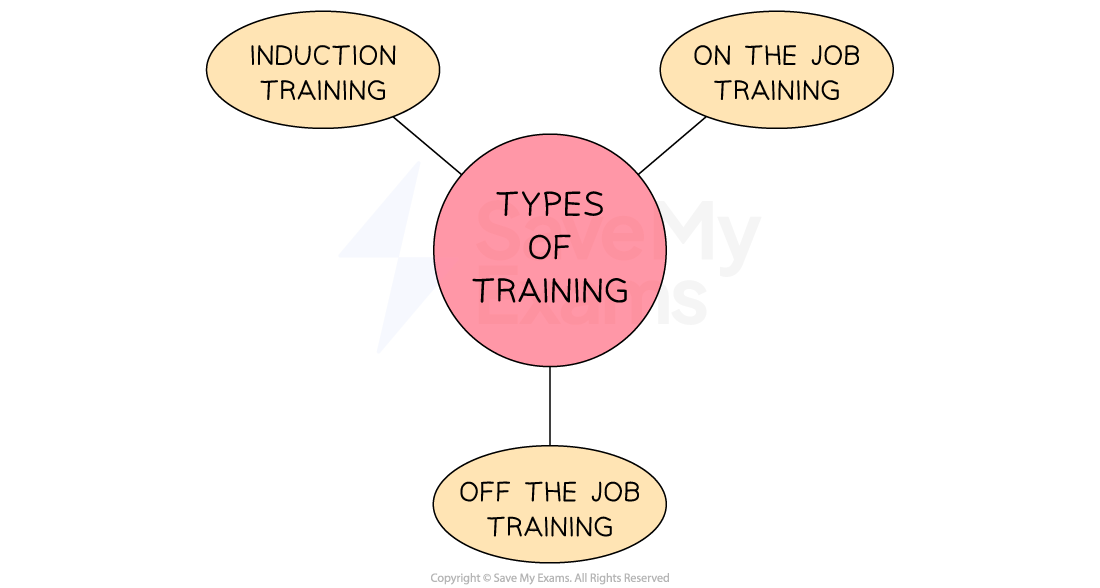
A useful distinction is:
| Method | Main question it answers |
|---|---|
| Induction training | How does a new employee learn about this particular business? |
| On-the-job training | How does an employee learn a practical task while working? |
| Off-the-job training | How does an employee gain specialist or broader skills away from normal work? |
The methods can sometimes be combined. For instance, a new hotel receptionist may first receive induction training, then learn the booking system through on-the-job training. In an exam, however, focus on the specified method and explain its effects clearly.
The three methods and who benefits
1. Induction training
Induction training is given to new employees when they join a business. It introduces them to the workplace, their colleagues, company rules, job responsibilities, safety procedures, and sometimes basic customer-service expectations.
Imagine a new employee starting at a café. During induction, they may be shown hygiene procedures, the fire exit, how to report absence, how the till system works, and who to ask for help.
For the employee, induction training can:
- make them feel welcomed and more confident;
- help them understand what the business expects;
- reduce anxiety during their first days;
- make it less likely that they make basic or unsafe mistakes.
For the business, these benefits matter because a confident employee who understands procedures becomes productive more quickly. Fewer mistakes with cash, safety rules, or customer orders can reduce waste, complaints, and the cost of correcting errors.
A strong explanation does not stop at “induction reduces mistakes.” It develops the point:
New café employees will learn the business’s hygiene and till procedures during induction training. This helps them understand their responsibilities and feel more confident serving customers. As a result, they are less likely to make incorrect orders or handle food unsafely, reducing customer complaints and protecting the café’s reputation.
Induction training does have a cost: staff must be paid and managers must spend time training rather than doing their normal work. But for a business where safety, customer service, or company procedures matter, this cost may be worthwhile.
2. On-the-job training
On-the-job training happens while an employee is carrying out their actual work. Usually, an experienced colleague or supervisor demonstrates the task, then the trainee practises it and receives guidance.
For example, a new machine operator may be shown by an experienced worker how to set up a machine, check product quality, and follow safety rules. A trainee is learning in the exact environment where they will later work independently.
For the employee, on-the-job training can:
- teach practical, job-specific skills;
- allow immediate practice rather than only theory;
- build confidence through guidance from an experienced colleague;
- help the worker become competent quickly.
For the business, it can:
- be relatively low cost because there may be no course fee or travel expense;
- be tailored closely to the firm’s own equipment and procedures;
- allow the employee to apply the training immediately;
- improve quality and productivity once the employee becomes skilled.
Consider a small bakery teaching a new worker how to decorate cakes. The employee learns the exact techniques, equipment, and standards used by that bakery. The business does not need to pay for an external course, and the employee develops a skill they can use every day.
However, the quality of training depends on the trainer. If the experienced worker has bad habits, these may be passed on. Also, the trainer’s own work may slow down while they support the trainee. Therefore, on-the-job training is particularly suitable where practical skills must be learned quickly and an able, experienced trainer is available.
3. Off-the-job training
Off-the-job training takes place away from the employee’s usual workplace. It may involve a course, workshop, college class, seminar, conference, or online programme. It is often delivered by specialist trainers.
For instance, a business introducing new accounting software may send its finance employees to a course led by an expert. A manager might attend a leadership workshop to develop communication and decision-making skills.
For the employee, off-the-job training can:
- provide specialist and up-to-date knowledge;
- develop broader skills beyond one daily task;
- increase confidence;
- improve promotion and future career opportunities.
For the business, the employee may return with new ideas and more advanced skills. This can help the business use new technology effectively, improve product quality, or solve problems more efficiently.
A good chain of explanation could be:
The firm could send its supervisors on an off-the-job leadership course run by an expert. The supervisors would gain wider communication and team-management skills, increasing their confidence when dealing with staff problems. This could improve coordination in the factory, reduce delays, and increase output.
The major drawbacks are usually cost and absence from work. Fees, travel, accommodation, and paying for cover can make this method expensive. Furthermore, a general course may not match the business’s exact needs. It is most appropriate when specialist, current, or broad skills are needed and the expected improvement is worth the expense.
IGCSE: Business. Chapter 2.3: Recruitment, selection and training
Watch Mr Lee – Business Econ’s short comparison of the three training methods. It is useful for hearing the advantages and disadvantages expressed in exam-ready language.
Watch induction training for the link between company procedures, fewer errors, and initial costs. Then watch on-the-job training, concentrating on why it is practical and tailored but depends on the trainer. Finish with off-the-job training to compare specialist expertise with higher costs and possible lack of relevance.
Writing an explanation for both sides
Questions may ask you to explain how a particular method benefits employees and the business. Treat these as connected but separate parts of the answer.
Use this structure:
- Name the training method and identify what it involves.
- Explain the employee benefit: skill, confidence, safety, motivation, or career development.
- Explain the business benefit: productivity, quality, lower costs, fewer mistakes, better service, or staff retention.
- Use scenario details to make the explanation specific.
A clear planning grid can help:
| Training method | Employee benefit | Business benefit |
|---|---|---|
| Induction | Understands role, rules, and workplace; feels confident | Fewer early mistakes; employee becomes productive sooner |
| On-the-job | Gains practical, role-specific skills | Training fits exact business needs and can be lower cost |
| Off-the-job | Gains specialist, broader, or current knowledge | New expertise can improve quality, technology use, or management |
Worked exam-style response
Scenario: BrightPrint has bought new digital printers. Several existing employees do not know how to use the machines, and damaged printed materials are expensive.
Question: Explain how off-the-job training could benefit BrightPrint and its employees.
BrightPrint could send employees on an off-the-job course run by a specialist in digital printing. The employees would learn how to operate the new printers correctly and would feel more confident using unfamiliar technology. This develops their skills and may improve their chances of promotion in the future. For BrightPrint, specialist training should reduce the number of printing errors and damaged materials. This lowers waste costs and helps the business produce higher-quality printed products for customers.
Why this works:
- It identifies off-the-job training.
- It explains an employee benefit: skills, confidence, promotion prospects.
- It links the training to the business problem: costly damaged materials.
- It develops the business effect: fewer errors, less waste, better quality.
Avoid these weak answers
| Weak statement | Why it is incomplete | Improve it by explaining… |
|---|---|---|
| “Training helps employees.” | It does not say how. | Which skill, confidence, or opportunity the worker gains. |
| “Training increases profit.” | The link is missing. | How training improves quality, productivity, sales, or costs first. |
| “On-the-job training is cheap.” | It is a point, not an explanation. | Why there are no external course or travel costs, and why this matters to the business. |
| “Off-the-job training is good.” | “Good” is too vague. | Why expert instruction or broader skills solve the firm’s specific problem. |
| “Employees will earn more.” | Training does not automatically increase pay. | Confidence, skills, promotion opportunities, motivation, or job security instead. |
Remember: an employee benefit is not always an immediate business benefit. You must make the connection. For example, if employees feel valued because the business invests in training, they may be more motivated and less likely to leave. The business may then save money on recruitment and training replacement staff.
Key takeaways
- Induction training is for new employees and helps them understand the organisation, procedures, safety requirements, and role.
- On-the-job training takes place while employees work. It is practical, specific to the role, and often lower cost, but depends on the quality of the trainer.
- Off-the-job training takes place away from normal work and can provide specialist, current, and broader skills, though it can be expensive.
- To explain benefits well, develop a chain from the training method to an employee outcome and then to a business outcome.
- Always apply your answer to the scenario: identify the skill gap, business problem, or need for training.
Next, you will consider how financial and non-financial methods of motivation can encourage employees to work more effectively.