Recommended resources
The freely available resources this lesson will direct you to.
- IGCSE Business studies 0450 - 2 3 - Recruitment, Selection, and Training of Workerswww.youtube.com
- IGCSE: Business. Chapter 2.3: Recruitment, selection and trainingwww.youtube.com
- Part-Time Versus Full-Time | Cambridge (CIE) IGCSE Business Revision Notes 2018www.savemyexams.com
- Business: Cambridge International GCSE (2027 Exams) - Contracts of Employmentsenecalearning.com
Hello. This first module prepares you for the People in Business part of Tuesday’s test. Businesses do not simply “hire staff”: they choose arrangements that match how much work exists, when it happens, how predictable it is, and how important continuity is.
In this lesson, you will learn to identify the main types of employment and, more importantly, recommend the best one for a business scenario with a clear business reason.
Employment is more than one decision
An employment contract is a legal agreement between a business and an employee. It normally states the job, pay, hours, start date, and other conditions. In an exam scenario, however, the key is not to list what is in a contract. Your task is to decide which arrangement best fits the business’s needs.
Business: Cambridge International GCSE (2027 Exams) - Contracts of Employment
Read these concise Seneca Learning notes to establish what a contract is, then focus on job sharing and zero-hour contracts—two arrangements that can be confused with part-time work.
In the opening section, read the contract definition. Note the kinds of details an employer and worker need certainty about. Then find the subsection “Job share.” Read the full subsection, focusing on the trade-off between flexibility for staff and the need for strong communication. Finally, find “Zero-hour contracts.” Read from its definition at the beginning of the subsection, then study the benefits and drawback. Distinguish “no guaranteed hours” from simply working fewer hours.
The important point is that employment choices operate on different dimensions. A worker can be permanent and part-time, or fixed-term and full-time. Therefore, read the wording of the question closely before choosing one label.
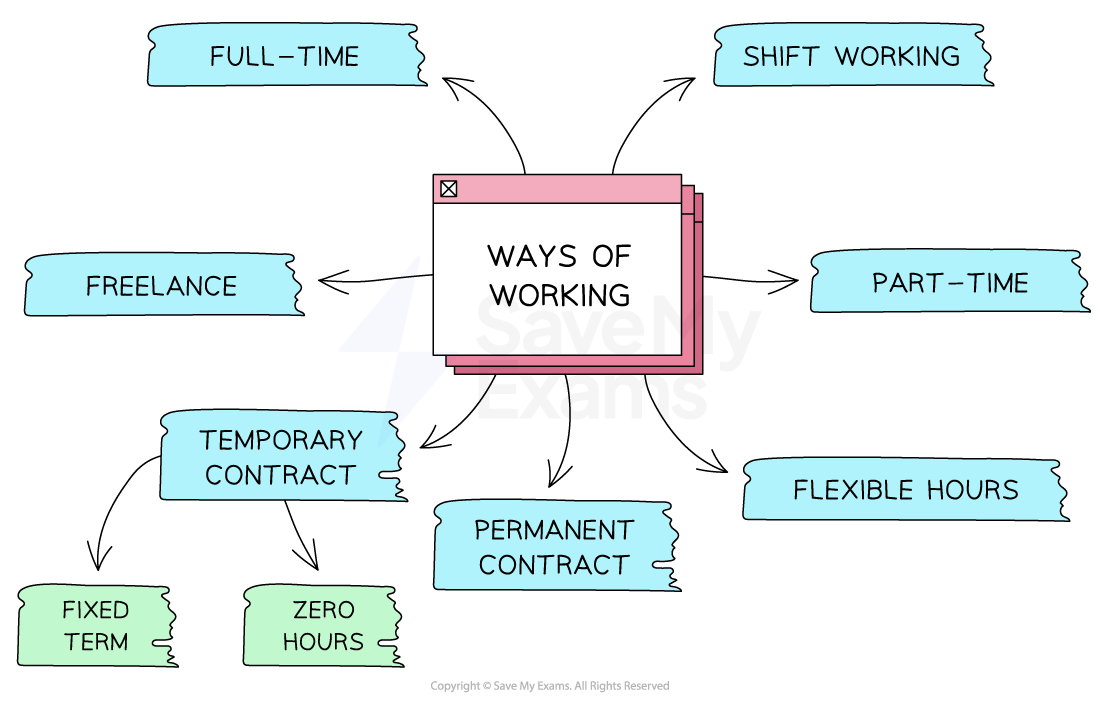
| Question about the job | Employment terms that answer it |
|---|---|
| How many regular hours are needed? | Full-time or part-time |
| How long will the worker be needed? | Permanent or temporary/fixed-term |
| Are working hours guaranteed? | Standard-hours contract or zero-hour contract |
| When must the work be done? | Shift working or flexible hours |
| Is a specialist needed for a particular task? | Freelance work |
| Can two people cover one full-time post? | Job share |
For example, a supermarket may employ a permanent part-time worker on evening shifts. “Permanent” tells you that the job has no planned end date; “part-time” tells you that the worker has fewer weekly hours than a full-time employee; “evening shifts” tells you when they work.
The main employment types
Full-time employment
A full-time employee usually works around 35 hours or more per week, although the exact number is set by the contract. Full-time employment suits a business that needs regular labour throughout the week and wants a stable, experienced workforce.
A business may choose full-time employees when it needs:
- consistent quality or customer service;
- workers who understand detailed procedures;
- reliable cover every day;
- staff who can develop skills and potentially be promoted.
For example, a hotel operating all year may need full-time receptionists. Regular guests expect accurate bookings, reliable service, and staff who understand the hotel’s systems. A stable full-time team can make this more likely.
The main disadvantage is cost. A full-time worker must still be paid during quiet periods. If demand falls, the business may have too many employees relative to the work available.
IGCSE: Business. Chapter 2.3: Recruitment, selection and training
Watch “IGCSE: Business. Chapter 2.3: Recruitment, selection and training” by Mr Lee - Business Econ for a focused comparison of part-time and full-time employment.
Watch the contract comparison. Focus on the reason behind each advantage: part-time staff can be scheduled around busy periods, while full-time staff can provide reliability, communication, and commitment. Make sure you can explain the possible cost of each choice to the business.
Part-time employment
Part-time employees work fewer hours per week than full-time employees, often under 30 hours. They are particularly useful where demand is predictable but limited.
A café that is busy every weekday from 12:00 to 14:00 may not need another full-time worker. It could employ a part-time assistant specifically for lunch periods. This allows the café to serve customers quickly at busy times without paying that person for quiet morning and late-afternoon hours.
Part-time employment can therefore give a business:
- lower labour costs if fewer hours are needed;
- flexibility to schedule workers at known busy times;
- longer opening hours, including evenings or weekends;
- access to workers who prefer fewer hours.
However, a business with many part-time staff may face communication problems. Employees may not be present for the same meetings or shifts, and some may have less commitment to the business or leave for full-time work elsewhere. In a service business, high staff turnover may reduce customer-service quality because new staff need training.
Permanent and fixed-term employment
A permanent contract has no stated finishing date. It is suitable when the job is expected to continue for the long term. For instance, a growing manufacturer that needs an additional machine operator every day is likely to choose a permanent employee. The worker can build experience, and the business avoids repeatedly recruiting and training replacements.
A fixed-term contract lasts until a specified date or the end of a known task. It is suitable when the business knows both that it needs extra staff and when it will stop needing them.
Examples include:
- a retailer employing extra staff for the six weeks before a major festival;
- a business hiring someone to cover an employee’s maternity leave;
- a construction firm hiring a worker for one particular building project;
- a holiday resort employing staff for its summer season.
The benefit is control of labour costs after the temporary demand ends. The drawback is that experienced workers may leave when their contracts finish, so the business may need to recruit and train again next season.
Zero-hour contracts
With a zero-hour contract, the business does not guarantee a minimum number of working hours. It can offer work when needed, and the worker can generally accept or decline it.
This gives maximum flexibility. It may suit a business whose demand is highly uncertain, such as an events company that does not know which bookings will be confirmed until shortly before an event.
But zero-hour contracts are not automatically the best choice for any seasonal business. If a beach shop knows it will need two assistants every Saturday throughout July and August, the demand is predictable. A fixed-term part-time contract may be more appropriate because it gives both the business and workers greater certainty.
Zero-hour arrangements can also cause lower motivation or weaker loyalty because employees may feel insecure. The business may struggle to obtain staff at short notice if workers have accepted shifts elsewhere.
Shift work, flexible hours, job sharing, and freelance work
These terms are useful, but they answer slightly different business needs.
- Shift working means employees work at different times. A hospital, factory, call centre, or 24-hour convenience store may use shifts to operate for long hours without expecting one worker to work all day.
- Flexible hours allow variation in when employees start and finish work. This can help a business recruit and retain workers who have childcare or travel commitments. It does not necessarily mean the employee works fewer total hours.
- Job sharing occurs when two people share the responsibilities and hours of one full-time job. It can retain skilled workers who cannot work full-time, but handovers and communication must be managed carefully.
- Freelance work means hiring an independent specialist for a particular piece of work. A small business may hire a freelance web designer to create a website rather than employ a permanent designer. This provides specialist expertise without an ongoing salary commitment, but the business has less direct control over the freelancer’s availability and may not retain their skills afterwards.
Matching the contract to the business situation
When choosing a type of employment, look for clues in the scenario. The strongest answers do not begin with a memorised advantage. They begin with the business’s actual need.
| Scenario clue | Most likely suitable choice | Why it fits |
|---|---|---|
| Demand is steady all year and service quality matters | Full-time, permanent | Creates a stable workforce and supports training, consistency, and commitment |
| The business is busy only at regular peak times, such as weekends or lunch hours | Part-time | Employees can be scheduled when demand is highest, avoiding unnecessary wage costs |
| Extra workers are needed for a known period, such as a summer season | Fixed-term, often part-time | Provides labour for the temporary period without a long-term commitment |
| Demand is irregular and difficult to predict | Zero-hour contract | The business can offer work only when it is required |
| The business must operate overnight or for extended hours | Shift work | Different groups of workers cover different time periods |
| A one-off specialist task is required | Freelance worker | The business can obtain expertise without creating a permanent role |
| An experienced worker cannot work full-time but the role must be covered | Job share | Maintains cover while allowing each employee fewer hours |
A useful distinction is predictable versus unpredictable demand:
- If demand is predictable but only occurs at certain times, choose part-time or fixed-term part-time employment.
- If demand is unpredictable, a zero-hour arrangement may offer more flexibility.
- If demand is regular and ongoing, full-time permanent employment is usually stronger.
Turning a choice into a justification
In IGCSE Business, “justify” means more than naming an advantage. You need to connect the employment choice to a result for that particular business.
Build your explanation in four parts:
- Choose a specific type of employment.
- Use a detail from the scenario.
- Explain the direct effect on the business.
- Link to a business objective, such as lower costs, higher sales, better service, or profit.
A strong chain might sound like this:
The business should employ part-time sales assistants because customer numbers are highest only on Saturdays and after school. The assistants can be scheduled for these busy periods, so customers are less likely to wait or leave without buying. The business avoids paying full-time wages during quieter hours, helping to control labour costs and protect profit.
Notice that every sentence adds a new idea. It is not enough to write, “Part-time workers are flexible.” Explain how the flexibility solves the business’s problem.
A worked recommendation
Scenario: Coastline Kayaks operates from April to October. It is busiest at weekends during the school holidays, when it needs two additional workers to check equipment and serve customers. The business has very few customers during winter.
Recommended employment type: Fixed-term, part-time employees.
Justification:
Coastline Kayaks should employ two fixed-term part-time workers for the summer season. The business only needs the extra employees from April to October and mainly at weekends and during school holidays. Part-time workers can be scheduled for these busy periods, helping customers receive equipment quickly and reducing the risk of lost sales. Fixed-term contracts mean the business does not have to continue paying the workers during the quiet winter period, keeping wage costs lower. Although full-time staff may be more experienced and committed, there is insufficient demand outside the season to justify full-time permanent contracts.
This is stronger than simply choosing “temporary workers.” It makes the choice precise: the work is temporary because the season has a known end, and part-time because the extra labour is mainly needed at particular times.
Common errors to avoid
| Weak exam approach | Why it is weak | Better approach |
|---|---|---|
| “Use part-time workers because they are cheaper.” | It is generic and may not fit the business. | Explain when the business needs labour and how fewer paid hours reduce unnecessary costs. |
| “Use zero-hour staff because the business is seasonal.” | Seasonal demand can still be predictable. | If the season and shifts are known, recommend fixed-term part-time staff instead. |
| “Use flexible hours because the business is busy at weekends.” | Flexible hours do not necessarily provide weekend cover. | Recommend part-time weekend shifts if the business needs staff at specific times. |
| “Full-time workers are always more committed.” | The word “always” is too absolute, and the cost may be unsuitable. | Balance commitment and continuity against higher fixed wage costs. |
| Naming several types without selecting one | The question asks for a recommendation. | Choose the most suitable arrangement, then briefly acknowledge a realistic alternative if useful. |
Before deciding, ask yourself: What exactly is the business trying to solve? A shortage of workers every day, a short seasonal rush, unpredictable bookings, extended opening hours, or a one-off specialist task each requires a different answer.
Key takeaways
- Full-time employment suits regular, ongoing work where stability, skills, and service consistency matter.
- Part-time employment suits predictable busy periods and can reduce labour costs.
- Fixed-term contracts suit work with a known end date, such as seasonal demand or a specific project.
- Zero-hour contracts suit highly unpredictable demand but may reduce worker commitment and availability.
- Shift work, flexible hours, job sharing, and freelance work solve different staffing problems; they are not interchangeable.
- A good justification links the scenario detail to an effect on costs, service, sales, productivity, or profit.
Next, you will look at training methods and explain how a chosen method can benefit both the business and its workers.