Recommended resources
The freely available resources this lesson will direct you to.
Hello! Welcome back to our module on LLM Token Economics and Billing Systems.
In our previous lesson, we built a robust, idempotent API for handling single, non-streaming usage reports. By using an Idempotency-Key, we ensured that network retries wouldn't lead to duplicate charges—a critical feature for any billing system.
However, the world of LLMs is increasingly moving towards streaming responses to improve the user experience. Instead of waiting seconds for a complete answer, users see text appear token by token. This poses a new challenge for our billing system: usage data no longer arrives in a single, neat package. It arrives as a flow of incremental updates.
Today's lesson tackles this head-on. Our learning outcome is to adapt the API design to support incremental usage reporting for streaming responses. We will explore how to reliably capture usage from a stream of events without sacrificing accuracy or performance.
Given your work on Bedrock's infrastructure and the Rudi scheduler, you're deeply familiar with handling continuous data flows and ensuring system reliability. We'll apply those same principles to design a resilient billing pipeline for streaming LLM services.
1. The Mechanics of Streaming LLM Responses
Before we can bill for a stream, we must understand how it works. In a non-streaming API call, you make a request and wait for the entire response to be generated before you receive it. With streaming, the server starts sending back data as soon as the first pieces are ready.
This is typically achieved using technologies like Server-Sent Events (SSE), where the server holds a connection open and pushes a series of small data chunks to the client.
To see this in action, let's watch a short video that demonstrates both the user-facing benefit and the core backend implementation difference.
Streaming LLM Responses with FastAPI
This video from Code with Irtiza clearly illustrates the difference between blocking, non-streaming requests and the immediate feedback of streaming responses. It also shows the necessary code changes in a FastAPI application.
Please watch the following two segments: 00:00 - 01:57: Focus on the tangible difference in user experience between the two approaches. 04:28 - 08:41: Pay attention to how the backend code switches from llm.invoke() to llm.stream(), which yields chunks, and how FastAPI's StreamingResponse is used to send these chunks to the client.
As the video shows, the key change is that the server iterates through a generator of response "chunks" and yields them, rather than returning a single object. Our billing system must now contend with this sequence of events.
2. How Usage is Reported in a Stream
Fortunately, we don't have to count tokens ourselves from the text chunks. Modern LLM APIs, like Anthropic's, embed usage information directly within the event stream. This is a crucial design detail.
Let's examine the official Anthropic documentation to see exactly how this is structured.
Streaming Messages - Claude API Docs
The official Claude API documentation on streaming provides the ground truth for our design. It details the event structure and, most importantly, how token usage is reported.
Please read the sections 'Event types' and 'Full HTTP Stream response'. As you read, focus on two key points: The sequence of events: message_start, content_block_delta, and especially message_delta and message_stop. The sentence right before the 'Ping events' subsection: 'The token counts shown in the usage field of the message_delta event are cumulative.' This is the single most important detail for our design.
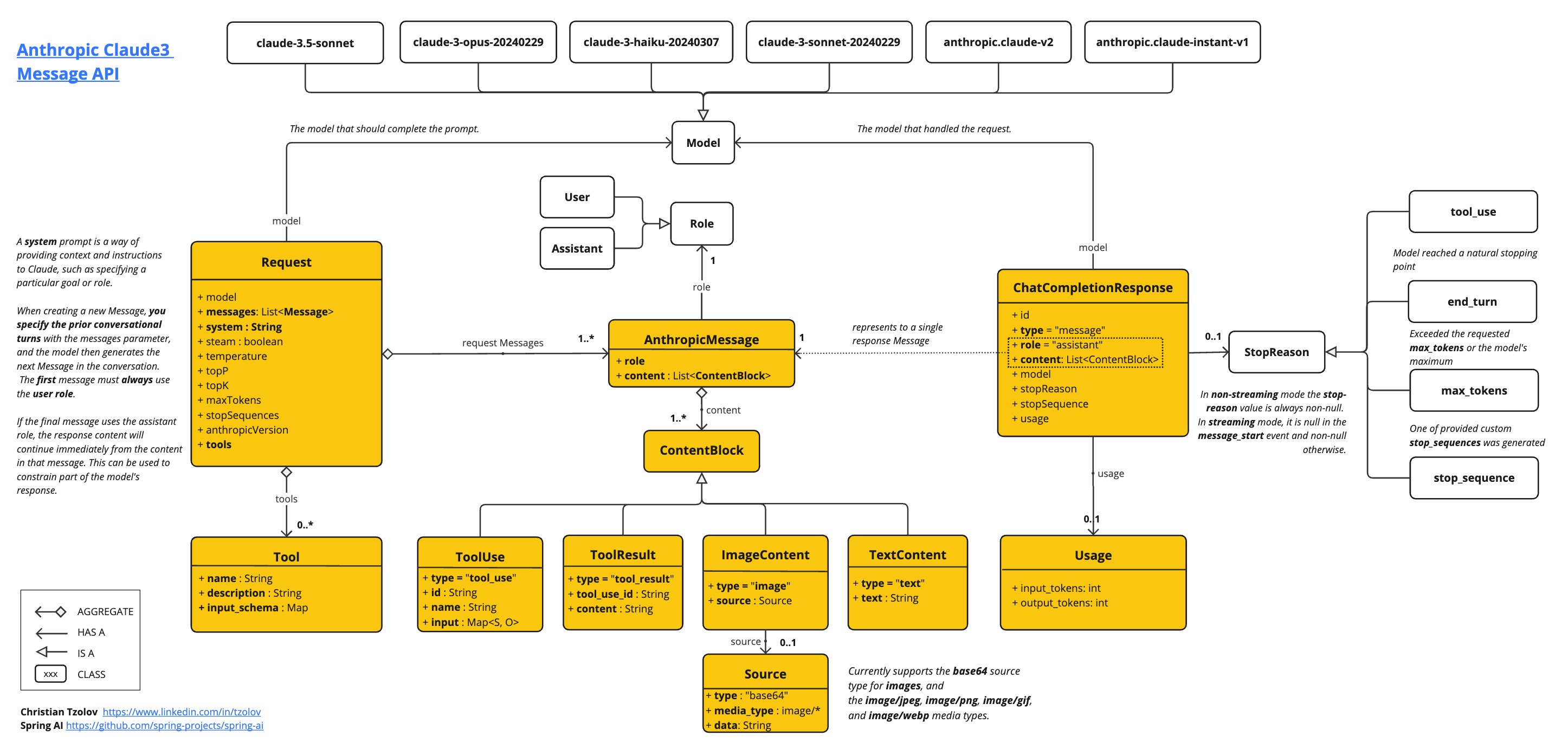
The fact that the usage field is cumulative is a game-changer. It means each message_delta event gives us the total output tokens generated so far for that stream. We don't have to sum up deltas on the client side, which greatly simplifies our logic and reduces the risk of miscalculation.
The stream gives us a sequence of state snapshots:
message_start: Contains the initialinput_tokens.message_delta: Periodically provides a cumulative count ofoutput_tokens.message_stop: Signals the end of the stream.
This is visually represented in the API's class diagram, where the Usage object is a core part of the response structure.
3. Architectural Design: An Asynchronous, Decoupled Pipeline
Our API service that calls the LLM should not be blocked waiting for the billing system. Just as we discussed for payment systems, critical operations like billing should be handled asynchronously and off the main request path.
When dealing with a stream of usage events, this becomes even more important. We don't want to add network latency inside the tight loop that's processing response chunks. The best practice is to "fire-and-forget" billing events to a durable message queue.
How to Track API Usage for Billing in Real Time | Flexprice
This article from Flexprice on real-time usage tracking provides an excellent architectural blueprint that we can adapt.
Please read 'Step 02: Capturing Usage at the Source' and 'Step 03: Ingestion and Buffering'. Note the advice to 'send events asynchronously and off the critical path' and the use of a queue as a 'shock absorber'.
This leads to a simple and robust architecture:
- API Service: The service making the call to the Claude API. It processes the stream and emits usage events.
- Message Queue: A durable queue (e.g., AWS SQS, Kafka, Google Pub/Sub) that receives the events.
- Billing Ingestion Service: A separate service that consumes events from the queue, deduplicates them, and aggregates them into a database.
This decoupling ensures that even if the billing service is slow or down, the API service remains unaffected, and no billing data is lost (as it's buffered in the queue).
4. Adapting the API for Incremental Reports
Our previous POST /v1/usage-events endpoint was designed for a single event. We now need a way to submit a sequence of related events. We'll design a new schema for these incremental reports.
4.1. The Incremental Event Schema
An incremental event needs to contain enough information to be uniquely identified and correctly ordered.
from pydantic import BaseModel, Field
from datetime import datetime
import uuid

class IncrementalUsageEvent(BaseModel):


    # The unique ID for the entire streaming session.
    # Could be the 'message.id' from the LLM API response.
    stream_id: uuid.UUID


    # A monotonically increasing number for each report in this stream.
    sequence_number: int = Field(gt=0)


    # Tenant/User identifiers
    tenant_id: str
    user_id: str


    # Cumulative token counts, reflecting the latest state.
    cumulative_input_tokens: int
    cumulative_output_tokens: int


    # Timestamp of when this event was generated.
    timestamp: datetime


    # Flag to signal the final event of the stream.
    is_final: bool = False
4.2. Idempotency for Streams
In our last lesson, the Idempotency-Key was tied to a single logical operation. Here, a single logical operation (one LLM query) produces many usage reports. We can't reuse the same key for all of them.
The solution is a composite idempotency key. The unique identifier for an incremental report is the combination of (stream_id, sequence_number). This allows the client to safely retry sending report number N for a given stream without fear of it being double-counted.
Your ingestion service's logic would be:
- Receive an
IncrementalUsageEvent. - Check a database (like DynamoDB) for a record with the key
(stream_id, sequence_number). - If it exists, the event is a duplicate. Discard it.
- If it doesn't exist, process it and store the key to prevent future duplicates.
This pattern ensures "exactly-once" processing for each individual report within the stream.
5. Client-Side Reporting Strategy
The service calling the LLM now has a choice: when should it send an incremental report?
-
Strategy A: Report on Every Update
- Send an
IncrementalUsageEventfor everymessage_deltareceived from the LLM API. - Pros: Real-time, highly accurate data.
- Cons: Very high network overhead. Might generate hundreds of events for a single query.
- Send an
-
Strategy B: Report on Final Update Only
- Wait for the
message_stopevent and send a single report with the final cumulative usage. - Pros: Minimal overhead.
- Cons: Not real-time. If the service crashes before the stream finishes, all usage data is lost. This is unacceptable for long-running streams.
- Wait for the
-
Strategy C: Throttled "Heartbeat" Reports (Recommended)
- Send an
IncrementalUsageEventperiodically (e.g., every 5 seconds or every 500 new tokens). - Crucially, always send a final report upon receiving the
message_stopevent. - Pros: Balances accuracy and overhead. Provides good real-time visibility and dramatically reduces data loss risk in case of a crash.
- Cons: Slightly more complex client logic.
- Send an
The "heartbeat" approach is the most production-ready. Let's sketch out what this client logic would look like.
import time
import uuid
from datetime import datetime, timezone


# Assume `anthropic_client` is an initialized Anthropic SDK client
# Assume `billing_client.report_usage(event)` sends the event asynchronously

def process_streaming_query(prompt: str):
    stream_id = None
    sequence_number = 0
    last_report_time = 0


    # Use a real message queue in production!
    # This is a placeholder for fire-and-forget logic.

    with anthropic_client.messages.stream(
        max_tokens=4096,
        messages=[{"role": "user", "content": prompt}],
        model="claude-3-5-sonnet-20240620",
    ) as stream:
        for event in stream:


            # Capture the stream_id on the first event
            if event.type == "message_start":
                stream_id = uuid.UUID(event.message.id)


            # Process content for the user
            if event.type == "content_block_delta":
                print(event.delta.text, end="", flush=True)


            # Check for a usage update
            if event.type == "message_delta" and stream_id:
                current_time = time.time()


                # Throttle: send report every 5 seconds
                if current_time - last_report_time > 5:
                    sequence_number += 1
                    usage_event = IncrementalUsageEvent(
                        stream_id=stream_id,
                        sequence_number=sequence_number,


                        # ... tenant_id, user_id from context ...
                        cumulative_input_tokens=stream.get_final_message().usage.input_tokens,
                        cumulative_output_tokens=event.usage.output_tokens,
                        timestamp=datetime.now(timezone.utc),
                        is_final=False
                    )


                    # billing_client.report_usage(usage_event)
                    print(f"\n[Sent heartbeat report #{sequence_number}]")
                    last_report_time = current_time


    # After the stream is fully processed, send the final, definitive report
    if stream_id:
        final_message = stream.get_final_message()
        sequence_number += 1
        final_event = IncrementalUsageEvent(
            stream_id=stream_id,
            sequence_number=sequence_number,


            # ... tenant_id, user_id ...
            cumulative_input_tokens=final_message.usage.input_tokens,
            cumulative_output_tokens=final_message.usage.output_tokens,
            timestamp=datetime.now(timezone.utc),
            is_final=True
        )


        # billing_client.report_usage(final_event)
        print(f"\n[Sent FINAL report #{sequence_number}]")
Note: The code uses stream.get_final_message() to access the input_tokens. This helper accumulates the stream internally. A more optimized approach might cache the input token count from the message_start event.
Conclusion
We have successfully adapted our billing architecture to handle the complexities of streaming responses. By understanding the event-driven nature of LLM streams and leveraging the cumulative usage data they provide, we designed a robust and scalable system.
Key Takeaways:
- Streaming APIs use event streams (SSE) to send data in chunks, including cumulative usage information.
- Billing for streams should be asynchronous, using a message queue to decouple the application from the billing service.
- A new event schema is needed for incremental reports, including a
stream_id,sequence_number, and anis_finalflag. - Idempotency for streams is achieved with a composite key (
stream_id,sequence_number), ensuring each partial report is processed exactly once. - A "heartbeat" reporting strategy (throttled updates + a guaranteed final report) provides the best trade-off between real-time accuracy and system overhead.
Next Lesson Preview
We have now designed a reliable pipeline to capture both single and incremental usage events. But where does this data go? Raw event logs are not suitable for fast, user-facing queries like "How much have I spent this month?". In our next lesson, we will design a data model for storing aggregated token counts that supports efficient querying by user, model, and time.