Welcome back. In our previous lesson, we explored how to infuse tapping with rhythm by integrating percussive, muted strikes between melodic notes. You learned to make a single musical line perform a dual function—carrying both melody and its own rhythmic accompaniment.
Today, we're going to isolate and master one of the most distinctive rhythmic elements of modern guitar music, particularly in the style of Polyphia. Our objective is to execute syncopated, trap-influenced hi-hat patterns on muted strings to a metronome. Instead of embedding rhythm within a melodic line, you'll learn to lay down a purely rhythmic track on your guitar, mimicking the intricate, skittering hi-hats of a trap beat. This technique, often called "scratching," adds a layer of electronic texture and rhythmic drive that is fundamental to the modern sound you're aiming to achieve.
1. The Mechanic: The Muted String "Scratch"
Before we can program the rhythms, we need to perfect the sound source. The goal is to produce a consistent, crisp, percussive "chka" or "tzk" sound with your pick on muted strings. It should be devoid of any discernible pitch.
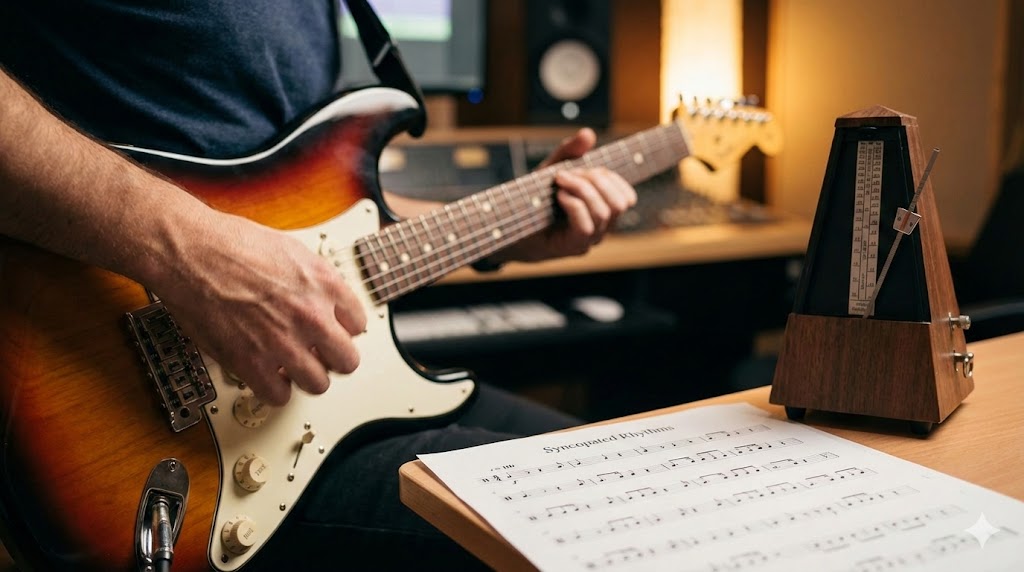
Fretting Hand (The Mute):
Your fretting hand's only job is to ensure silence. Lightly lay your fingers across all six (or seven) strings over the fretboard. You don't need to be near a specific fret. The goal is to deaden the strings completely so that when you strike them with the pick, you get a purely percussive sound. You've already practiced this for creating "dead notes" in a previous lesson; the principle is identical, but now it's applied across the entire fretboard.
Picking Hand (The Rhythm):
Your picking hand will execute all the rhythmic patterns.
- Grip: Hold your pick firmly.
- Motion: Use a relaxed but controlled wrist motion for your alternate picking (down-up strokes). The movement should be small and efficient.
- Target: Aim to consistently strike the same group of strings, typically the lower, wound strings (like the E, A, and D strings), as they produce a clearer, more defined percussive sound than the thinner, plain strings.
- Sound: Experiment with your pick angle. A slightly angled pick (around 30-45 degrees) often produces a crisper "scratch" than a pick held flat against the strings.
Initial Practice:
Set your metronome to a slow 60 BPM. Using alternate picking (Down-Up-Down-Up), play steady 16th notes on the muted strings. Focus entirely on the consistency of your sound. Every stroke should sound identical in volume and timbre. Ensure there is no ringing or unwanted harmonic content.
2. The Vocabulary of Trap Hi-Hats
Trap hi-hat patterns are defined by their rapid changes in subdivision. While rooted in a 16th-note pulse, they are punctuated by faster 32nd-note rolls and syncopated 16th-note triplets to create a feeling of shifting tempo and rhythmic tension.
Let's break down the core components:
- The Foundation (16th Notes): This is your default groove. Counted as "1-e-and-a, 2-e-and-a...". Your picking pattern will be a steady
D-U-D-Ufor each beat. - The Roll (32nd Notes): These are twice as fast as 16th notes, creating a rapid "brrr" effect. To play a full beat of 32nd notes, you would play eight strokes:
D-U-D-U-D-U-D-U. More often, they appear in short bursts. - The Stutter (16th-Note Triplets / Sextuplets): This is perhaps the most characteristic sound. A sextuplet fits six evenly spaced notes into the space of one quarter note. You'll count it as "1-trip-let-and-trip-let" and pick it
D-U-D-U-D-U. This creates a syncopated, three-over-four feel that breaks up the straight 16th-note grid.
3. Building the Patterns: Rhythmic Drills
Now, let's integrate these rhythmic units into exercises. Set your metronome to a manageable tempo, such as 70 BPM. Perform all exercises on fully muted strings.
Exercise 1: The 32nd-Note Burst
This drill trains you to seamlessly switch from 16th notes to a short 32nd-note roll and back again. We'll play a one-bar pattern where the roll occurs on the fourth beat.
- Beat 1: 16th notes (
D U D U) - Beat 2: 16th notes (
D U D U) - Beat 3: 16th notes (
D U D U) - Beat 4: Two 8th notes, with the second one filled with a 32nd-note roll. The rhythm is
[8th] [32nd] [32nd] [32nd] [32nd].- Count: "4 ... and-a-e-a"
- Pick:
D ... U D U D - Let's simplify this for clarity. A simpler and more common pattern is to replace the last two 16th notes of a beat with four 32nd notes.
- Beat 4 (revised):
16th, 16th, 32nd, 32nd, 32nd, 32nd - Count: "4 - e - and - a" becomes "4 - e - (and-a-e-a)"
- Pick:
D - U - D U D U
Loop this one-bar pattern. The challenge is the sudden burst of speed on beat 4. Keep your wrist relaxed and your pick motion compact.
Exercise 2: The Sextuplet Stutter
This drill introduces the syncopated triplet feel. We'll place a sextuplet on the third beat.
- Beat 1: 16th notes (
D U D U) - Beat 2: 16th notes (
D U D U) - Beat 3: One full beat of sextuplets.
- Count: "3-trip-let-and-trip-let"
- Pick:
D U D U D U
- Beat 4: 16th notes (
D U D U)
Loop this bar. Focus on making the transition into and out of the sextuplet smooth. The sextuplet should feel like a controlled, groovy stutter, not a rushed mess. Ensure all six notes are even.
4. Integration: A Two-Bar Trap Hi-Hat Loop
Now, let's combine these elements into a more musical and complex two-bar phrase. This is analogous to sequencing rhythmic functions to build a more complex program. Each beat is a call to a specific rhythmic "component" (play16ths(), play32ndBurst(), playSextuplet()), all synchronized by the metronome's "clock".
Set your metronome to 80-90 BPM (or slower if needed).
Bar 1:
- Beat 1: 16th notes (
D U D U) - Beat 2: 16th notes (
D U D U) - Beat 3: 16th notes (
D U D U) - Beat 4: 16th notes with a 32nd-note burst on the last 16th.
- Rhythm:
16th, 16th, 16th, 32nd, 32nd - Pick:
D - U - D - U D
- Rhythm:
Bar 2:
- Beat 1: 16th notes (
D U D U) - Beat 2: Sextuplet (
D U D U D U) - Beat 3: 16th notes (
D U D U) - Beat 4: Sextuplet (
D U D U D U)
Practice each bar separately until it's clean and comfortable. Then, loop the full two-bar phrase. Your goal is to make it sound like a programmed drum machine—metronomically precise, but with a fluid, modern groove.
Conclusion
Today, you've isolated a key component of the modern guitar soundscape: the trap-influenced hi-hat pattern. By mastering the muted scratch and internalizing the rhythmic vocabulary of 16th notes, 32nd-note rolls, and sextuplets, you've added a powerful tool for creating texture and propulsive groove.
Key Takeaways:
- The "muted scratch" is a percussive technique using a pick on fully muted strings to create a hi-hat-like sound.
- Trap-style rhythms are built on a 16th-note foundation but are characterized by syncopated interjections of faster subdivisions like 32nd notes and 16th-note triplets (sextuplets).
- Mastery of these patterns requires breaking them down into small, manageable components and practicing them slowly with a metronome before combining them.
In our next lesson, we will take this abstract rhythmic skill and apply it directly to your playing. You will learn to integrate these trap-style rhythmic accents into a simple melodic riff, finally merging the percussive world of today's lesson with the melodic world of the guitar.