Recommended resources
The freely available resources this lesson will direct you to.
Introduction
In our previous lesson, we designed the security perimeter for our self-hosted agent, establishing controls for API key management and network access based on the Zero Trust principle. A secure system is non-negotiable, but security alone does not guarantee performance. In the dynamic and often unpredictable environment of real-world operations, services fail, APIs become unresponsive, and AI models can produce unexpected outputs.
This lesson directly addresses this challenge and fulfills the learning outcome: Design error handling, retry logic, and graceful degradation patterns for robust agent workflows. We will move from building a secure system to building a resilient one. For a systems thinker, this is the transition from a stable design to an anti-fragile one—a system that not only withstands failures but recovers from them intelligently. We will equip our agent with the architectural patterns needed to handle the inevitable chaos of production environments.
The Unique Nature of AI Agent Failures
Your experience with traditional programming has likely familiarized you with deterministic errors: null pointers, network timeouts, or validation failures. These are predictable and can be handled with standard try/except blocks.
AI agents, however, introduce a new class of non-deterministic, or semantic, failures. They operate on probabilistic models, meaning their behavior is not always perfectly repeatable or predictable.
Error Recovery and Fallback Strategies in AI Agent Development
To build a robust system, we must first understand its potential points of failure. The article 'Error Recovery and Fallback Strategies in AI Agent Development' by GoCodeo provides a precise, technical categorization of the errors unique to agentic systems.
Read the section 'Key Categories of Errors in AI Agent Systems'. As you read, focus on distinguishing between traditional 'Execution-Level Errors' and the more nuanced 'Semantic' and 'State' errors specific to AI.
As the article details, we must design for a spectrum of failures:
- Execution-Level Errors: The most straightforward failures. An API call fails (e.g., HTTP 503), a tool command doesn't exist, or a database connection is lost. These are common in any distributed system.
- Dependency Errors: A specific type of execution error where an external service fails, for example, hitting an LLM provider's rate limit or a third-party data API being down.
- Semantic Errors: The agent generates a syntactically valid but logically incorrect output. For instance, it calls a real API function but hallucinates incorrect parameters, leading to a valid but undesired action.
- State Errors: The agent's internal model of the world desynchronizes from reality. It might believe a file has been saved when the write operation actually failed, causing all subsequent actions based on that faulty assumption to also fail.
- Timeouts and Latency: The agent gets stuck waiting for a long-running task or a non-responsive service, breaking its main processing loop.
A robust agent architecture must have specific strategies to mitigate each of these failure modes.
Core Resilience Patterns for Agentic Workflows
We will now explore a toolkit of architectural patterns to handle these failures. These are not mutually exclusive; a truly resilient system layers them to create defense-in-depth against failure.
Top 5 Microservices Resilience Patterns
Many of these patterns are adapted from the world of microservices, which has long dealt with the challenges of distributed system reliability. This video from ByteMonk offers a clear, concise overview of several core patterns.
Watch the following short segments to grasp the fundamental concepts: Circuit Breaker Pattern (01:23 - 02:10) Retry Pattern (02:10 - 02:43) Fallback Pattern (02:43 - 03:21) Timeout Pattern (04:20 - 04:55) Focus on the core logic of each pattern: when it is used and what problem it solves.
Let's integrate these patterns into a coherent strategy for our agent.
1. First Line of Defense: Timeouts and Retries
For transient issues like temporary network latency or a briefly overloaded API (Execution-Level and Dependency Errors), a simple retry is often sufficient.
-
Timeout Pattern: Every external call (to an LLM, tool, or API) must have a defined timeout. This prevents an agent's worker process from hanging indefinitely, consuming resources while waiting for a response that will never come. If a timeout is hit, the system should treat it as a failure and move to the next step of the recovery process.
-
Retry Pattern with Exponential Backoff: When a timeout or a retriable error (like an HTTP 5xx status code) occurs, the immediate response should not be to retry instantly. This can lead to a "thundering herd" problem, overwhelming the already struggling service. The correct approach is to retry with exponential backoff: wait for a short period (e.g., 1 second), then retry; if it fails again, wait longer (e.g., 2 seconds), then 4, and so on, up to a maximum number of attempts. This gives the downstream service time to recover.
2. Preventing Cascading Failures: The Circuit Breaker
What if a service isn't just slow, but is consistently failing? Continuously retrying will waste resources and add load to a dead service.
- Circuit Breaker Pattern: This pattern acts as an automated, temporary kill switch. It wraps the calls to a specific tool or service and monitors their failure rate.
- Closed State: Initially, the circuit is "closed," and requests pass through normally.
- Open State: If the number of failures in a given time window exceeds a threshold, the circuit "trips" and moves to the "open" state. For a set period, all subsequent calls to that service are failed immediately without even being attempted. This prevents the agent from wasting time on a known-bad dependency and allows the failing service to recover without additional load.
- Half-Open State: After the timeout, the circuit moves to a "half-open" state, allowing a single test request through. If it succeeds, the circuit closes. If it fails, the circuit opens again for another timeout period.
This pattern is crucial for isolating failures in a multi-agent or multi-tool system, preventing one faulty component from bringing down the entire workflow.
3. Maintaining Functionality: Fallback and Graceful Degradation
When retries have been exhausted or a circuit is open, the agent shouldn't just crash. It should degrade its functionality gracefully.

- Fallback Pattern: This involves defining an alternative action to take when the primary action fails. For an agent, this could mean:
- Using a secondary, perhaps more expensive or slower, data provider if the primary one is unavailable.
- Serving slightly stale data from a cache instead of fetching live data.
- In a multi-agent system, routing the task to a simpler, more deterministic agent that can perform a subset of the original task.
For example, in an underwriting workflow, if a sophisticated AI-based risk analysis tool fails, the agent could fall back to a simpler, rule-based risk scoring model. The output is less nuanced, but the process doesn't halt. This concept of graceful degradation is essential for maintaining business continuity.
Advanced Strategies for Stateful AI Agents
The patterns above are standard for reliable distributed systems. However, the stateful and non-deterministic nature of AI agents requires additional, more specialized strategies.
How to Design Exception Handling for AI Agents That Fail Unpredictably
The article 'How to Design Exception Handling for AI Agents' from Datagrid dives into the specific challenges of non-deterministic failures and how to preserve an agent's valuable working context during recovery.
Please read the following three sections: Step 1: Classify and Detect Non-Deterministic Failures: Focus on the detection methods, such as monitoring confidence scores and using circuit breakers for agent chains. Step 2: Preserve Context During Recovery: This is critical. Understand the concepts of context snapshots and incremental checkpointing. Step 3: Prevent Cascading Failures Across Agent Networks: Note how message queues and graceful degradation are used to isolate failures.
Checkpointing and State Verification
When an agent fails mid-way through a complex, multi-step task (e.g., analyzing a 100-page loan application), simply retrying the whole task is inefficient.
-
Incremental Checkpointing: The agent should periodically save its state—the work it has completed, the data it has extracted, and its reasoning chain—to a persistent store like Redis or a database. This creates a "save point." If the agent fails at step 7 of a 10-step plan, it can be restarted and resume from the last successful checkpoint at step 6, loading its previous context instead of starting from scratch.
-
State Verification: To combat state errors, the agent must adopt a "trust but verify" approach. After executing a critical action (e.g., "create file
report.pdf"), it should perform a verification step (e.g., "check ifreport.pdfexists on the filesystem"). If the verification fails, the agent knows its internal state is out of sync with reality and can trigger a recovery or replanning process.
Synthesizing a Resilient Agent Workflow Architecture
Let's combine these patterns into a single, robust architecture using a message queueing system, a standard for building resilient enterprise applications.
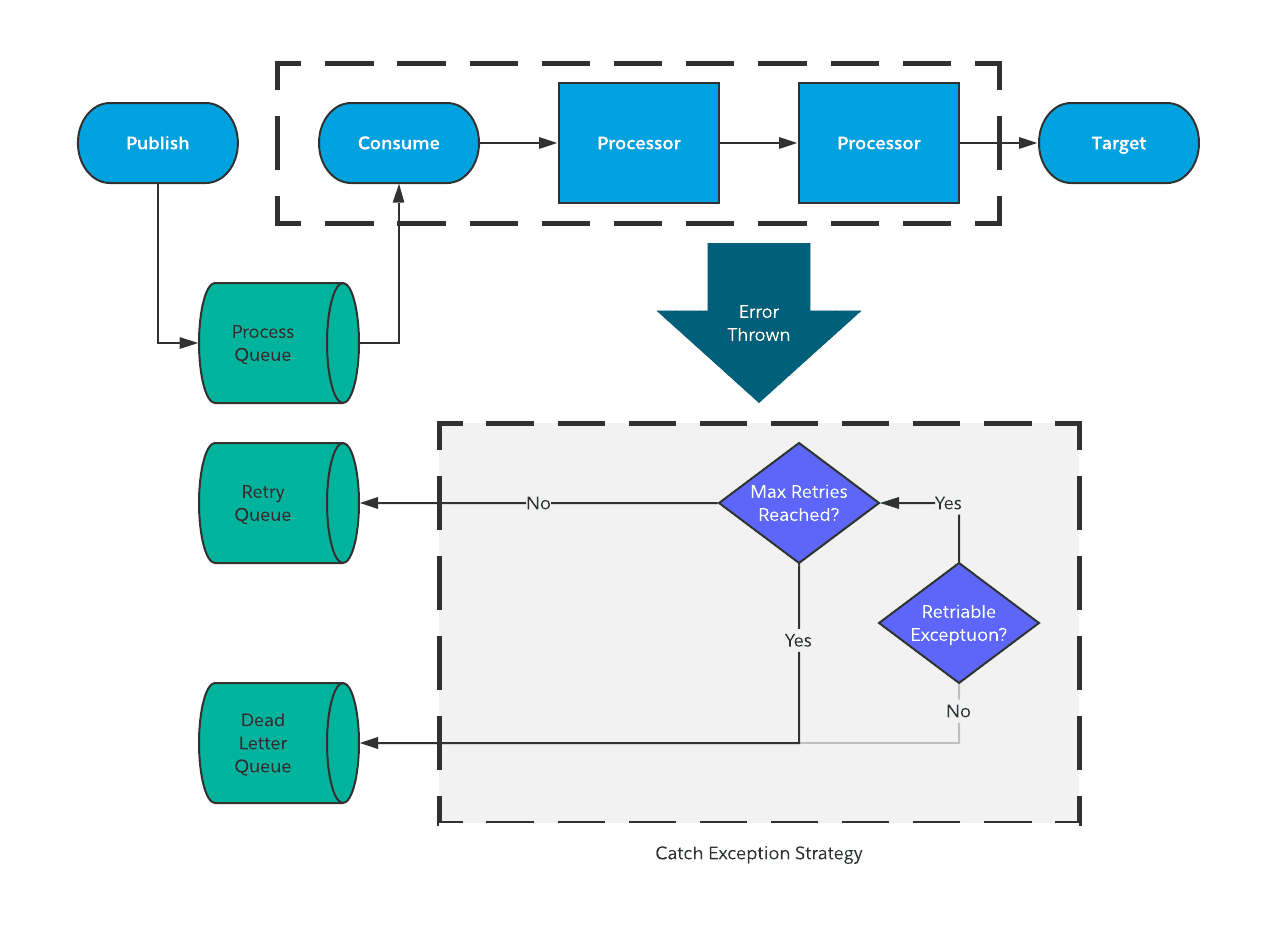
Here is how we apply this architecture to an agent workflow:
- Ingestion: A task (e.g., "process loan application #123") is published as a message to a Process Queue.
- Execution: An agent worker consumes the message. It begins its multi-step plan, with each external call wrapped in a Timeout, Retry (with backoff), and Circuit Breaker pattern. The agent performs Checkpointing after each major successful step.
- Transient Failure: If a retriable error occurs and all retries fail, the agent does not discard the task. Instead, it publishes the message to a Retry Queue with a delay. A separate pool of workers can process this queue later, giving the failing dependency more time to recover.
- Persistent or Semantic Failure: If a non-retriable error occurs (e.g., a semantic error the agent can't self-correct) or the task has failed its maximum number of retries, it is moved to a Dead-Letter Queue (DLQ).
- Human-in-the-Loop Fallback: The DLQ is the ultimate fallback. Messages landing here trigger an alert for a human operator. The message should contain the original task, the last known good state from the checkpoint, and detailed error logs. This allows a human to diagnose the problem efficiently and either correct and resubmit the task or make a manual decision.
This queue-based architecture decouples the components of the system, isolates failures, and provides a structured, auditable path for every task, whether it succeeds or fails.
Conclusion
Building a production-ready AI agent is not just about designing clever prompts and tool integrations. It is about applying rigorous software engineering principles to create a system that can withstand the unreliability of the real world. By layering these resilience patterns, you design an agent that is not just intelligent but also dependable.
Key Takeaways:
- Categorize Failures: Distinguish between deterministic execution errors and non-deterministic semantic and state errors to apply the correct mitigation.
- Use Core Resilience Patterns: Implement Timeouts, Retries with Exponential Backoff, and Circuit Breakers to handle transient and persistent dependency failures.
- Design for Graceful Degradation: Use Fallback patterns to ensure your agent can still provide value even when primary functions are unavailable.
- Manage Agent State: For complex, multi-step tasks, use Incremental Checkpointing to avoid losing work and State Verification to ensure the agent's world model is accurate.
- Architect for Recovery: A queue-based architecture with separate process, retry, and dead-letter queues provides a robust, scalable, and auditable framework for managing workflows and escalating unrecoverable errors to a human.
Preview of the Next Lesson:
The robust error handling, logging, and human-escalation pathways we've designed are not just for reliability—they are fundamental building blocks for governance and compliance. In our next lesson, we will begin Module 10 by exploring how to "Define a governance framework for autonomous agents in regulated financial services," using the technical controls we've established as the foundation for meeting regulatory and risk management requirements.