Recommended resources
The freely available resources this lesson will direct you to.
Introduction
In our last lesson, we engineered resilience into our agent, designing a system of error handling, retries, and graceful degradation. These technical patterns are essential for creating a robust agent that can withstand production failures. However, reliability is only one part of the equation. In a regulated environment like financial services, what an agent does, why it does it, and who is accountable are paramount questions.
This lesson marks the beginning of our final module on Governance and Risk Management. We will directly address the learning outcome: Define a governance framework for autonomous agents in regulated financial services. We will elevate our thinking from the technical implementation of a single agent to the organizational and regulatory structures required to deploy fleets of agents responsibly. The error logging, state checkpointing, and human-escalation pathways we previously designed are not just for reliability; they are the foundational data streams for the governance framework we will build today.
The Unique Governance Challenge of Agentic AI
Traditional AI governance has largely focused on the inputs and outputs of predictive models: ensuring fair training data, validating model accuracy, and explaining predictions. Agentic AI introduces a fundamentally different challenge because agents don't just predict; they act. This autonomy creates a new class of risks that traditional frameworks are ill-equipped to handle.
AI Agent Governance: Best Practices for Enterprise
To understand the scope of the problem, let's start with a clear definition of agent governance and why it's a distinct discipline. The article 'AI Agent Governance: Best Practices for Enterprise' provides a concise overview of the core challenges.
Read the first two sections, 'What Is AI Agent Governance and Why Does It Matter in 2026?' and 'The Unique Challenges of Governing AI Agents'. Focus on how autonomy, multi-agent complexity, and speed differentiate agent governance from traditional model governance.
As the reading highlights, the core governance challenges stem from three unique properties of agents:
- Autonomy Without Clear Boundaries: An agent's probabilistic reasoning can lead it to take novel actions or chain tools in unexpected ways, potentially exceeding its intended operational scope.
- Multi-Agent Complexity: The interactions between multiple specialized agents can lead to emergent behaviors that are difficult to predict or control from the logic of any single agent.
- Speed and Scale: Agents operate at machine speed, capable of executing thousands of actions before a human review cycle can even begin. This makes reactive oversight insufficient.
These challenges necessitate a shift in our approach—from static, pre-deployment reviews to dynamic, real-time, and automated governance.
The Pillars of an Agent Governance Framework
A comprehensive governance framework is not a single document but a multi-layered system of policies, processes, and technical controls. It's an architecture for accountability. While different organizations may structure their frameworks differently, they generally converge on a set of core components.
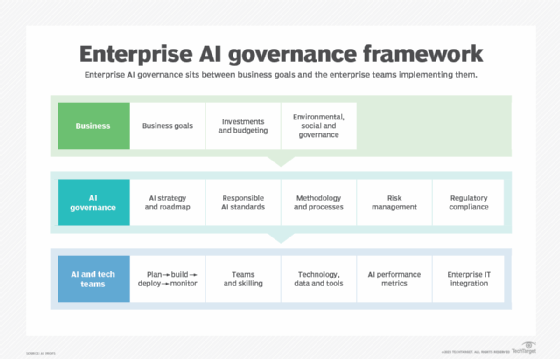
Let's break down the essential pillars required to build this bridge. The following reading outlines a practical, component-based approach.
AI Agent Governance: Best Practices for Enterprise
The article 'AI Agent Governance: Best Practices for Enterprise' offers a structured, six-part framework that is highly practical for implementation. We will use this as the backbone for our discussion.
Read the section 'Building a Comprehensive AI Agent Governance Framework'. As you read, conceptualize each of the six components as a control layer in your overall system design.
Synthesizing this, a robust framework consists of the following interconnected pillars:
-
Digital Job Descriptions: Before an agent is deployed, it must have a clearly defined role and scope. This is not a technical configuration file but a formal document specifying its objectives, authorized tools, data access permissions, decision-making authority, and escalation paths. This is the foundational policy layer.
-
Identity and Access Management (IAM): An agent is a non-human identity. It requires specialized IAM controls, such as dynamic, short-lived credentials scoped to a specific task. The principle of least privilege is non-negotiable. This is the core security layer.
-
Tiered Human Oversight Models: Not all agent actions carry the same risk. A governance framework must define a risk-based model for human involvement:
- Human-in-the-Loop (HITL): For high-stakes decisions (e.g., final loan approval), the agent can prepare a recommendation but requires explicit human sign-off to execute.
- Human-on-the-Loop (HOTL): For moderate-risk tasks (e.g., flagging suspicious transactions), the agent acts autonomously but humans monitor the activity in real-time or via dashboards and can intervene if necessary.
- Fully Autonomous: For low-risk, well-defined tasks (e.g., data extraction from a document), the agent operates without direct oversight, but its actions are still logged and auditable.
-
Comprehensive Monitoring and Observability: This goes beyond the logging we discussed for error handling. It involves creating an immutable audit trail for every single agent action: every observation, every thought in its reasoning chain (e.g., Chain-of-Thought prompt), every tool call, and every resulting action. This is the transparency layer.
-
Continuous Evaluation and Testing: The agent's performance and behavior can drift over time. The framework must mandate continuous, automated testing for performance (accuracy, latency), security (vulnerability to prompt injection), and fairness (bias). Red teaming exercises, where a dedicated team tries to make the agent fail or act maliciously, are critical.
-
Emergency Override Mechanisms: You must have a "kill switch". The technical patterns we discussed, like Circuit Breakers, are part of this. The framework must also define procedural overrides, allowing human operators to pause, reset, or completely disable an agent or fleet of agents immediately if anomalous behavior is detected.
This multi-layered approach is reinforced by other industry analyses, which call for a combination of technical safeguards, process controls, and clear accountability structures.
Risks of Agentic AI: What You Need to Know About Autonomous AI
The following short video clip reinforces this layered model, breaking down governance into technical guardrails, process controls, and organizational accountability.
Watch the segment from 02:45 to 03:57. Notice how it categorizes controls into these three distinct but related groups, providing a clear mental model for structuring your governance efforts.
Special Considerations for Financial Services
While the framework above is universally applicable, its implementation in financial services requires a specific focus due to intense regulatory scrutiny and the high-stakes nature of financial transactions.
AI Agent Governance: Best Practices for Enterprise
Let's now drill down into the specific governance requirements for the financial sector.
Read the short section on 'Financial Services' and the following section on 'Regulatory Compliance and Legal Frameworks'. Pay close attention to the terms 'auditability', 'explainability', and the reference to specific regulations like the EU AI Act and GDPR.
For banking and insurance, your governance framework must explicitly address:
- Regulatory Compliance: The framework must be designed to produce evidence of compliance with regulations like the EU AI Act, GDPR (for data privacy), and rules from bodies like the SEC, FINRA, and central banks (e.g., HKMA). This means agent actions must be traceable to specific regulatory constraints.
- Immutable Audit Trails: This is a non-negotiable technical requirement. Every decision and action taken by an agent must be logged in a way that cannot be altered. This is the foundation of auditability—proving what happened.
- Decision Explainability: Regulators, auditors, and customers may demand to know why an agent made a particular decision (e.g., why a loan was denied). While perfect explainability of LLM reasoning is an open research problem, the framework must mandate that the agent logs its reasoning chain, the data it used, and the rules it followed. This is the foundation of explainability.
- Bias and Fairness: The framework must include processes for rigorously testing agents for bias in their decision-making, particularly in areas like lending and underwriting, to ensure compliance with fair lending laws.
- Data Security: Given the sensitivity of financial data, the framework must enforce strict data handling protocols, including PII detection and masking, encryption, and access controls, aligning with the "Security Foundation" pillar described in the EY risk framework (LINK).
Activating the Framework: Roles and Responsibilities
A framework is only as effective as the people who implement and enforce it. Governance is a cross-functional discipline, not an isolated IT task.

To make this a reality, clear roles and responsibilities must be established.
AI Agent Governance: Best Practices for Enterprise
Finally, let's look at the team structure required to support this framework.
Read the section 'Building AI Agent Governance Teams', focusing on the composition and purpose of the AI Governance Council.
An effective governance structure typically includes:
- An AI Governance Council: A cross-functional body with representatives from legal, compliance, security, IT, data science, and key business units. This council sets policies, reviews high-risk agent deployments, and acts as the ultimate authority on governance matters.
- Chief AI Officer (CAIO) or equivalent: A senior leader who owns the AI strategy and is ultimately accountable for its responsible implementation.
- Dedicated Teams: Legal and compliance teams interpret regulations, security teams protect against threats, and ethics panels review for fairness and societal impact.
Conclusion
Defining a governance framework for agentic AI in financial services is a complex but critical task. It requires moving beyond traditional model validation to a new paradigm of behavioral safety, decision accountability, and continuous oversight. By thinking in terms of a multi-layered system, you can construct a framework that is both robust and adaptable.
Key Takeaways:
- Governance Follows Action: Agentic AI requires a new governance paradigm focused on managing autonomous actions, not just static predictions.
- A Multi-Pillar Framework: A comprehensive framework is built on interconnected pillars: digital job descriptions, robust IAM, tiered human oversight, deep observability, continuous testing, and emergency overrides.
- Finance Demands Rigor: In financial services, this framework must be specifically tailored to demonstrate regulatory compliance, ensure auditability and explainability, and rigorously test for bias.
- Governance is a Team Sport: Effective implementation requires a cross-functional governance council and clear roles and responsibilities across the organization.
Preview of the Next Lesson:
We have established the necessity of tiered human oversight (HITL, HOTL) as a core pillar of our framework. In our next lesson, we will perform a deep dive on this concept, focusing on the learning outcome: Design human-in-the-loop patterns including approval gates, escalation triggers, and override mechanisms. We will move from the 'what' and 'why' of human oversight to the practical 'how' of designing these crucial control points.