Recommended resources
The freely available resources this lesson will direct you to.
Hello!
In our last lesson, we focused on verifying circuit solutions using power balance, a method grounded in the conservation of energy. We saw how resistors are components that dissipate energy, converting it into heat.
Today, we shift our focus to a new type of component that fundamentally changes how a circuit behaves: the capacitor. Unlike a resistor, a capacitor's primary role is to store energy. Your interest in understanding energy flow will be central here, as we'll explore the physical mechanism of this storage.
This lesson addresses the first learning outcome in our "Energy Storage Elements" module: Explain how a capacitor stores energy in an electric field and use Q=CV to relate its charge, voltage, and capacitance.
By the end of this lesson, you will have a strong mental model of how a capacitor works, moving beyond formulas to the underlying physics.
1. The Anatomy of a Capacitor: Storing Charge
At its core, a capacitor is a surprisingly simple device. It consists of two electrical conductors separated by an insulating material called a dielectric.
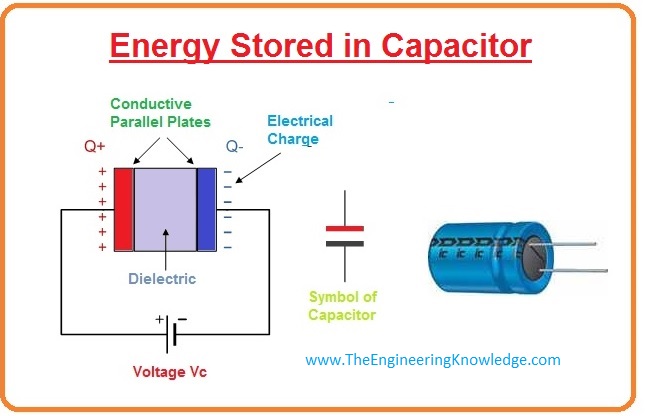
When we connect a voltage source (like a battery) across a capacitor, the source does work. It pulls electrons from one plate, making it positively charged, and pushes an equal number of electrons onto the other plate, making it negatively charged. The dielectric prevents the electrons from jumping across the gap. This separation of charge is the essence of how a capacitor functions.
But why are two plates necessary? Why can't we just store charge on a single conductor? Let's build our intuition for this.
Capacitors and Capacitance: Capacitor physics and circuit operation
This animation from Physics Videos by Eugene Khutoryansky provides an excellent physical model for why a second plate is crucial for storing a significant amount of charge.
Watch the segment from the beginning until 03:13. Focus on the forces at play. Notice how trying to add electrons to a single plate is difficult due to repulsion, but the presence of a second plate changes the situation entirely.
As the video illustrates, the negatively charged plate repels new incoming electrons, while the positively charged plate attracts them. This interplay allows for a much greater amount of charge to be accumulated than would be possible on an isolated conductor.
Because of this accumulated charge separation, an electric field is established in the dielectric material between the two plates. This field is the key to our next topic: energy.

2. Defining Capacitance: The Q = CV Relationship
We've established that a capacitor stores charge. The "capacity" of a capacitor to store charge for a given voltage is called its capacitance, denoted by the letter C.
Capacitance is defined by the fundamental relationship:
Where:
- Q is the magnitude of the charge stored on each plate, measured in Coulombs (C).
- V is the voltage across the capacitor, measured in Volts (V).
- C is the capacitance, measured in Farads (F).
A capacitance of one Farad means that for every one Volt of potential difference applied, the capacitor stores one Coulomb of charge. The Farad is a very large unit, so in practice, you'll almost always see capacitance measured in microfarads (), nanofarads (), or picofarads ().
Let's watch a short video that formally introduces this concept.
This clip from ALL ABOUT ELECTRONICS clearly defines capacitance and presents the Q=CV formula.
Watch the section from 04:21 to 05:08. This will reinforce the definition of capacitance and the relationship between charge, voltage, and capacitance.
From , we can see that for a fixed voltage, a larger capacitance allows for more charge to be stored. So, what physical properties determine a capacitor's capacitance?
Capacitors and Capacitance: Capacitor physics and circuit operation
Let's return to the Khutoryansky video. It provides a brilliant intuitive explanation of what determines capacitance by connecting it directly back to the idea of storing more charge for the same voltage.
Watch the segment from 04:48 to 09:28. Observe how three factors allow the capacitor to hold more charge for the same applied voltage (and thus have a higher capacitance): Increasing the plate area. Using a better dielectric material. Decreasing the distance between the plates.
This animation provides the "why" behind the factors affecting capacitance. It's not just a formula to memorize; it's a direct consequence of electrostatic forces.
3. Energy Storage: Work and the Electric Field
We've mentioned that capacitors store energy, but how? And where does this energy reside?
Think about the process of charging. To move negative charges away from the positive charges they are attracted to, the battery must do work. This is analogous to lifting an object against gravity; you do work, and that work is stored as gravitational potential energy.
This article from 'Explain that Stuff' offers a great analogy for understanding energy storage in a capacitor.
Read the section titled 'Why do capacitors store energy?'. It frames the work done in separating charges as storing electrical potential energy, much like climbing stairs stores gravitational potential energy.
This raises a crucial question that gets to the heart of your interest in energy flow: Where is this potential energy actually stored? Is it on the metal plates? In the dielectric?
The 19th-century physicist Michael Faraday proposed a revolutionary idea: the energy is not located on the conductors but is stored in the electric field that permeates the space between them.
Energy Stored in a Capacitor | SciencePedia
This article from SciencePedia provides a deeper, more fundamental explanation of this concept. It's a perfect fit for your preference for abstract and critical thinking about physical principles.
Please read the section titled 'The Field as a Reservoir of Energy'. Focus on the central idea: every cubic meter of space containing an electric field holds energy. The article introduces the concept of energy density, uE, and shows that integrating this field energy gives you the total energy stored in the capacitor.
This is a profound shift in perspective. The components and wires of a circuit are merely the guides for the energy, which truly resides and moves through the surrounding electromagnetic fields. When we say a capacitor "stores energy," we mean it creates a stable electric field in a small volume, and that field is the reservoir of energy.
4. Practice Calculation
Let's apply the core formula to a simple problem.
A capacitor with a capacitance of is connected to a 12V DC power supply.
- What is the total magnitude of charge stored on each plate of the capacitor?
- If this capacitor were replaced with a capacitor, how much charge would be stored at the same 12V?
Your Task:
Use the formula to find the answers. Remember to be careful with your units!
Click here to see the solution.
Part 1:
- Given: ,
- Formula:
- Calculation:
- Answer: The charge stored is Coulombs, or 5.64 millicoulombs (mC).
Part 2:
- Given: ,
- Formula:
- Calculation:
- Answer: The charge stored is 12 millicoulombs (mC). As expected, more than doubling the capacitance at the same voltage more than doubles the stored charge.
Conclusion
In this lesson, we introduced our first energy storage element, the capacitor. We focused on building a physical intuition for how it works, from the interaction of charges on its plates to the nature of the energy stored within its electric field.
Key Takeaways:
- A capacitor stores energy by physically separating charge onto two conductive plates separated by a dielectric.
- The relationship between charge (Q), voltage (V), and capacitance (C) is defined by the fundamental equation .
- Capacitance is a physical property determined by the geometry of the plates (area, distance) and the material of the dielectric.
- The energy stored in a capacitor is not on the plates themselves but resides within the electric field in the space between them.
Preview of the Next Lesson:
Now that we have a solid conceptual foundation for how and where a capacitor stores energy, our next step will be to answer the question, "How much?" We will derive and apply the formula for the energy stored in a capacitor, . We will then introduce the second major energy storage element: the inductor, which stores energy in a magnetic field.