Recommended resources
The freely available resources this lesson will direct you to.
Welcome back. Last time, you calculated a trade’s notional value and its gross return relative to that value. You also saw why a return on the shares is not necessarily a return on the cash in your trading account.
Today, that distinction becomes central. Leverage lets you control a larger intraday position with less money committed upfront. You will see why the same small stock-price move can then produce a much larger gain—or loss—relative to that money.
Position value is not the same as money committed
Suppose a share costs ₹1,000. Buying 20 shares creates a position worth ₹20,000. If you pay the full amount yourself, a 2% rise in the share price produces a ₹400 gross gain: the position has gained 2%, and so has the ₹20,000 you committed.
Now suppose an intraday facility lets you use ₹20,000 as initial margin to control 100 shares instead. The shares have an entry notional value of ₹100,000, so this is 5× leverage:
Margin is the amount you must commit to open the position; it is not the position’s total value or a cap on its potential loss. The precise arrangement, margin requirement, and availability depend on the broker, product, and stock.
Watch the stock-trade example in What is Leverage & Margin in Intraday Trading – Margin in Zerodha Explained from Your Trade Guide. Treat its stated leverage as an example, not a promise that the same leverage is available for every stock.
What is Leverage & Margin in Intraday Trading - Margin in Zerodha Explained
The video shows how a larger intraday share position can be opened with a smaller upfront margin, then connects that position size to gains and losses.
Start with the share example to distinguish the trade’s full value from the margin required. Continue through both outcomes, watching how a favorable and an unfavorable move affect the money committed. In the recap, note the warning that margin is not available for every stock.
The key question after opening a leveraged position is not merely “How much did the stock move?” It is also “How large a position did I expose to that move?”
Follow the same price move in both directions
Return to the hypothetical 100-share position bought at ₹1,000 per share. A 2% rise takes the price to ₹1,020. The gain is ₹20 on each of 100 shares, or ₹2,000 gross. That is still a 2% gain relative to the ₹100,000 share position, but it is 10% relative to the ₹20,000 initial margin:
A 2% fall takes the price to ₹980. The same 100 shares now produce a ₹2,000 gross loss, or −10% relative to initial margin. Leverage has not changed the stock’s price movement. It has increased the number of shares exposed to that movement.
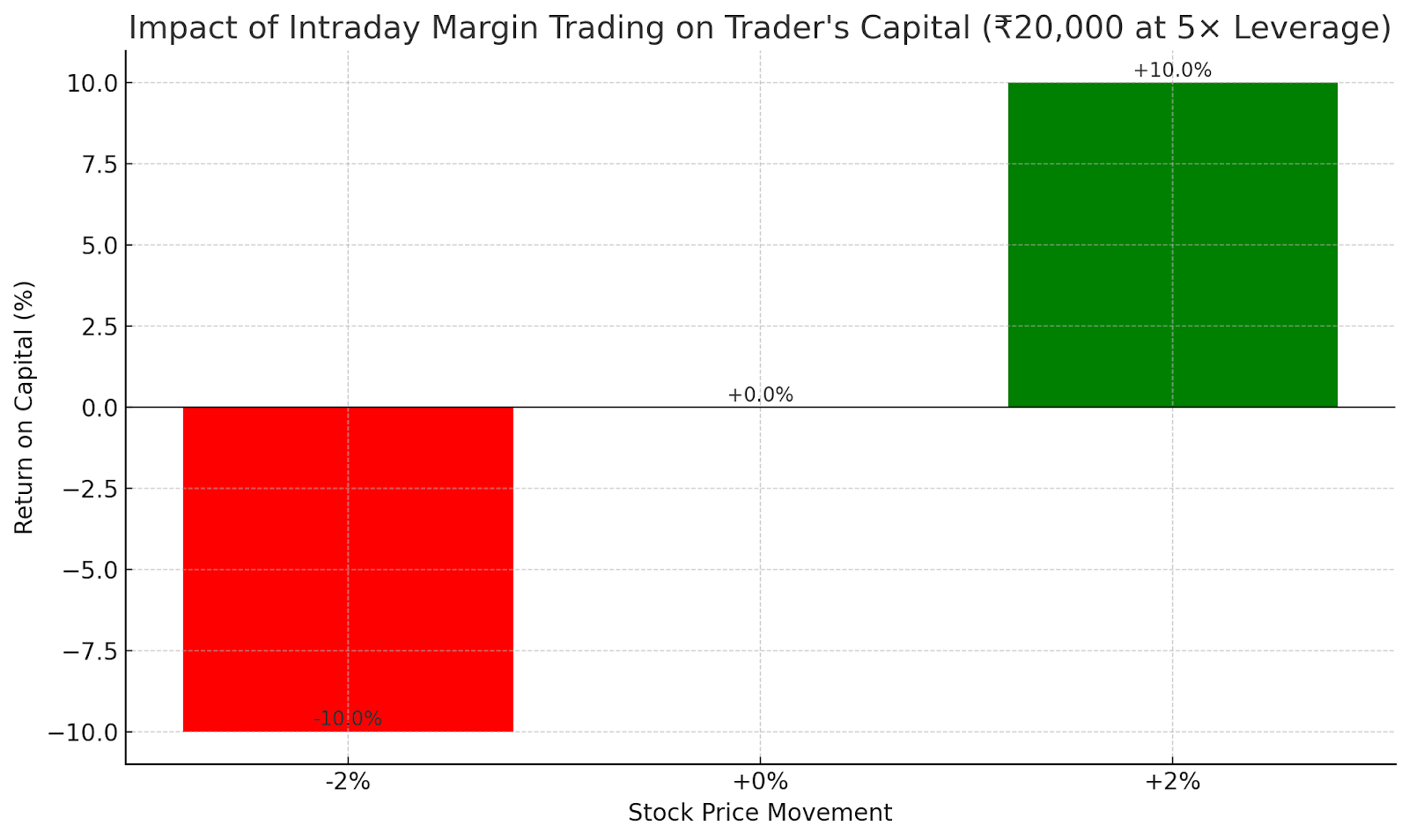
Compare the two ways of using ₹20,000 at the same entry price:
| Position | Shares controlled | If price rises 2% | If price falls 2% |
|---|---|---|---|
| Paid for in full | 20 | ₹400 gross gain | ₹400 gross loss |
| 5× leveraged | 100 | ₹2,000 gross gain | ₹2,000 gross loss |
The leveraged position produces five times the rupee gain or loss because it contains five times as many shares. Its return relative to the ₹20,000 committed is also five times the stock’s percentage move, before costs, provided the shares can be exited at the assumed price.
The useful rule—and its limits
For a straightforward buy-then-sell example with a fixed entry position and margin, you can express that relationship as:
So a 3× position exposed to a 7% price rise has a gross gain equal to 21% of its initial margin. A 7% fall produces a gross loss equal to 21% of that margin.
Read the worked intraday example in Groww’s Guide to the Intraday Margin Trading Facility to check the rule using share quantities and rupees, rather than relying only on a percentage shortcut.
Guide to the Intraday Margin Trading Facility
Groww’s three-times-leverage example provides a second set of numbers with which to trace both outcomes.
In “How Does Intraday Margin Trading Work?”, find the example beginning “Say you have ₹10,000 in cash.” Read from that sentence through the paragraph ending “while also having to pay interest on the borrowed funds.” The linked worked example covers the share price, quantity, larger position, gain, and loss. Focus on why the ₹2,100 result comes from 150 shares rather than the 50 shares affordable with cash alone. Then, under “What are Margin Calls?”, read from “In intraday trading, brokers require you to maintain” through “without needing your approval.” Use that explanation to understand why a broker might require more funds or close a position.
In that example, ₹10,000 buys 50 shares at ₹200 without leverage. At 3× leverage, the position contains 150 shares worth ₹30,000. A 7% move is ₹14 per share. Across 150 shares, that is ₹2,100—21% of the ₹10,000 committed—whether the result is a gain or a loss.
The multiplication rule describes gross price exposure, not a guaranteed realised return. It assumes the stated entry and exit prices and leaves out brokerage, taxes, other charges, and any financing cost applicable to the particular facility. A stock that finishes at your hoped-for price does not guarantee that you could execute every share there.
Why margin deserves caution
A small adverse move can consume a large fraction of initial margin. In the simplified 5× example, a 10% fall in the share price would create a gross loss of ₹10,000—half the ₹20,000 initially committed. A 20% fall would create a gross loss of ₹20,000, equal to that initial amount, if the full position remained open and was exited at that price. Costs would worsen either result.
That is a calculation of exposure, not a forecast of when a broker would act. Margin requirements can change as a position loses value. A broker may require additional funds or close a position under its rules; rapid moves or poor execution can still leave losses greater than the amount initially deposited. An automatic close-out should not be treated as a guaranteed limit on loss.
For now, the practical habit is to state both denominators when discussing a leveraged trade: the return on the full share position and the return relative to money committed. Saying only “I made 10%” hides the important fact that, in our example, the stock moved just 2% while a 5× position magnified the effect on capital.
Key takeaways
Leverage is the ratio of a position’s notional value to its initial margin. It increases exposure, not the probability of being right: under the same assumptions, it magnifies favorable and unfavorable price moves equally relative to money committed. Gross returns are useful for understanding the mechanism, but costs, execution, and broker margin rules affect real outcomes.
Next, you will configure a charting workspace. A clean watchlist and chart can help you observe Indian equities without confusing a visible price move with the return—or risk—of a position you might take.