Recommended resources
The freely available resources this lesson will direct you to.
Hello! Welcome to the seventh lesson in our module on AI Alignment and Safety.
In our last lesson, we examined the ways large language models can fail, including hallucinations, jailbreaking, and prompt injection. We saw that these aren't just simple bugs but can be fundamental vulnerabilities tied to the model's architecture. These risks naturally increase as models become more capable. A key question for any frontier AI lab is: how do you responsibly manage this escalating risk?
Today, we'll explore Anthropic's answer to that question. Your learning outcome is to explain the core ideas behind Anthropic's Responsible Scaling Policy (RSP) and AI Safety Levels (ASL).
For someone interviewing at Anthropic, understanding the RSP is as crucial as understanding their tech stack. It's the "constitution" that guides their engineering and research, reflecting their core mission. Your experience at AWS designing robust systems like Rudi, which handle different service levels and have built-in safeguards, provides a great conceptual parallel. The RSP can be seen as a similar system of safeguards, but applied to managing the societal-scale risks of increasingly powerful AI.
1. The "Why": The Philosophy Behind the RSP
Before diving into the technical details of the policy, let's understand its purpose and the philosophy behind it. The RSP isn't just a document; it's a central part of Anthropic's identity and operational strategy.
Building Anthropic | A conversation with our co-founders
To get a sense of the RSP's importance within the company, let's hear from Anthropic's co-founders in this video titled 'Building Anthropic'. They discuss the origins of the RSP and its role as a foundational document.
Please watch the following three clips: 18:35 - 20:31: The genesis of the RSP, moving from a single cap to a series of thresholds. 20:31 - 22:00: The 'Constitution' analogy and the importance of iterating on the policy. 38:59 - 40:50: The idea of a 'race to the top' and 'exporting seatbelts'—how making safety and competitiveness coexist can incentivize the whole industry to be safer.
As the co-founders discuss, the RSP is treated with the gravity of a constitutional document. It’s designed to be a "forcing function" that ensures safety work isn't just an afterthought but a prerequisite for developing more capable models. The goal is to prove that safety and competitiveness are not mutually exclusive and to create a model for the entire industry to follow—a "race to the top."
Now, let's look at how these ideas are formalized.
[PDF] Responsible Scaling Policy
The official Responsible Scaling Policy document lays out these principles clearly. The introduction is the best place to start.
Read the 'Introduction' section of the PDF. It begins after the table of contents. Focus on the three core principles guiding their approach to risk governance: proportional, iterative, and exportable.
These three principles are key:
- Proportional: Safeguards should be proportional to the risk. You don't apply the most stringent, costly measures to a model that poses little risk.
- Iterative: The policy is not static. It's a living document that evolves as the technology and Anthropic's understanding of risk mature. This should be familiar from modern software development practices.
- Exportable: The policy is designed to be a "proof of concept" that other companies and regulators can learn from and adopt, much like the "exporting seatbelts" analogy in the video.
2. The "How": AI Safety Levels (ASL) and Capability Thresholds
So, how does the RSP translate these principles into a concrete engineering and deployment plan? The core mechanism is a framework of AI Safety Levels (ASLs).
This is the "if-then" structure mentioned in the policy. Let's get a quick, clear explanation from Anthropic's CEO, Dario Amodei.
AI Safety Levels explained: Current level is ASL-2 | Dario Amodei and Lex Fridman
In this clip from an interview with Lex Fridman, Dario Amodei explains the basic concept of ASLs.
Watch from the beginning to 03:15. Pay attention to how he defines the 'if-then' structure and describes the progression from ASL-1 to the higher levels.
Amodei lays out a tiered system where demonstrating a new level of capability (the "if") triggers the need for a higher level of safety and security (the "then").
This image provides a helpful visual summary of the levels and their associated risks.
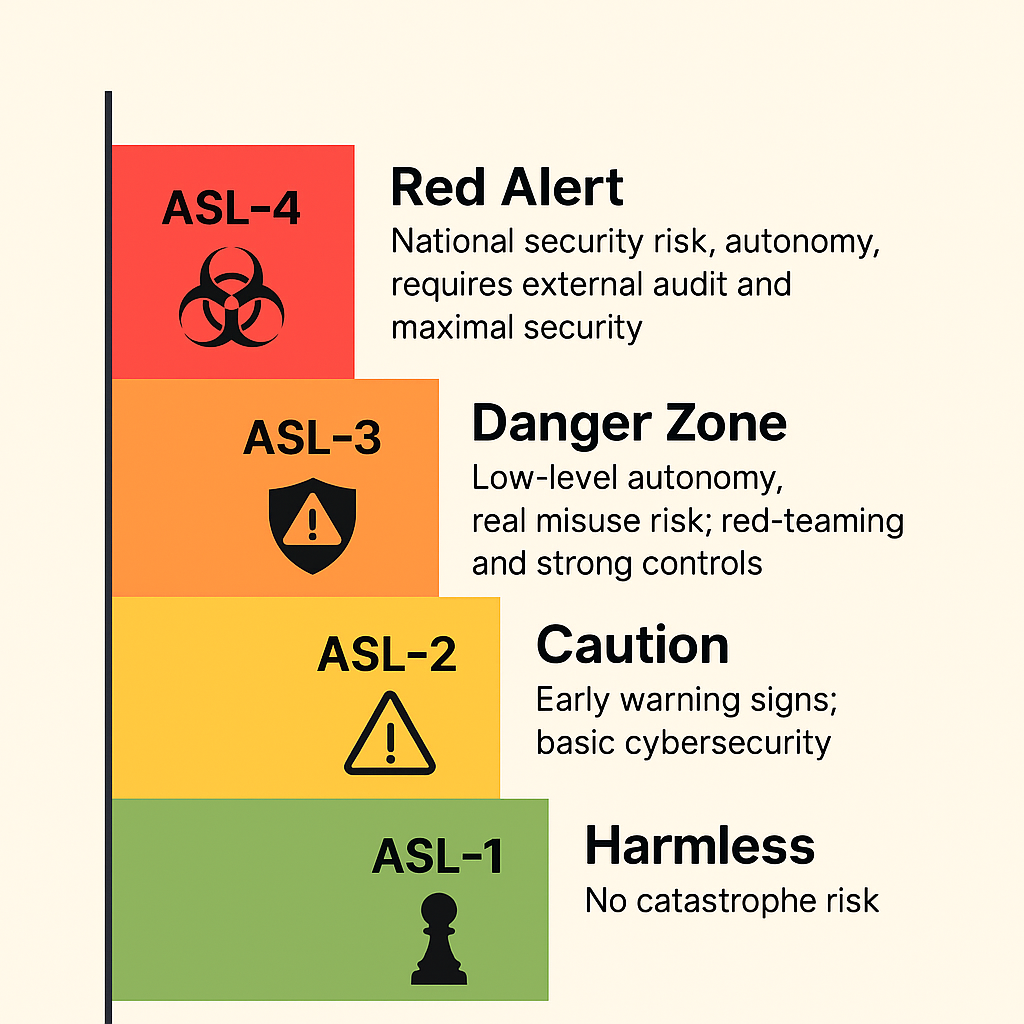
To make this "if-then" logic operational, the RSP defines two key concepts:
- Capability Thresholds: A prespecified level of AI capability that, if reached, signals a meaningful increase in risk.
- Required Safeguards: The specific set of safety and security standards (i.e., the next ASL) that must be implemented once a model crosses a capability threshold.
Let's turn back to the official policy document to see how these are formally defined.
[PDF] Responsible Scaling Policy
The details of the ASL framework, thresholds, and safeguards are the engine room of the RSP. Reading these sections will give you the precise definitions.
Please read two sections from the policy document: Section 1. Background: This defines ASL Standards, breaking them into Deployment Standards (safe usage) and Security Standards (preventing theft). Section 2. Capability Thresholds and Required Safeguards: This gives concrete examples of thresholds, such as risks related to CBRN weapons and Autonomous AI R&D, and specifies that crossing them requires upgrading to ASL-3 standards.
This mechanism is analogous to the QoS and capacity management systems you've built. In your work on Rudi, a spike in request latency or queue depth beyond a certain threshold might trigger load shedding. In the RSP, a model demonstrating the ability to significantly help create a bioweapon (crossing the CBRN threshold) triggers much stricter security around the model weights and more rigorous filtering on its deployment endpoints (the ASL-3 Required Safeguards).
Currently, all of Anthropic's models are at ASL-2. This level requires a baseline of safety, including things like harmlessness training (Constitutional AI), enforcement of a usage policy, and security measures to thwart opportunistic attackers.
3. The "Trade-offs": Why the RSP Evolves
A policy like this isn't created in a vacuum and then set in stone. As the "iterative" principle suggests, it must adapt. The RSP has gone through several versions, and understanding the reasons for these changes reveals the real-world trade-offs involved in AI safety.
The shift from RSP v2 to v3 involved a significant change in philosophy, moving away from rigid, potentially unachievable commitments toward a more flexible and pragmatic framework.
Responsible Scaling Policy v3 - LessWrong
Holden Karnofsky, who works on the RSP at Anthropic, wrote a detailed post on LessWrong explaining the evolution to RSP v3. It provides a fascinating, candid look at the trade-offs.
Please read two key sections from this post: 'How it’s going: the good and the bad': Focus on the subsection 'ASL-4 and ASL-5 prep: the wrong incentives'. This explains how the old policy's requirements for future, extremely powerful models were seen as potentially unachievable and were creating counterproductive incentives. 'RSP v3’s attempt to amplify the good and reduce the bad': This explains how the new policy separates different goals: industry-wide recommendations, internal risk reports, and a public 'Roadmap' of ambitious but achievable goals.
Karnofsky's analysis highlights a crucial trade-off. While it might seem best to commit to the strongest possible safety measures (e.g., protecting model weights from state-level actors), if those measures are not plausibly achievable in the near term, the commitment can distort planning and create a culture of "safety theater" rather than genuine risk reduction.
The RSP v3 revision reflects a pragmatic engineering mindset: focus on ambitious but achievable goals. It separates the ideal state of safety for the entire industry from the concrete, verifiable steps Anthropic commits to taking for its next generation of models. This allows the company to make tangible progress without being paralyzed by commitments that may be currently impossible to fulfill.
Conclusion
In this lesson, we've unpacked the core ideas behind Anthropic's signature safety framework. This is a critical piece of knowledge for understanding the company's culture and priorities.
Key Takeaways:
- The Responsible Scaling Policy (RSP) is Anthropic's public commitment and internal framework to ensure safety measures keep pace with increasing AI capabilities. It's built on principles of being proportional, iterative, and exportable.
- The core mechanism is an "if-then" structure based on AI Safety Levels (ASLs). Crossing a prespecified Capability Threshold (e.g., related to CBRN risk) triggers the need for Required Safeguards from a higher ASL.
- All current models are at ASL-2, which is the baseline standard. ASL-3 and above involve significantly more stringent security and deployment controls to handle catastrophic risks.
- The RSP is a living policy that has evolved. The latest version (v3) focuses on setting ambitious but achievable goals, separating internal roadmaps from broader industry recommendations to avoid the pitfalls of rigid, unachievable commitments.
Next Lesson Preview
Today's lesson focused on understanding Anthropic's specific framework for managing the trade-offs between capability and safety. In our final lesson of the course, you'll synthesize everything we've covered. The learning outcome will be to articulate a thoughtful position on a trade-off between model capability, safety, and speed of deployment. This will challenge you to form and defend your own perspective, preparing you for the kinds of deep, nuanced discussions you can expect in a senior-level interview at a mission-driven company like Anthropic.