Recommended resources
The freely available resources this lesson will direct you to.
- How difficult is AI alignment? | Anthropic Research Salonwww.youtube.com
- Dario Amodei (Anthropic CEO) — The hidden pattern behind every AI breakthroughwww.youtube.com
- Inside Claude: How Anthropic Built the World's Most Safety ...medium.com
- [PDF] System Card: Claude Opus 4 & Claude Sonnet 4 - Anthropicwww-cdn.anthropic.com
Hello! Welcome to the final lesson of your course.
In our last lesson, we explored Anthropic's specific answer to managing the risks of increasingly powerful AI: the Responsible Scaling Policy (RSP) and its AI Safety Levels (ASL). We saw how this "if-then" framework links demonstrated capabilities to required safeguards, creating a structured approach to deployment.
This lesson is the capstone of our entire journey. We will synthesize the technical and philosophical concepts we've covered to address the central challenge facing any frontier AI lab. Your learning outcome is to articulate a thoughtful position on a trade-off between model capability, safety, and speed of deployment.
This isn't about finding a single "correct" answer. Instead, it's about preparing you for the kind of deep, mission-oriented discussion that is a hallmark of interviews at Anthropic. Your extensive experience at AWS building and operating high-stakes services like Rudi has given you a practical foundation in making these kinds of trade-offs daily—balancing feature velocity, system performance, and reliability. Today, we'll apply that same critical thinking to the unique, high-stakes context of AI safety.
1. The Three Competing Pressures
At the heart of this topic is a constant tension between three desirable, but often conflicting, goals. Let's break them down.
- Capability: This is the raw power of the model. It's measured in benchmarks, but it's also about emergent abilities like complex reasoning, scientific discovery, and autonomy. The drive for more capability comes from the desire to solve bigger problems, from competitive pressures, and, as we'll see, from the need for powerful models to help with safety research itself.
- Safety: This encompasses a wide range of properties. It includes alignment (the model does what we intend), robustness (it doesn't break in unexpected ways), and security (it can't be stolen or easily misused). Prioritizing safety is about mitigating catastrophic risks, maintaining public trust, and ensuring the long-term viability of the technology.
- Speed: This refers to the pace of research, development, and deployment. The pressure to move fast is immense, driven by commercial competition, the desire to get products to market, and the opportunity to learn from real-world user interaction.
The core challenge is that you can't perfectly maximize all three simultaneously. Pushing for maximum capability at maximum speed often requires cutting corners on safety. Enforcing perfect safety can slow progress to a crawl, potentially ceding the field to less cautious competitors.
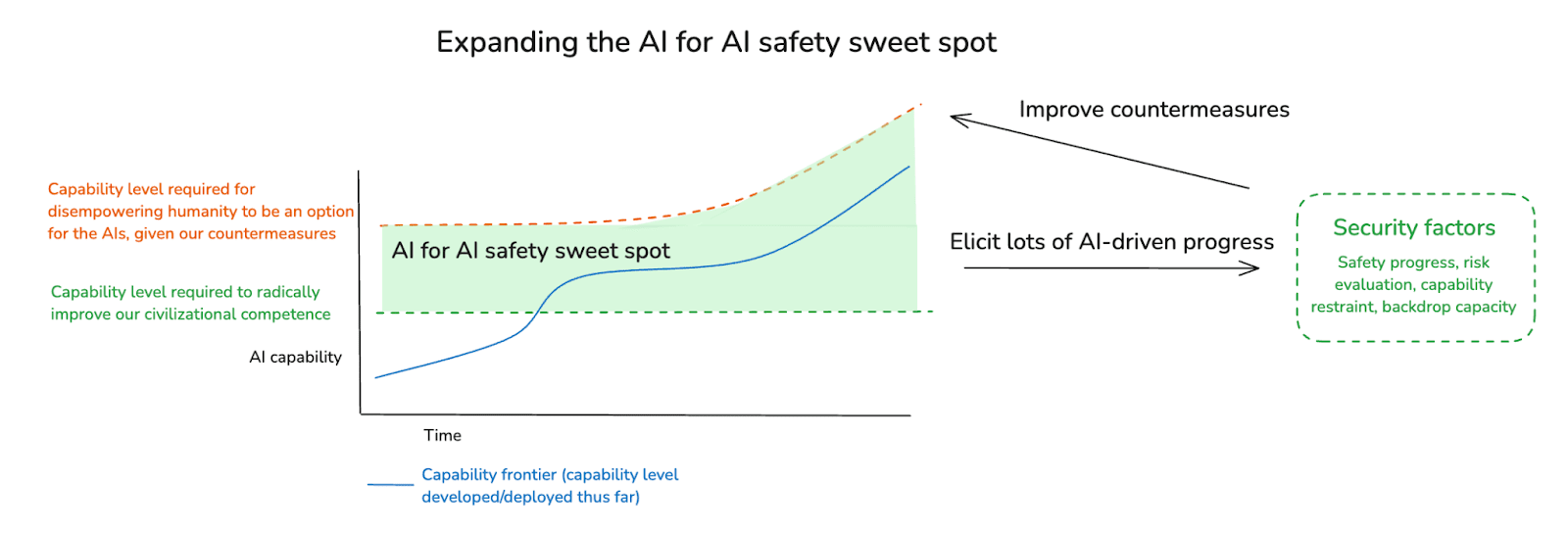
This dynamic is visualized in the diagram below, which shows an "AI for AI safety sweet spot." The goal is to keep the capability frontier within a zone where it can be used for good without becoming uncontrollable. This requires actively managing the trade-offs.
2. The Anthropic Stance: A Deliberate Choice
Anthropic has been very public about its philosophy on this trade-off. Their approach is not an accident; it's a deliberate engineering and corporate strategy.
Inside Claude: Part 9: Engineering Trade-Offs and Future Directions
This article, 'Inside Claude', provides an excellent, concise summary of the engineering trade-offs Anthropic makes. It frames their entire development process around this core philosophy.
Please read 'Part 9: Engineering Trade-Offs and Future Directions' and the 'Conclusion'. This is a short but critical section that explicitly lists what Anthropic chooses to optimize for and what it is willing to sacrifice.
As the article states, Anthropic explicitly optimizes for constitutional alignment, multi-cloud flexibility, and graduated safety levels. In exchange, they are willing to sacrifice potentially faster release cycles and aggressive capability pushing at any cost.
This philosophy is embodied in their deployment process, which you can see in the diagram below. It's a continuous cycle where evaluation and monitoring are not one-off checks but are integral to every stage, from training to post-deployment. This mirrors the high-reliability practices you'd be familiar with, like canary deployments and continuous monitoring, but with an added layer of safety-specific evaluations.

3. Nuances and Justifications from the CEO
Anthropic's stated position is clear, but the reasoning behind it is nuanced. It's not as simple as "safety is more important than capability." CEO Dario Amodei has spoken extensively about the complex dynamics at play.
Dario Amodei (Anthropic CEO) — The hidden pattern behind every AI breakthrough
In this interview, Dario Amodei discusses the difficult choices and complex realities behind Anthropic's strategy. These clips provide the 'why' behind the trade-offs we just read about.
Please watch these three key segments: 38:06 - 41:16: Amodei discusses the concrete risk of AI-enabled bioterrorism. Notice how the trend in capability growth informs his timeline and sense of urgency, forcing a safety trade-off. 58:21 - 01:01:38: He makes a critical, counter-intuitive point: you need highly capable, frontier models to do meaningful safety research. This creates a 'two snakes coiled with each other' dynamic. 01:01:38 - 01:03:34: He lays out the stark choices Anthropic faces as training costs escalate: fall behind, accept the trade-offs of staying at the frontier, or hope for regulatory slowdowns.
Amodei's points reveal that the trade-off is not a simple slider.
- The Ticking Clock: The steady advance of capabilities (like in the biorisk example) means that delaying deployment for safety isn't a free action; it's a race against the model's own potential.
- Capability for Safety: The idea that you need to push capability to improve safety is a powerful complication. You can't just stop scaling and hope to solve alignment with weaker models. This justifies, to some extent, staying on the frontier despite the risks.
- The Hard Choices: The options he lays out are pragmatic and difficult. This isn't a purely philosophical exercise; it's a business and mission-survival decision.
4. A Spectrum of Views: The Internal Discussion
Even within a mission-driven organization like Anthropic, there isn't a single, monolithic view on how to solve these problems. Researchers debate the best path forward, revealing a healthy intellectual tension.
How difficult is AI alignment? | Anthropic Research Salon
This Research Salon video from Anthropic gives a rare look into the internal discussions. It shows how different researchers, focusing on different aspects of the problem, view the trade-offs.
Watch the discussion from 00:28 to 23:43. As you watch, pay attention to the different perspectives: Amanda's iterative approach: Making models 'go well enough' to improve later, focusing on shaping behavior like a 'morally motivated, kind human.' This prioritizes practical, near-term progress. Jan's challenge: Questioning if this behavioral approach is sufficient for super-capable models that can perform complex, uninterpretable actions. Josh's take on interpretability: Seeing it as a way to verify why a model is behaving well, to distinguish genuine alignment from a 'pretend to be nice' feature. The 'Banality of Evil' point (20:45): A questioner raises the idea that even individually 'aligned' models could lead to harmful outcomes at a systems level, highlighting a massive complexity in the trade-off.
This discussion shows that "safety" is not one thing. There's a trade-off between focusing on near-term behavioral safety (Amanda's work) and preparing for long-term, structural risks (Jan's concern). There's also a trade-off between black-box evaluation (observing behavior) and white-box verification (Josh's interpretability work), which itself has costs in terms of time and resources.
5. Synthesizing Your Position
You now have the context: the core tension, Anthropic's public stance, the CEO's justifications, and the internal debates. The final step is to formulate your own thoughtful position. An interviewer at Anthropic won't be looking for you to parrot the company line, but to show that you've grappled with these issues and can defend a reasoned perspective.
Use the following questions to structure your thoughts. There are no right or wrong answers, but your reasoning is key.
-
Starting Point: What is your default inclination? Does your experience building resilient infrastructure at AWS lead you more toward a "precautionary principle" (be certain of safety before deploying), or a "move fast and iterate" model (deploy and learn from the real world)? How does the concept of a "Game Day" exercise translate to AI safety?
-
The Role of Competition: How heavily should the actions of competitors influence a lab's decision to release a new model? Is the "race to the top" argument (making safety a competitive advantage) a viable long-term strategy, or is it a convenient justification for keeping pace?
-
The Case of Claude Opus 4: The System Card for Claude Opus 4 and Sonnet 4 (which we provide a link to for further reading, but summarized in the previous lesson) showed a real-world example of this trade-off. Evaluators could not rule out that Opus 4 had crossed the capability threshold for ASL-3, so it was deployed with the stricter ASL-3 safeguards as a precaution. This likely increased cost and complexity. Do you see this as the correct, responsible decision, or an overly cautious one that might hinder competitiveness?
-
A Hypothetical Scenario: Imagine you are on the release committee for "Claude 5."
- Capability: It demonstrates a 2x improvement in autonomous software engineering, a huge commercial and scientific breakthrough.
- Safety: Evaluations show it can autonomously find and exploit novel, medium-complexity security vulnerabilities in web servers with a 15% success rate. This is a significant increase in risk.
- Speed: A major competitor has just announced their next model, putting immense pressure on your company to release.
- What is your recommendation: (a) Delay release indefinitely until the risk is fully mitigated? (b) Release with extensive monitoring and access controls? (c) Release a "lobotomized" version with the risky capabilities disabled? Justify your choice by explicitly weighing the three factors.
-
Your Personal Philosophy: Based on everything we have covered in this course—from production Python to concurrency, system design, and AI safety—what do you believe is the most defensible position for a senior software engineer at a frontier AI lab to hold regarding this trade-off? How would you contribute to implementing that position in your day-to-day work?
Conclusion and Course Wrap-Up
In this final lesson, we've navigated the complex, high-stakes trade-off between AI capability, safety, and speed of deployment. We've seen that there are no easy answers, only a spectrum of defensible positions grounded in different principles and priorities. The key takeaway is not a specific answer, but the ability to engage in a nuanced, evidence-based discussion about these tensions.
This brings our course to a close. We started with the fundamentals of writing production-quality Python, progressed through implementing complex data structures and managing concurrency, and then applied these skills to building small-scale distributed systems like rate limiters and schedulers. Finally, we delved into the domain-specific challenges of serving large language models and the profound safety questions that define Anthropic's mission.
You have demonstrated a strong commitment to deeply understanding these topics, and your background in building robust, high-performance systems at AWS has provided a fantastic lens through which to view these new challenges. You are now well-equipped not just for the coding and system design aspects of an interview at Anthropic, but also for the critical, mission-driven conversations that will determine if it's the right fit.
Thank you for your hard work and engagement throughout this course. I wish you the very best in your preparation and your upcoming interviews.