Recommended resources
The freely available resources this lesson will direct you to.
- How To Write Short Comicswww.youtube.com
- Comics School: Making Comics - The Power of Short Storieswww.youtube.com
- How to Plot Your 8-Page Comic Story Idea | #8PgChallenge – Step 2 – Comic Book School by Buddy Scalerawww.comicbookschool.com
- How to Revise the Plot of Your 8-Page Comic Storywww.comicbookschool.com
Hello. Last time, you tested whether a short-comic premise gives an artist meaningful changes to show. The missing name on the sign-up board passed that test: it can become a discovery, a confrontation, and a choice. Now the question is whether those events can form a complete story in eight pages, rather than the opening chapter of a much larger one.
This matters for the portfolio you want to build. Setting a large idea aside need not mean abandoning it. A short comic gives you a place to practice finishing a story: making a promise to the reader, developing its central conflict, and delivering an ending within a firm limit. Today you’ll learn how to find that complete, smaller conflict inside an idea that keeps expanding.
A short story is a complete unit, not a shortened epic
An oversized premise often contains several things you genuinely want to write: a setting, a cast, mysteries, relationships, and possible future conflicts. The problem is not that those elements are uninteresting. It is that an eight-page comic cannot give all of them the attention needed to make their outcomes satisfying.
In Comics School: Making Comics – The Power of Short Stories, Jim Zub discusses singular focus: building a short comic around one interaction, action, or contained situation. Watch his examples with a particular question in mind: what does the reader get resolved, even though the story leaves room for a wider world?
Comics School: Making Comics - The Power of Short Stories
Watch “Comics School: Making Comics – The Power of Short Stories” by Jim Zub for its distinction between a contained story and a fragment of a larger one.
Watch singular focus, where Zub discusses keeping a short story centered on a manageable interaction or situation. Continue through three-page payoff for an example of delivering a complete story without first explaining an entire world. Focus on what the short form asks him to select, not just what it asks him to remove.
A fragment might introduce a strange place, reveal a danger, and stop just as a character decides to investigate. The reader has received a beginning, not the outcome of the conflict they were invited to follow. A complete short could take place in the same strange place, but ask a smaller question: Will this character warn one person before the door is sealed? That question can be answered without solving every mystery about the place.
The supplied Walmond the Wizard comic offers an especially compact illustration of a payoff. It builds curiosity about a powerful-looking brew, lets the dragon voice the question, reveals that the “potion” is chili, and closes on the characters having lunch.
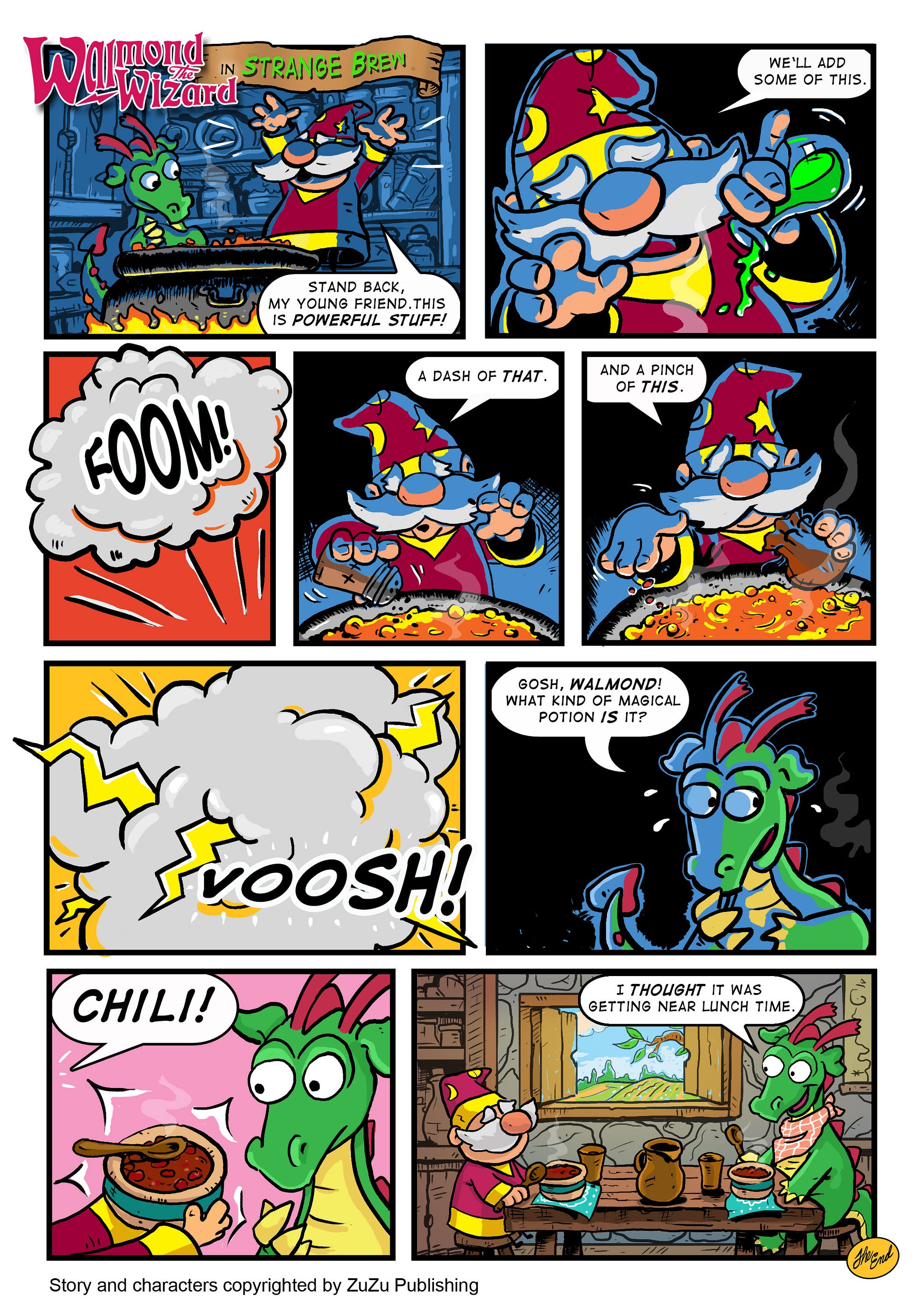
That strip is a gag, not a template for every dramatic eight-page comic. Its useful lesson is closure at the scale of its setup. It does not need to explain the wizard’s history or establish a continuing threat. It raises a particular expectation and answers it. A more serious short can do the same with a consequential choice rather than a joke.
Set the boundary before choosing what happens
“Eight pages” is not merely a length to cut down to after drafting. It is a condition that helps you choose which story to tell. A new location needs establishing. A new character needs enough context to be understood. An explanation of how the world works takes space from actions and reactions. If a premise requires several of each before its central struggle can begin, it is probably still carrying too much.
Jake Parker makes this connection between production limits, panel space, and conflict in How To Write Short Comics. His discussion is useful here because he moves from the physical boundaries of a comic to the questions that identify its central struggle.
Watch “How To Write Short Comics” by Jake Parker for a way to turn a broad idea into a story that fits its chosen format.
Watch story parameters for how page count and available panel space constrain the amount of story you can convey. Then watch core conflict for his questions about the protagonist’s goal, obstacle, and opposition. Treat his panel counts as illustrations of limited space, not as a required number of panels for your pages.
A helpful reduction has two boundaries.
The physical boundary is where and when this particular struggle occurs. One venue and one impending deadline are often easier to make clear than a journey through five venues over several weeks. Those are useful constraints, not laws: an eight-page story can change location or cover more time when each change earns its space.
The dramatic boundary is the question the ending must answer. “Will the hero dismantle the organization?” may demand a series. “Will the hero hand over the evidence tonight, knowing it implicates a friend?” can potentially end in eight pages. The wider organization can still exist, but this comic is responsible for the handover and its immediate consequence—not for every consequence that might follow.
This distinction prevents a common mistake: keeping the epic’s central question and merely rushing through its events. More panels cannot make an investigation, betrayal, reunion, and final confrontation feel earned if each receives only a glimpse. The better move is to choose a smaller question with its own ending.
Find the conflict worth keeping
To reduce an idea, identify what would still interest you if its scale disappeared. Perhaps the attraction is not a kingdom-wide contest but a friend deciding whether protection justifies interference. Perhaps the memorable element is not the history of a magical school but a student choosing whether to admit a mistake. This is the idea’s dramatic center: a person wants something, meets resistance, and must do something that matters.
Then distinguish that center from everything you have attached to it. Here is an intentionally swollen version of the sign-up-board story from the previous lessons:
A first-time reader prepares a tribute performance. Across a season of events, she faces rival performers, investigates missing registration slips, learns the venue’s complicated history, revisits an earlier performance through flashbacks, and tries to repair her friendship with the person who has been quietly steering her choices.
Several stories could live there. An eight-page version does not need to summarize them all. It could retain one charged encounter: the reader arrives to confirm her place, discovers that her friend removed her name, and has until registration closes to decide whether to put it back. The tribute explains why the risk matters. The friend’s concern makes the interference understandable without making it right. The season, rivals, investigation, and venue history can remain notes for another project.
Notice what compression has not done. It has not made the reader’s choice trivial. If performing the tribute might expose grief she is not ready to share, putting her name back has a cost. If her friend acted from sincere concern, confronting that friend has a cost too. Small scope can hold substantial emotional pressure.
For this version to work, the ending should settle the immediate question. For example, the friend admits removing the strip and argues that the reader need not perform. As the board is about to come down, the reader takes a blank strip and writes her own name. The friend sees it and stays beside her, uncertain what to say. We do not need to see the performance to know whether the reader reclaimed the choice. Nor do we need to claim that their friendship is entirely repaired. The local conflict has ended; its human consequences may continue.
That is different from ending with “She realizes the venue has a sinister secret,” when the secret is the only new development the comic has offered. A larger mystery can be present, but it cannot substitute for paying off the question this short asked.
Cut dependencies, not just pages
When a proposed short still feels crowded, the useful question is not simply “What can I delete?” Ask instead: What must the reader know or see for the central choice to make sense? Everything else is a candidate to cut, combine, or save.
Buddy Scalera’s How to Plot Your 8-Page Comic Story Idea explains why reorganizing before scripting is less costly than discovering the problem after you have written panels and dialogue. His published-story example in the article runs to eleven pages; read it for the trimming principle, not as an eight-page allocation to copy.
Read Buddy Scalera’s discussion of plotting and trimming at Comic Book School to see why a page limit changes story selection before it changes script formatting.
In “Step 2: Plotting Your 8-Page Comic Story,” find the paragraph beginning “However, and this is an important point I want to make.” Read plot before scripting through its explanation of why reorganizing early helps. Then go to “Getting to the Scene.” Begin with the paragraph about an editor helping trim the opening, and read scene trimming. Finally, after the intervening message-board paragraph, read what to remove. Focus on the distinction between keeping an enjoyable detail and keeping a detail this particular story needs.
There are three particularly useful ways to reduce dependencies:
Cut: Remove a scene whose outcome does not affect the central decision. In the sign-up story, a rival performer’s separate audition may be interesting, but it does not automatically belong in the comic about the two friends.
Combine: Let one element perform more than one story job. The missing strip both creates an immediate practical problem and reveals that the friend has crossed a boundary. A closing board both belongs naturally to the setting and makes delay consequential.
Save: Preserve material you like without requiring this comic to introduce it. The venue’s history might become another one-shot, or part of the larger project you eventually pitch. Removing it from these eight pages is a decision about placement, not a verdict on its quality.
Be careful not to replace one problem with another. If the shortened story requires a caption explaining a season of events before the first scene, you may have cut the scenes but kept their informational burden. Try beginning at the moment the present conflict becomes legible. A reader may not need to know every earlier conversation to understand a missing name, a friend’s admission, and a closing deadline.
Check whether the small story is big enough—and complete enough
An idea can fail the eight-page test in either direction. Too much material produces crowded introductions and rushed payoffs. Too little produces a single observation stretched across pages. The solution to the second problem is not necessarily another subplot; it may be more development of the one conflict.
Consider the bare version: “She discovers her name is gone and puts it back.” The outcome is clear, but the resistance barely registers. In the stronger version, discovering who removed it changes her understanding of the problem. Her friend has a reason she cannot dismiss outright. Restoring the name then means accepting a risk and rejecting someone else’s claim to make that choice for her. Those developments give the decision weight without enlarging the cast or inventing another plot.
At the premise stage, you can test a possible eight-page story with a few plain questions:
- What question will this comic answer? State it so the answer could be yes, no, or a specific choice—not “What is this world really like?”
- What changes before the answer? Look for distinct developments in knowledge, resistance, opportunity, or risk, rather than repeated versions of the same conversation.
- What context is indispensable? A first-time reader should understand the goal, the opposition, and the cost without studying a separate history.
- What can the ending actually show? The protagonist’s consequential action and at least its immediate result should fit on the page. A promise to resolve them in the next installment is not closure.
These questions are a scope test, not a page-by-page outline. Later lessons will tackle character choices, structure, and the allocation of story beats across eight pages. For now, you are choosing a conflict that is capable of supporting that work.
A short comic can also be connected to a larger idea without becoming an advertisement for it. Zub briefly discusses using a short story as a proof of concept for something bigger. Watch for how the short can demonstrate appeal while remaining a story in its own right.
Comics School: Making Comics - The Power of Short Stories
Return to Jim Zub’s “The Power of Short Stories” for the relationship between a finished short and a larger creative project.
Watch proof of concept. Focus on the difference between giving readers a satisfying small story within a larger idea and asking them to wait for a later project to receive the payoff.
For a portfolio, that distinction is important. A finished one-shot can show how you handle conflict, visual choices, and an ending. A teaser can show an intriguing premise, but it gives someone much less evidence of how you finish a comic.
Key takeaways
To reduce an oversized idea, keep its most compelling human conflict, then give that conflict a physical boundary, an immediate goal, meaningful resistance, and an ending the comic can actually show. Cut or save material that demands its own setup and payoff. Do not hurry through a large plot and call it short; choose a smaller story that is complete on its own.
The sign-up-board story can end when the reader makes the registration choice herself, even though the tribute performance and the friendship still have a future. Next, you’ll start building characters whose choices make that focused conflict matter.