Recommended resources
The freely available resources this lesson will direct you to.
Hello. In the last lesson, the sign-up-board premise gained a thematic question: when you think a friend will be hurt by a choice, should you intervene or let them decide? The immediate struggle remains concrete. A first-time reader wants her name restored before registration closes; her friend removed it to protect her.
Today you’ll test whether that struggle offers enough visual action to work as a short comic. This does not mean adding a chase or a fight. It means finding changes a reader can see: who has the name strip, whether the board is still open, and what each friend does when the other resists. That test will help you choose portfolio ideas that use the strengths of comics rather than relying on an explanation of a good idea.
Visual action means a visible change in the struggle
An arresting picture can be a productive starting point, but it is not yet a story. In The 8 Step Comic Writing Process, Jake Parker begins with an image he wants to draw, then asks what the character wants, what stands in the way, and how the conflict might end.
The 8 Step Comic Writing Process
Watch “The 8 Step Comic Writing Process” by Jake Parker to see how a striking image can lead to a conflict rather than remain an isolated spectacle.
Watch the starting image, where Parker describes the picture that drew him to the idea. Continue through finding the conflict, focusing on the questions he asks about the protagonist’s goal and opposition. His particular story is action-heavy; the useful method is connecting an image to a changing struggle.
Here is an action page that makes change in physical position especially easy to see.
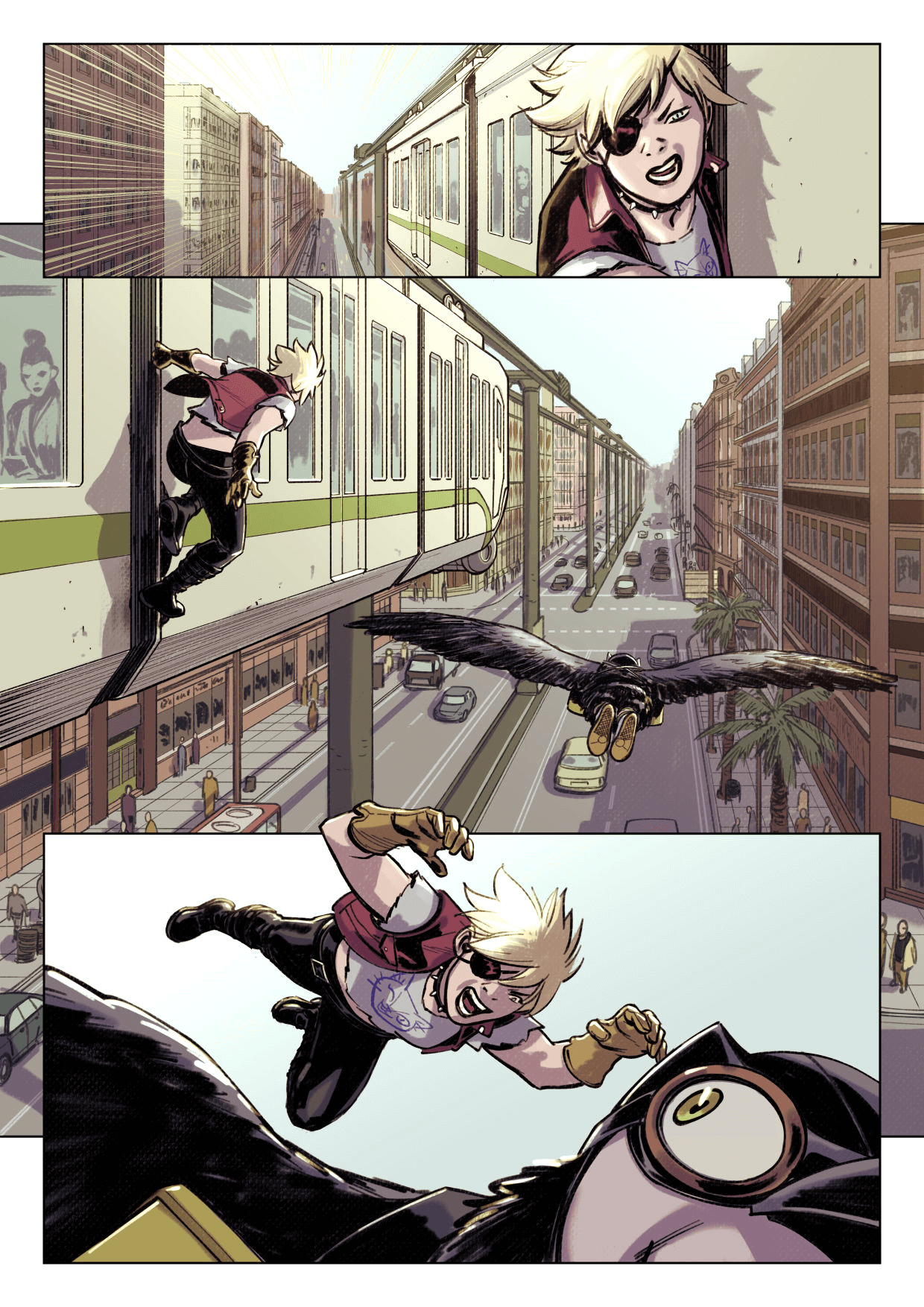
The page communicates movement, height, danger, and increasing proximity. Yet the pictures alone do not necessarily tell us why the character is pursuing the birdlike figure or what the encounter means to them. That distinction matters when evaluating a premise. A sequence can be visually exciting but thin as a story; conversely, a quiet encounter can be visually rich if each visible action changes the conflict.
For the sign-up-board story, taking a strip from the board is action. So is concealing it, offering it back, or letting the deadline pass while still holding it. These are not exciting because hands are moving. They matter because control of the choice changes. An artist could draw that change, and a reader could register its consequence.
Ask what the pictures contribute that words cannot do alone
Donald F. Glut’s discussion of comic writing offers two useful cautions: avoid pages that are only static conversation, and do not use dialogue to announce what the picture already shows.
How To Write A Comic Book - Donald F. Glut
Watch “How To Write A Comic Book” from Film Courage, featuring Donald F. Glut, for a practical account of how panels can carry story information beyond their dialogue.
Watch visual continuity, paying particular attention to his example of text redundantly describing an event already shown. Then watch information in panels for his examples of how behavior, posture, and setting can add meaning to the central action.
“Don’t make it talking heads” is a warning, not a ban on conversation. Two friends arguing beside a board could make a strong comic scene. The question is whether the artwork gives their exchange another dimension. If the reader says, “My name is gone,” while pointing to an obvious gap, those words add little. If she notices the gap while her friend silently closes a hand around the missing strip, the image gives us information before anyone speaks. Dialogue can then do a different job: reveal why the friend acted, challenge her reasoning, or expose what the reader is afraid to admit.
There is also a limit to what you should demand from images. The reason the reader promised to perform a tribute may be too specific to convey through a prop alone. A few well-chosen words could supply it. The aim is not to make every comic wordless. It is to avoid a premise in which all the important developments occur in speeches while the artwork merely records who is speaking.
The contrast with prose becomes particularly clear when a story depends on private sensations. Read this short passage from The Page and the Panel: Writing Between Prose and Comics in Uncanny Magazine.
The Page and the Panel: Writing Between Prose and Comics - Uncanny Magazine
Read this passage for its distinction between describing an inward experience in prose and communicating it on a comic page.
In the discussion contrasting prose with comics, find the paragraph that begins “The differences are subtle but important.” Read the paragraph through its final sentence. Focus on the author’s point that a sensation such as a skipped heartbeat is not itself something an artist can depict. You need not adopt the final sentence as a rule against all captions; consider instead what the pictures must contribute.
Suppose your entire premise is “A young woman realizes her friend does not believe in her.” That may describe the emotional heart of a story, but it does not yet give an artist much to depict. What happens that makes the realization possible? What can the friend do in response? In our continuing example, removing the name strip makes the breach of trust observable. Whether the reader later chooses to perform, withdraw, or confront her friend can make her response observable too. The inner conflict has events to inhabit.
A practical test for a short-comic premise
Before outlining pages or writing panels, look for three different kinds of evidence in a premise.
First, can you name visible turning events? A turning event leaves the situation different afterward. “They discuss the reading” is a subject for a scene, not yet a turn. “The reader discovers her name missing” changes what she knows. “She sees the strip in her friend’s hand” changes what she knows about the opposition. “The board is about to be taken down” changes how much time remains. These could all be depicted without a character narrating that each has happened.
You are not trying to reach a quota of incidents. Three discoveries of the same missing name would feel repetitive. Look for changes in knowledge, control, opportunity, or risk.
Second, do the images clarify why each change matters? A detail earns its place when it helps a reader understand the struggle. A gap on the board is clearer if we have already seen the reader approach expecting to find her name. The strip in the friend’s hand is more charged if she hides it when the reader looks over. A visible closing time matters if someone is now removing the list. Props and setting are valuable here because characters can use them—not because every panel needs to be busy.
Third, does the conflict require consequential behavior rather than only explanation? Imagine covering most of the dialogue. You need not understand every motive, but could you still tell that something is being pursued, resisted, and decided? If the crucial event is a five-page account of a past disagreement and the present-day characters never act on it, the premise may need a stronger present conflict. If one friend can withhold the strip and the other must decide how to respond before the board closes, their differing beliefs have immediate consequences.
A quiet story can pass all three checks. A character returning a key, declining an offered hand, or leaving an unsigned form on a desk may be more consequential than an elaborate fight. Visual action is story change made observable, not a requirement for spectacle.
Apply the test to the sign-up board
Consider a thin version of our premise: the reader asks why her name was removed. Her friend explains her concerns. They debate whether protection or choice matters more, and eventually agree. The underlying disagreement is promising, but if nothing changes while they talk, the artwork has little narrative work to do.
Now consider a possible version with visible turns. The reader reaches the board expecting to find her name and sees an empty place. Her friend is holding the removed strip alongside a marked-up practice sheet; the sheet hints at why she is worried without settling whether her intervention was justified. As registration closes, someone begins taking names down. The friend must either keep withholding the strip or give it back while there is still time. If the reader receives it, pinning it to the board becomes her own choice, not merely the result of winning an argument.
This is not a prescribed plot or panel sequence. It is a way to test the premise. Each event changes what an image can tell us: an absence becomes a discovery; a suspected obstacle becomes a person making a choice; a disagreement acquires a deadline; the final decision has a visible consequence. Dialogue can still carry the tribute’s significance and the friend’s specific fear. It no longer has to carry the entire story.
When evaluating another idea, a useful verdict is one of three kinds:
- Ready to develop: You can identify distinct visible changes, and the central choice affects what happens.
- Promising but needs repair: The human conflict is strong, but the decisive events exist only in thoughts, backstory, or speeches. Look for a present situation in which the characters must act on that conflict.
- Better suited to another form—or a different comic premise: Making this particular idea drawable would require adding unrelated business, while its real interest remains entirely in narration or explanation.
That verdict is about the current version of a premise, not a judgment on the value of its subject. Friendship and autonomy are no less drawable than a train-top confrontation. They need actions through which a reader can witness the struggle.
Key takeaways
A comic premise has enough visual action when its important turns can become distinct, observable changes—not merely illustrations beside an explanation. Test what changes, why the reader will recognize its importance, and whether the characters’ choices have visible consequences. Keep words where they add something the pictures cannot, rather than using them to repeat the pictures.
The sign-up-board premise can support a comic because its disagreement can be enacted through the missing strip, the closing board, and the friends’ choices about both. Next, you’ll examine how to keep that conflict small enough to resolve within an eight-page one-shot.