Recommended resources
The freely available resources this lesson will direct you to.
- Converting Between Fractions, Decimals, and Percents | A Mini Course | Math with Mr. Jwww.youtube.com
- Percentages 1: Fractions to Percentages | Arithmetic for CAT 2027 | Ravi Prakash Rodhawww.youtube.com
- Converting between percents, fractions, & decimals (article) | Khan Academywww.khanacademy.org
- CAT Quant Percentage: Concepts, Shortcuts, and Solved Exampleswww.pw.live
Hello! Last lesson, you used common factors to simplify fractions without changing their value. That same idea helps you move quickly among fractions, decimals, and percentages. In CAT quantitative aptitude, a question may describe a proportion in one form but be easiest to calculate in another.
Today’s goal is to recognize that these are three representations of the same quantity, choose an efficient conversion, and distinguish an exact value from a rounded one. The percentage-change problems later in this module will rely on these foundations.
1. Percent means “out of 100”
A fraction such as describes 21 parts out of a reference whole of 25 parts. A percentage expresses the same proportion with 100 as the reference whole. Since multiplying both parts of a fraction by the same nonzero number preserves its value,
The decimal also represents 84 hundredths. Thus , , and are equal, not three successive calculations.
For a concise introduction to converting a fraction to a percentage, watch the opening explanation in Percentages 1: Fractions to Percentages from Rodha.
Percentages 1: Fractions to Percentages | Arithmetic for CAT 2027 | Ravi Prakash Rodha
Watch Rodha’s “Percentages 1: Fractions to Percentages” for the meaning of “per hundred” and the basic fraction-to-percent calculation.
Watch the introduction. Focus on why multiplying a fraction’s value by 100 gives the number placed before the percent sign.
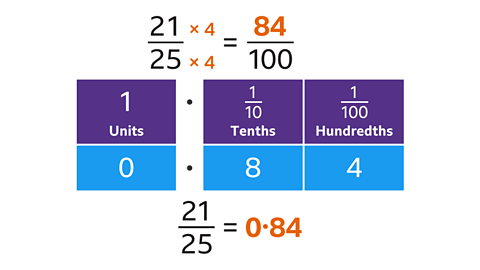
The reference whole matters. If 21 is out of 25, it is of that whole; 21 out of a different total would generally have a different percentage. And is one whole, not a ceiling: a quantity can be of a reference quantity.
2. Move between fractions and decimals using place value or division
A terminating decimal can be written as a fraction by counting its decimal places. One place gives tenths, two give hundredths, and so on. Then simplify using the cancellation method from the previous lesson:
The initial denominator is because the final digit is in the thousandths place. The same reasoning works when the number exceeds one:
Watch the decimal-to-fraction examples and then the fraction-to-decimal examples in Converting Between Fractions, Decimals, and Percents from Math with Mr. J.
Converting Between Fractions, Decimals, and Percents | A Mini Course | Math with Mr. J
Math with Mr. J demonstrates how decimal place value creates a fraction and how division creates a decimal. These two methods cover conversions in both directions.
Start with decimal place value: compare 0.9, 0.09, and 0.75, paying attention to the denominator before simplification. Then watch fraction division, which contrasts a terminating result with a repeating one.
In the other direction, a fraction is a division: to convert to a decimal, divide by . Before doing long division, check whether an equivalent fraction with denominator , , or is easier. For instance,
Not every fraction has a terminating decimal. Dividing by gives
The bar says that the repeats indefinitely. This notation preserves the exact value; is only an approximation. In CAT calculations, keeping as a fraction may be both faster and more accurate than working with its rounded decimal.
3. Convert percentages without losing the factor of 100
The percent sign has a precise numerical meaning:
So, to turn a percentage into a decimal, divide the number before the percent sign by 100. To turn a decimal into a percentage, multiply the decimal by 100 and attach the percent sign. Moving the decimal point two places is a shortcut for that multiplication or division, not a separate rule.
Watch the two relevant segments of Math with Mr. J’s video to see the shortcut applied in both directions.
Converting Between Fractions, Decimals, and Percents | A Mini Course | Math with Mr. J
Return to Math with Mr. J’s “Converting Between Fractions, Decimals, and Percents” for decimal-to-percent and percent-to-decimal examples.
Watch decimal to percent, especially the cases requiring a zero or leaving a decimal in the percentage. Then skip to percent to decimal; notice why 2\% is 0.02, not 0.2.
Place value makes the distinction clear:
For a percentage-to-fraction conversion, write the number before the percent sign over , then simplify. If that number itself contains a decimal, clear it from the numerator and denominator together:
The method still works beyond :
To convert any fraction to a percentage, multiply its value by . A denominator of 100 is convenient, but not required. For example,
This is exact. Writing instead is a rounded approximation. That distinction matters when you later combine percentages across several steps: rounding early can change the final answer.
4. Choose the fastest representation for the calculation
For CAT work, the aim is not to write every quantity in all three forms. It is to recognize when a familiar fraction saves arithmetic. The following are useful starting points; derive less familiar values from them rather than memorizing a long chart.
| Fraction | Decimal | Percentage |
|---|---|---|
For example, is three lots of , so it is . Similarly, is three lots of , so it is . These fractions can be especially useful when a percentage must be applied to a quantity: finding of a number often requires less writing than multiplying by .
The next Rodha segment shows how to build such values from simpler fraction-percentage pairs.
Percentages 1: Fractions to Percentages | Arithmetic for CAT 2027 | Ravi Prakash Rodha
Return to Rodha’s “Percentages 1: Fractions to Percentages” to see how familiar fractions generate less obvious CAT-useful percentages.
Watch fraction benchmarks. Focus on constructing values such as 37.5\% and 18.75\% from simpler fractions, rather than memorizing each conversion independently.
When deciding on a form, use a quick rule of thumb: place value for a terminating decimal, an equivalent denominator of 100 or 1000 when it is easy to make, and division when neither is convenient. If division repeats, retain the fraction for exact arithmetic. In a brief review, revisit a couple of the video’s worked conversions with their answers covered and identify which route requires the least calculation.
Key takeaways
A percentage is a fraction with reference base 100: . Decimal place value converts terminating decimals to fractions; division converts fractions to decimals; multiplying or dividing by 100 connects decimals and percentages. Preserve a fraction or repeating notation when an exact value matters, and use familiar fraction-percentage pairs to reduce arithmetic under time pressure.
Next, you will use exponent and root laws to simplify numerical expressions—another way to avoid unnecessary calculation in CAT-QA.