Recommended resources
The freely available resources this lesson will direct you to.
Hello! This is the first lesson in Numerical Fluency and Percentage Foundations, the opening module of your CAT quantitative-aptitude course. Before tackling percentages and arithmetic word problems, you need a reliable way to evaluate expressions without losing time to sign errors, unnecessary multiplication, or ambiguous order of operations.
Today you will work with integers and fractions, using four connected ideas: follow the structure of the expression, determine signs, cancel common factors, and factor before calculating when it helps. The aim is not merely to get an answer, but to get it accurately with less arithmetic.
1. Read the expression before calculating
An expression tells you which quantities belong together. Brackets make that grouping explicit; a fraction bar groups its entire numerator and its entire denominator. Within a group, evaluate powers if present, then multiplication and division, then addition and subtraction.
Multiplication and division have equal priority: in an ungrouped chain, work from left to right. The same is true of addition and subtraction. For example,
not . The latter is a different expression because it introduces brackets that were not there.
The following video makes this distinction particularly clear.
Order of Operations - Made Easy!
Watch “Order of Operations - Made Easy!” from The Organic Chemistry Tutor for a short explanation of precedence and worked mixed-operation examples.
Begin with the hierarchy. Then watch equal-priority operations, focusing on why division does not automatically come after multiplication. Finish with mixed expressions, noting which terms must wait until the multiplication or division is complete.
A CAT-useful distinction: Left-to-right evaluation protects the meaning of an ungrouped expression. Once you have rewritten a product correctly as factors, you may choose an easier calculation order. Thus . But cannot be changed to : that moves the into a denominator where it did not belong.
A long fraction bar also acts as grouping. In
evaluate the top and bottom separately before dividing. The numerator is , the denominator is , and the value is .
2. Settle the sign first
When multiplying or dividing, two negative factors give a positive result; one negative factor gives a negative result. With several factors, count the negative ones: an even number gives a positive product, and an odd number gives a negative product.
For addition and subtraction, it is often clearer to rewrite subtraction as addition of a negative number. Consider
The subtraction of becomes addition of , while . Hence
Writing the sign change explicitly is faster than having to diagnose a wrong answer later. Also keep a leading negative sign attached to its term when regrouping: is , not .
If powers appear, brackets decide whether a negative sign is part of the base: , whereas . We will study exponent laws later; for now, this distinction prevents a common sign error.
3. Cancel factors, not terms
Fractions become much easier when you simplify before multiplying. A fraction can be reduced because dividing its numerator and denominator by the same nonzero factor leaves its value unchanged. The word factor matters: it means a quantity joined by multiplication, not a term joined by addition.
Read OpenStax’s explanation of that principle and its multiplication examples before applying it to the worked calculation below.
4.2 Multiply and Divide Fractions - Prealgebra 2e | OpenStax
Read “4.2 Multiply and Divide Fractions” from OpenStax to see why cancellation preserves a fraction’s value and why doing it before multiplication reduces arithmetic.
In the subsection “Simplified Fraction,” continue through “Equivalent Fractions Property” and the “How To” steps for simplifying a fraction. Read the method, paying attention to the instruction to expose common factors first. Then go to “Multiply Fractions”: after Example 4.24, read the multiplication rule and examples through Example 4.27. Stop before Example 4.28. Compare simplifying after multiplication with removing common factors earlier.
The image below shows both kinds of cancellation you may use in a product: between the numerator and denominator of one fraction, or across two fractions. Both work because all the numerators form one product and all the denominators form another.
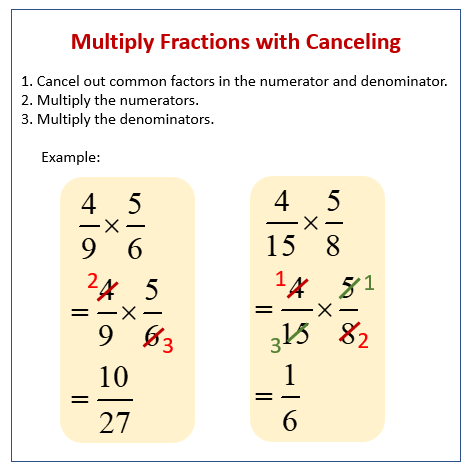
For instance, in , divide and by , then and by . Only remains.
Division of fractions has one additional step: replace division by a nonzero fraction with multiplication by its reciprocal. The reciprocal keeps the sign and swaps numerator with denominator; zero has no reciprocal.
4.2 Multiply and Divide Fractions - Prealgebra 2e | OpenStax
Return to the OpenStax section for the reciprocal and fraction-division rule. These complete the toolkit needed for mixed fractional expressions.
In “Find Reciprocals,” start at the paragraph introducing pairs of reciprocal numbers and read the reciprocal explanation, stopping before the question about zero. Then, in “Divide Fractions,” begin with the fraction-tile question and continue through the division rule, stopping immediately before the note about dividing by zero and Example 4.33. Focus on which fraction gets inverted: the divisor, not the first fraction.
Now combine sign, reciprocal, and cancellation:
Cancel with to leave and ; cancel with to leave and . The answer is , without ever multiplying .
Addition is different. To calculate , use a common denominator:
You cannot cancel a number from one term of a sum against a denominator elsewhere. Cancellation applies to factors of an entire numerator and denominator.
4. Factor before doing large arithmetic
Factorization makes a hidden common multiplier visible. Compare the two ways to evaluate
Multiplying both products first works, but creates avoidable numbers. Both numerator terms contain , so factor it out:
This is a legitimate cancellation because the whole numerator is now a product. By contrast, in , cancelling the from just one term would be invalid. You may first factor the numerator as ; only then can the common be cancelled, giving .
Here is the complete approach in a mixed expression:
The first fraction is positive because it has two negative factors. Cancelling with , and with , reduces it to . In the brackets, division by means multiplication by , which reduces to . Therefore
Notice the order of decisions: identify the grouped parts and sign, convert division if necessary, cancel factors, then combine the remaining terms. For CAT speed, this is more dependable than multiplying everything immediately and simplifying a large final fraction.
5. A short fluency routine
For a few minutes after this lesson, revisit two worked examples in the OpenStax reading with their solutions covered. Before doing any arithmetic, mark the grouped parts, predict the sign, and identify possible cancellations. Then compare your steps with the printed solutions. If you make an error, record whether it came from precedence, sign, reciprocal, or invalid cancellation; that label is more useful for revision than simply marking an answer wrong.
The module’s later timed set will use CAT previous-year questions. At this stage, prioritize a method you can execute correctly every time; speed will follow as these decisions become familiar.
Key takeaways
Read grouping before calculating. Treat multiplication and division as equal-priority operations, determine signs explicitly, and cancel only common factors in a numerator and denominator. When a numerator contains a sum or difference, factor it first if you want to cancel a shared multiplier.
In the next lesson, you will move between fractional, decimal, and percentage forms—representations that occur throughout CAT arithmetic.