Recommended resources
The freely available resources this lesson will direct you to.

Hello! In our last lesson, we architected the data flow and component placement for the three primary Web Application Firewall (WAF) deployment modes: reverse proxy, transparent bridge, and cloud-hosted. You now have a solid mental model of how each one works.
Today, we'll build on that foundation to address the crucial next question for any system architect: when and why would you choose one mode over another?
Our learning outcome for this lesson is to: Evaluate trade-offs across WAF deployment modes for different enterprise use cases and threat models.
This lesson moves from architectural patterns to architectural decision-making. We'll analyze the trade-offs of each deployment model across several critical dimensions and apply this framework to real-world scenarios, enabling you to select the optimal WAF architecture for a given set of constraints.
1. The Architect's Decision Matrix
Choosing a WAF deployment model isn't just a technical choice; it's a strategic one that balances security, performance, cost, and operational reality. As an architect, you'll need to evaluate each option against a consistent set of criteria:
- Security Effectiveness & Visibility: How well does it protect against different threats? What can it see, and what are its blind spots?
- Performance & Latency: What is the impact on application response time? Does it introduce a bottleneck?
- Scalability & Availability: How does it handle traffic growth? What happens if the WAF fails?
- Operational Complexity & Cost: How difficult is it to deploy, configure, and maintain? What are the upfront and ongoing costs?
- Network & Application Impact: What changes are required to existing network routing, DNS, or application code?
Let's use this matrix to dissect each deployment mode.
2. A Deep Dive into the Trade-offs
To understand these trade-offs from first principles, we'll consult a detailed network architecture guide from a real-world product. This will give us a granular view of the engineering implications of each choice.
FortiADC 8.0.0 Network Architecture Guide - AWS
The 'FortiADC 8.0.0 Network Architecture Guide' provides an excellent, in-depth look at different deployment modes. Although it's for an ADC (Application Delivery Controller), the principles for its WAF capabilities map directly to our discussion. We'll use its 'Decision Guide' and summary table as a reference.
Please read the 'Decision Guide' and the summary table that follows it. You can find this starting on page 15 of the PDF. Focus on the high-level comparison between Layer 2, Layer 4, and Layer 7 deployments. These correspond to Transparent Bridge, basic routing, and Reverse Proxy modes, respectively. Pay close attention to the rows for 'Deployment Characteristic', 'Back-end IP Exposure', 'Security integration', and 'Load Balancing Basis'.
This guide gives us the vocabulary to analyze the on-premises options: the Reverse Proxy (Layer 7) and the Transparent Bridge (Layer 2). We'll then contrast these with the modern Cloud-Hosted model.
A. Reverse Proxy (On-Premise / Self-Managed)
As we saw, this WAF acts as a full L7 proxy, terminating client connections and initiating new ones to the backend.
- Security Effectiveness & Visibility: High. Because it terminates TLS and fully understands the HTTP protocol, it has complete visibility into the request and response. This allows for the most advanced inspection rules, content rewriting, and security features. It's the most powerful mode in terms of raw inspection capability.
- Performance & Latency: Medium Impact. Terminating TLS and parsing HTTP is computationally expensive. This adds latency to every request. High-performance hardware or optimized software (like Nginx) is required to minimize this impact. It can also become a throughput bottleneck if not scaled properly.
- Scalability & Availability: Complex. You are responsible for scaling and availability. This typically means deploying a High-Availability (HA) pair of WAF appliances/VMs and using load balancers. This increases both complexity and cost. If the WAF cluster fails, the application goes down (fail-close) unless a bypass is explicitly architected.
- Operational Complexity & Cost: High. This is the most complex mode to manage. You are responsible for everything: hardware/VM provisioning, patching, network integration, rule-set tuning, and scaling. This requires significant in-house expertise. Costs include hardware/software licenses, infrastructure, and skilled personnel.
- Network & Application Impact: Significant. You must change your application's public DNS records to point to the WAF's Virtual IP (VIP). This mode also complicates client IP visibility. Since the WAF is the new client from the server's perspective, the original client IP is lost unless it's inserted into an HTTP header like
X-Forwarded-For. Your application and logging pipeline must be designed to use this header. The FortiADC guide highlights related complexities in its discussion of Layer 4 forwarding methods likeDNAT(preserves client IP but needs careful routing) andFULLNAT(hides client IP but simplifies routing).
B. Transparent Bridge (On-Premise / Self-Managed)
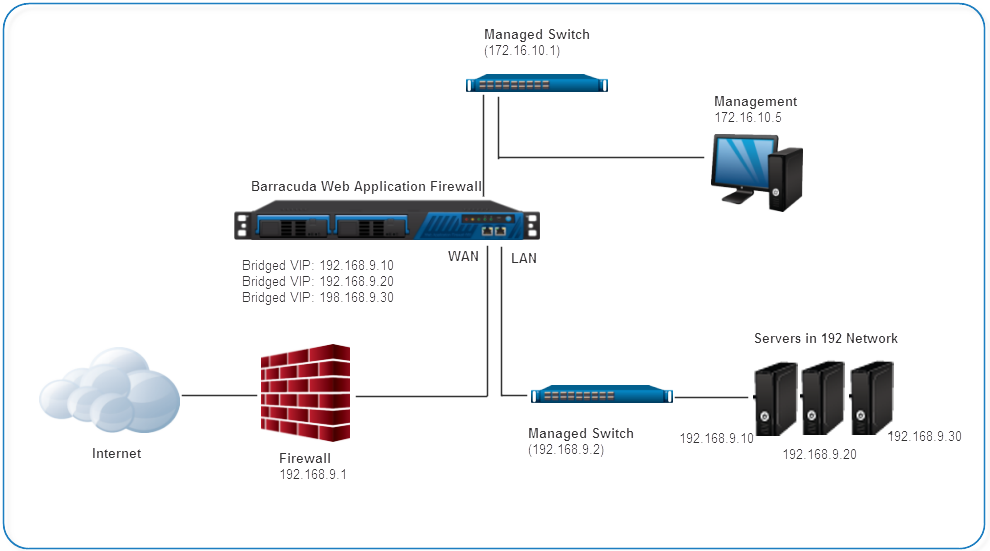
This WAF is a "bump-on-the-wire" that inspects traffic at Layer 2 without terminating connections.
- Security Effectiveness & Visibility: Low to Medium. Its biggest weakness is the inability to inspect encrypted (HTTPS) traffic in its pure form because it cannot terminate the TLS session. While some vendors have hybrid "transparent proxy" modes to get around this, the pure L2 bridge is blind to encrypted content. For unencrypted HTTP, its inspection capabilities are good, but it has less context than a full reverse proxy.
- Performance & Latency: Low Impact. Since it operates at L2 and doesn't terminate connections, it adds minimal latency. It's essentially just forwarding packets, making it very fast.
- Scalability & Availability: Complex. Like the reverse proxy, you are responsible for HA. This usually involves specialized hardware with fail-to-wire capabilities, where a hardware relay physically connects the input/output ports if the device fails, allowing traffic to pass through unimpeded (fail-open).
- Operational Complexity & Cost: Medium. Deployment is simpler because no IP or DNS changes are needed. However, you still manage the device, its rules, and its physical/virtual placement. Physically inserting a device into every required network path can be cumbersome.
- Network & Application Impact: Minimal. This is its key advantage. It's invisible to the surrounding network, requiring no changes to IP addresses, routing tables, or DNS. Client IP is naturally preserved.
C. Cloud-Hosted (WAF-as-a-Service / WAAP)
This model operates as a globally distributed reverse proxy managed by a third-party vendor (e.g., Cloudflare, AWS WAF).
- Security Effectiveness & Visibility: Very High. These services have evolved beyond traditional WAFs into Web Application and API Protection (WAAP) platforms. They combine WAF with DDoS mitigation, bot management, and API security. They leverage threat intelligence gathered from their massive global traffic to protect against emerging threats in near real-time.
- Performance & Latency: Variable Impact. While they add a processing step, these services often improve performance for a global user base. They use Anycast routing and have Points of Presence (PoPs) worldwide, serving as a Content Delivery Network (CDN) that caches content closer to users, reducing latency.
- Scalability & Availability: High. This is a core value proposition. The provider manages a massive, resilient, and scalable infrastructure. You are essentially outsourcing the problem of scale and availability.
- Operational Complexity & Cost: Low. You are no longer managing infrastructure. Your team's focus shifts from racking servers and patching kernels to configuring security policies through a web UI or API. The cost model is typically a subscription (pay-as-you-go), which shifts capital expenditure (CapEx) to operational expenditure (OpEx).
- Network & Application Impact: Minimal but Critical. The only change required is a DNS update (usually changing a CNAME record) to route your traffic through the provider's network. Like the on-prem reverse proxy, the client IP is masked, so applications must rely on headers like
CF-Connecting-IPorX-Forwarded-For.

3. Matching Deployment Modes to Use Cases
Now let's apply this framework. The right choice depends entirely on the organization's context, threat model, and existing architecture.
To explore this, let's analyze when to choose a traditional WAF model versus the more modern WAAP/cloud model.
WAAP vs WAF: Key Differences, Use Cases and How to Choose
The article 'WAAP vs WAF' provides an excellent breakdown of the specific scenarios where each approach shines. It will help us connect our technical trade-off analysis to real-world business drivers and threat models.
Please read the two sections: 'When Should You Choose WAF Over WAAP?' and 'When Should You Choose WAAP Over WAF?'. As you read, think about how the reasons given in the article (e.g., legacy app, API-first, bot attacks) map back to the trade-off criteria we just discussed (e.g., operational complexity, security effectiveness).
Based on this reading and our analysis, let's work through some scenarios.
Scenario 1: A Regional Bank
- Profile: On-premise data centers, a mix of old monolithic banking applications and a new set of public-facing REST APIs for mobile banking. They have a large, skilled security team and strict compliance requirements (PCI-DSS).
- Threat Model: OWASP Top 10 against the old web apps; API abuse, credential stuffing bots, and DDoS attacks against the new APIs.
- Architectural Choice & Rationale: A hybrid approach.
- For the legacy monolithic apps, an on-premise Reverse Proxy WAF makes sense. The security team has the expertise to manage it, wants full control over the traffic and logs for compliance, and the applications are stable, so the operational overhead is predictable.
- For the new APIs, a Cloud-Hosted WAAP is the superior choice. It provides specialized API protection (e.g., schema validation), advanced bot detection to stop credential stuffing, and volumetric DDoS mitigation, none of which are core strengths of a traditional WAF. The ability to scale instantly with traffic spikes is also critical for a public-facing mobile app.
Scenario 2: A Cloud-Native SaaS Startup
- Profile: A small company with its entire infrastructure on AWS, using a microservices architecture. The team is small and DevOps-oriented. The application is changing rapidly with multiple deployments per day.
- Threat Model: API abuse, account takeovers, scraping of proprietary data, and ensuring availability.
- Architectural Choice & Rationale: Cloud-Hosted WAAP (specifically, a native cloud provider WAF like AWS WAF or a third-party CDN provider).
- Operational Simplicity: The team lacks the resources to manage WAF hardware or software. A managed service is the only viable option.
- Scalability: The service needs to scale automatically with their application. A cloud WAF is built for this.
- Security Effectiveness: Their business logic is in APIs, which traditional WAFs protect poorly. WAAP's focus on API security, bot management, and integration with the cloud environment (e.g., AWS Shield for DDoS) is a perfect fit.
Scenario 3: A Manufacturing Plant
- Profile: A small IT team manages a factory network. They have a few internal web-based systems for inventory management that were built by a contractor years ago. They need to add a layer of security without a major project.
- Threat Model: Low. Primarily concerned with basic, opportunistic web attacks from internal users or malware that gets onto the network. Not a public target.
- Architectural Choice & Rationale: On-premise Transparent Bridge WAF.
- Minimal Impact: The key driver is simplicity. The IT team can "drop in" the appliance between the user network and the server network segment without any DNS, IP, or routing changes.
- "Good Enough" Security: Since the applications are internal and likely unencrypted (HTTP), the bridge's inability to inspect HTTPS is not a deal-breaker. It provides effective protection against common OWASP attacks, fulfilling the requirement. A reverse proxy or cloud WAF would be overkill and too complex for this environment.
Conclusion
You can now evaluate the complex trade-offs between WAF deployment modes and recommend an architecture that aligns with an organization's specific needs. There is no single "best" mode; the optimal choice is always context-dependent.
Key Takeaways:
- On-Premise Reverse Proxy: Offers maximum control and visibility but comes with the highest operational complexity and cost. Best suited for organizations with mature security teams and specific control requirements for stable applications.
- Transparent Bridge: The "easy button" for adding basic protection to existing networks with minimal disruption. Its primary limitation is the lack of visibility into encrypted traffic, making it less suitable for modern, public-facing applications.
- Cloud-Hosted (WAAP): The modern default for most public-facing applications. It provides superior scalability, availability, and a broader security scope (DDoS, bots, APIs) while reducing operational burden. It represents a strategic shift from managing infrastructure to consuming a security service.
The decision hinges on a trade-off between control (on-prem modes) and convenience/capability (cloud-hosted).
Preview of Next Lesson: In the next lesson, we'll roll up our sleeves and start designing a core component of a WAF. Having decided on a deployment mode, the next step is to build the engine. We'll start with the reverse proxy model and tackle its first challenge: Design the request interception and parsing component of a reverse-proxy WAF, including HTTP connection handling and request normalization.