Recommended resources
The freely available resources this lesson will direct you to.
Bonjour! Welcome to a new module that will unlock a crucial aspect of the French language.
In our last module, you learned to use the conditionnel to express hypotheses, regrets, and polite requests. We saw that the conditional is a grammatical mood used to talk about unreal or imagined situations. Today, we dive into another essential mood: le subjonctif (the subjunctive). This lesson will focus on our first learning outcome for this module: to recognize common triggers for the subjunctive mood (expressions of desire, doubt, emotion, and necessity).
The subjunctive is often considered a difficult topic, but our approach will be to break it down. For today, your only goal is to learn to recognize the situations that require the subjunctive. We will worry about forming the verbs in the next lesson.
What is the Subjunctive? The Mood of the Heart
Like the conditional, the subjunctive is not a tense (which tells you when an action happens), but a mood (which tells you the speaker's attitude toward the action). It's used to express ideas that are subjective, uncertain, or unreal.
A helpful way to think about this is to contrast it with the indicative mood (the one you've used most, for present, past, and future tenses), which reports facts.
To get a clearer sense of this distinction, let's watch a short video.
LE SUBJONCTIF EN FRANÇAIS / LEÇON COMPLÈTE (FREE PDF)
The video "LE SUBJONCTIF EN FRANÇAIS" by Français avec Nelly offers a wonderfully clear conceptual introduction. Pay attention to the distinction she makes between the 'mood of the heart' and the 'mood of the head'.
First, watch from 00:34 to 00:56. The presenter, Nelly, introduces the subjunctive as a mood for feelings, contrasting it with the indicative mood for facts. Next, watch from 01:43 to 02:24. Here, she highlights a crucial structural point: the subjunctive almost always appears after the word que, but que by itself doesn't automatically mean you need the subjunctive. The trigger is the combination of que with an expression of feeling, necessity, doubt, etc.
As Nelly explains, the subjunctive is the mood of subjectivity: emotions, desires, doubts, and necessities. The indicative, by contrast, is for objective facts and certainty.
- Indicative (fact): Je sais que tu es ici. (I know that you are here.)
- Subjunctive (emotion): Je suis content que tu sois ici. (I am happy that you are here.)
Notice the verb form changes from es to sois. Your job today is to learn to spot the phrases like Je suis content que... that cause this change.
Recognizing Subjunctive Triggers: The "WEIRDO" Acronym
Since the subjunctive is used in specific subjective contexts, we can learn to recognize them by grouping the triggering phrases into categories. A very common and useful mnemonic for this is WEIRDO.
The French subjunctive explained
This article, "The French subjunctive explained" from French with Agnes, introduces the WEIRDO acronym. It's a fantastic tool for remembering the types of expressions that trigger the subjunctive.
Read the section '2.1 Remembering subjunctive triggers with WEIRDO'. This will give you the framework for the rest of the lesson. Don't worry about the examples for now; just focus on what each letter of the acronym stands for.
As you've just read, the WEIRDO acronym stands for:
- Wishes / Desires
- Emotions
- Impersonal Expressions (of necessity, importance, etc.)
- Requests / Recommendations
- Doubt / Denial
- Opinions (subjective ones)
Now, let's see some of these triggers in action. The following video gives common, everyday examples.
Six of the most common ways to use the subjunctive in French - Everyday French
In "Six of the most common ways to use the subjunctive in French" from the channel French in Plain Sight, the presenter gives practical examples that fit our WEIRDO categories.
Watch the following clips, linking them to the WEIRDO categories: Impersonal Expressions (02:05 - 03:10): Listen for the most common trigger of all, Il faut que... (It is necessary that...). Emotions (03:10 - 03:58): Notice how expressing happiness, like Je suis content que..., triggers the subjunctive. Wishes & Opinions (03:58 - 05:04): See how phrases like J'aime que... (I like that...) or the conditional Je voudrais que... (I would like that...) introduce a subjective desire. Impersonal Expressions (06:23 - 07:03): Here is another key phrase, Il est important que... (It is important that...).
Building Your Catalogue of Triggers
You now have a framework (WEIRDO) and have seen several key examples. The categories often overlap, but the core idea remains: if the main clause expresses subjectivity rather than certainty, the clause that follows que will likely use the subjunctive.
Below are two images that summarize these common triggers visually. They are great for quick reference.

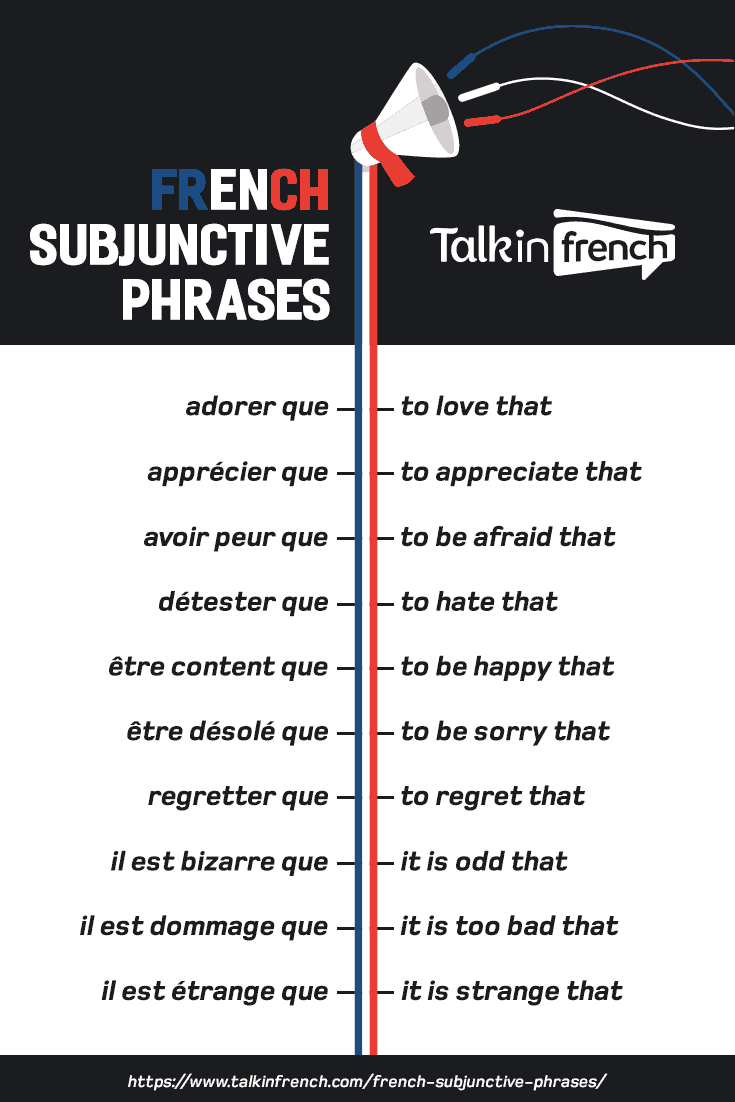
Finally, to give you a sense of the breadth of expressions that fall under these categories, you can look over the lists in the following resource.
French Subjunctive - Le subjonctif
The article 'French Subjunctive' from Lawless French is an excellent, comprehensive reference. Don't try to memorize everything! The goal is simply to scan the lists to appreciate the variety of phrases that fit into the WEIRDO categories you've learned.
Scan through the tables of verbs and expressions under the headings: 'Preferences, Advice, Needs, Desires, Orders (PANDO)' 'Judgments, Emotions, Feelings (JEF)' 'Possibilities, Opinions, Doubts, Suppositions (PODS)' \nNotice how these correspond to the letters in WEIRDO. This will help you build your pattern-recognition skills.
Conclusion
Excellent work today! You’ve taken the first, most important step toward mastering the subjunctive: understanding why and when it is used.
Key Takeaways:
- The subjunctive is a mood, not a tense, used to express subjectivity: desire, emotion, doubt, necessity, etc.
- It is triggered by specific phrases in a main clause, which are followed by
que. - The WEIRDO acronym is a powerful tool for remembering the categories of subjunctive triggers: Wishes, Emotions, Impersonal expressions, Requests, Doubt, and Opinions.
- You are now equipped to recognize the context for the subjunctive when you see it in a text.
Preview of the Next Lesson:
Now that you can identify when the subjunctive is needed, our next lesson will focus on the mechanics. We will learn how to form the present subjunctive for regular verbs. You'll see that, like with other tenses, there's a consistent pattern to follow.