Recommended resources
The freely available resources this lesson will direct you to.
- French Made Easy: le subjonctif (the French subjunctive)www.youtube.com
- 🇫🇷 LE SUBJONCTIF - 30 exemples d'utilisation -Conjugaison verbes réguliers et irréguliers- B1-B2-C1🔥www.youtube.com
- Regular verbs - subjunctive present conjugationsfrench.kwiziq.com
- French Subjunctive Conjugations - Regular Verbswww.lawlessfrench.com
Bonjour!
In our last lesson, we explored the why and when of the French subjunctive, identifying the common triggers like expressions of desire, emotion, and necessity using the WEIRDO acronym. You learned to spot the situations that call for this special mood.
Today, we move from theory to practice. This lesson addresses how to form the present subjunctive for regular verbs from example patterns. You'll discover that for the vast majority of French verbs, this process follows a simple, predictable pattern, which should be very satisfying. Let's begin.
The Three-Step Pattern for Conjugation
In the previous lesson, you saw sentences like:
- Je suis content que tu sois ici. (I am happy that you are here.)
- Il faut que tu apprennes ta leçon. (You must learn your lesson.)
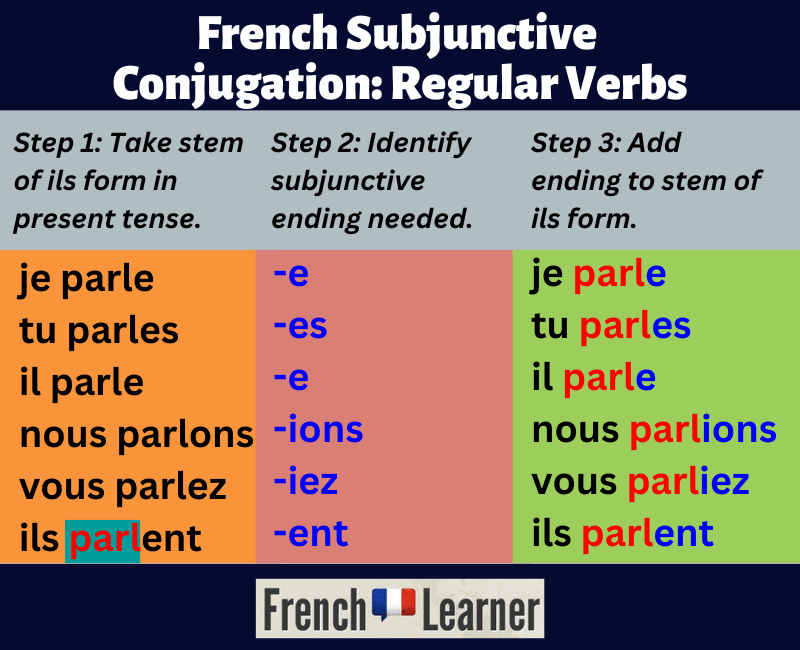
The verb forms sois and apprennes are in the subjunctive. While some verbs, like être (sois), are irregular, most follow a very clear rule. This rule is a three-step process:
- Take the
ils/ellesform of the verb in the present indicative. - Drop the
-entending to find the verb's subjunctive stem. - Add the appropriate present subjunctive ending.
This process is visualized perfectly in the following chart for the verb parler (to speak).
Seeing the Pattern in Action
This three-step procedure works consistently across all three groups of regular verbs: -er, -ir, and -re. To see this explained with clear examples, please watch the following video.
🇫🇷 LE SUBJONCTIF - 30 exemples d'utilisation -Conjugaison verbes réguliers et irréguliers- B1-B2-C1🔥
The video "LE SUBJONCTIF" by Madame FLE provides an excellent, step-by-step guide on how to form the present subjunctive. Focus on the method she demonstrates for regular verbs.
Watch the segment from 14:37 to 19:39. The presenter explains the conjugation process using examples for an '-er' verb (parler), an '-ir' verb (finir), and an '-re' verb (mettre). Notice how the same core rule applies to all three.
The Subjunctive Endings
As you saw in the video, once you have the stem, you add one of the following endings:
| Pronoun | Ending |
|---|---|
| que je | -e |
| que tu | -es |
| qu'il/elle/on | -e |
| que nous | -ions |
| que vous | -iez |
| qu'ils/elles | -ent |
A couple of interesting points to help you remember these:
- The endings for
nousandvous(-ions,-iez) are identical to the endings of the imparfait. - For most verbs, the pronunciation of the
je,tu,il/elle, andils/ellesforms are the same, even though the spelling is different. For example, que je parle, que tu parles, qu'il parle, and qu'ils parlent all sound the same.
Reinforcing the Pattern
To solidify your understanding, let's look at more examples. The table in the following resource is excellent for pattern recognition. It clearly shows the ils form, the resulting stem, and the final subjunctive conjugations for several common verbs.
French Subjunctive Conjugations - Regular Verbs
This page from Lawless French provides a clear, concise conjugation table that reinforces the pattern we've just learned. Seeing it applied to multiple verbs will help internalize the rule.
Focus on the main table under the heading 'Par exemple…'. Observe how the stem is derived from the 'ils' form for each verb (aimer, finir, vendre, etc.) and how the same set of subjunctive endings is then applied.
Time to Practice
Now, let's try forming the subjunctive yourself. Combine the trigger phrase with the verb in parentheses to complete the sentence. The answers are below for you to check your work.
- Il faut que nous... (choisir) un film.
- Je veux que tu... (répondre) à ma question.
- Il est important qu'ils... (étudier) pour l'examen.
- Bien que vous... (attendre) longtemps, le bus n'arrive pas.
Solutions:
- Il faut que nous choisissions un film. (Stem from ils choisissent ->
choisiss-+-ions) - Je veux que tu répondes à ma question. (Stem from ils répondent ->
répond-+-es) - Il est important qu'ils étudient pour l'examen. (Stem from ils étudient ->
étudi-+-ent) - Bien que vous attendiez longtemps, le bus n'arrive pas. (Stem from ils attendent ->
attend-+-iez)
Conclusion
Très bien! You have now learned the fundamental mechanism for conjugating the vast majority of French verbs in the present subjunctive.
Key Takeaways:
- The present subjunctive for regular verbs is formed using a consistent, three-step pattern.
- Step 1: Start with the
ils/ellesform of the present indicative (e.g., ils parlent, ils finissent, ils vendent). - Step 2: Remove the
-entto get the subjunctive stem (e.g.,parl-,finiss-,vend-). - Step 3: Add the subjunctive endings: -e, -es, -e, -ions, -iez, -ent.
Preview of the Next Lesson:
While this pattern covers most verbs, a few of the most essential verbs in French are, predictably, irregular. In our next lesson, we will focus on recognizing the unique present subjunctive forms of être, avoir, aller, and faire.